Building the Aga Khan University Cardiac Program, 1994–1998
The program, told in the University’s own pages.
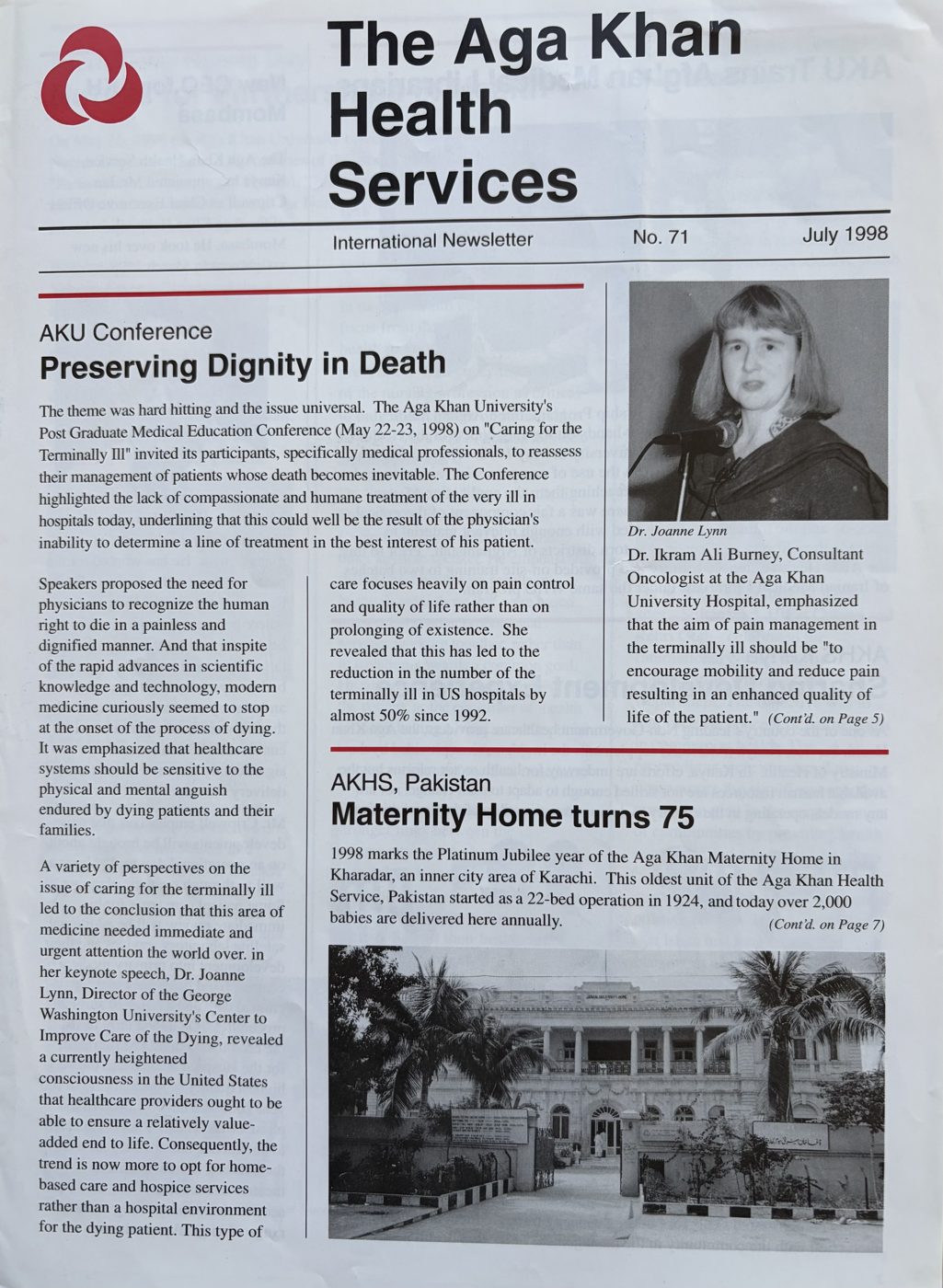
In 1994 Dr. Abdulla left Sudbury to build a complete, comprehensive Cardiovascular Program at the Aga Khan University Hospital in Karachi: cardiac catheterization and angiography first, then angioplasty and stenting, with cardiac surgery, rehabilitation, teaching and research developing alongside. He was the program’s founding Chief of Cardiology. In 1997–98 he proposed the dedicated cardiac centre that was built after he left.
The evidence is in the University’s and the Aga Khan Health Services’ own newsletters, annual reports and publications, photographed below. Click any page to read it. As at Sudbury, the credit is shared with the surgeons, anaesthetists, nurses, technicians, administrators and donors who built the program with him.
- 1993–94 — Helps update the 1990 program plan and equipment list; recruited to lead it
- Autumn 1994 — Moves to Karachi as founding Chief of Cardiology; opens the Cardiac Catheterization Laboratory
- October 1995 — Angioplasty and stenting program begins, the first stents in Karachi
- 1996 — Professor of Medicine
- 1997–98 — Moderates the Duke–AKU teleconference; continues the INTER-HEART Study and the Carvedilol Heart Failure Trial as site Principal Investigator; proposes a dedicated cardiac centre
- 1998 — Returns to Canada
Seven chapters on this page
Click or tap any title to go straight to it. The “Back to top” button, lower right, brings you back here.
Before: 1983, a medical college becomes a university
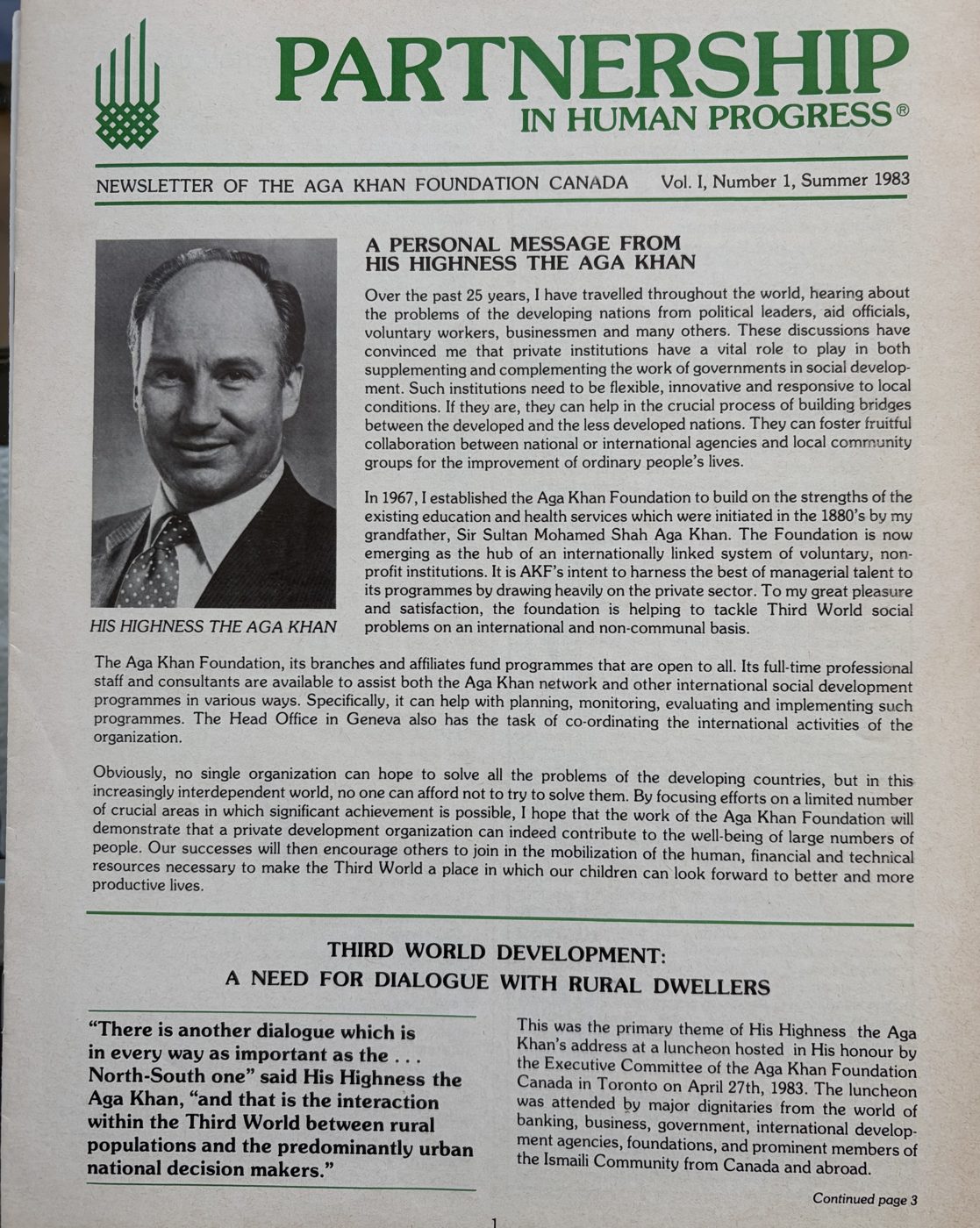
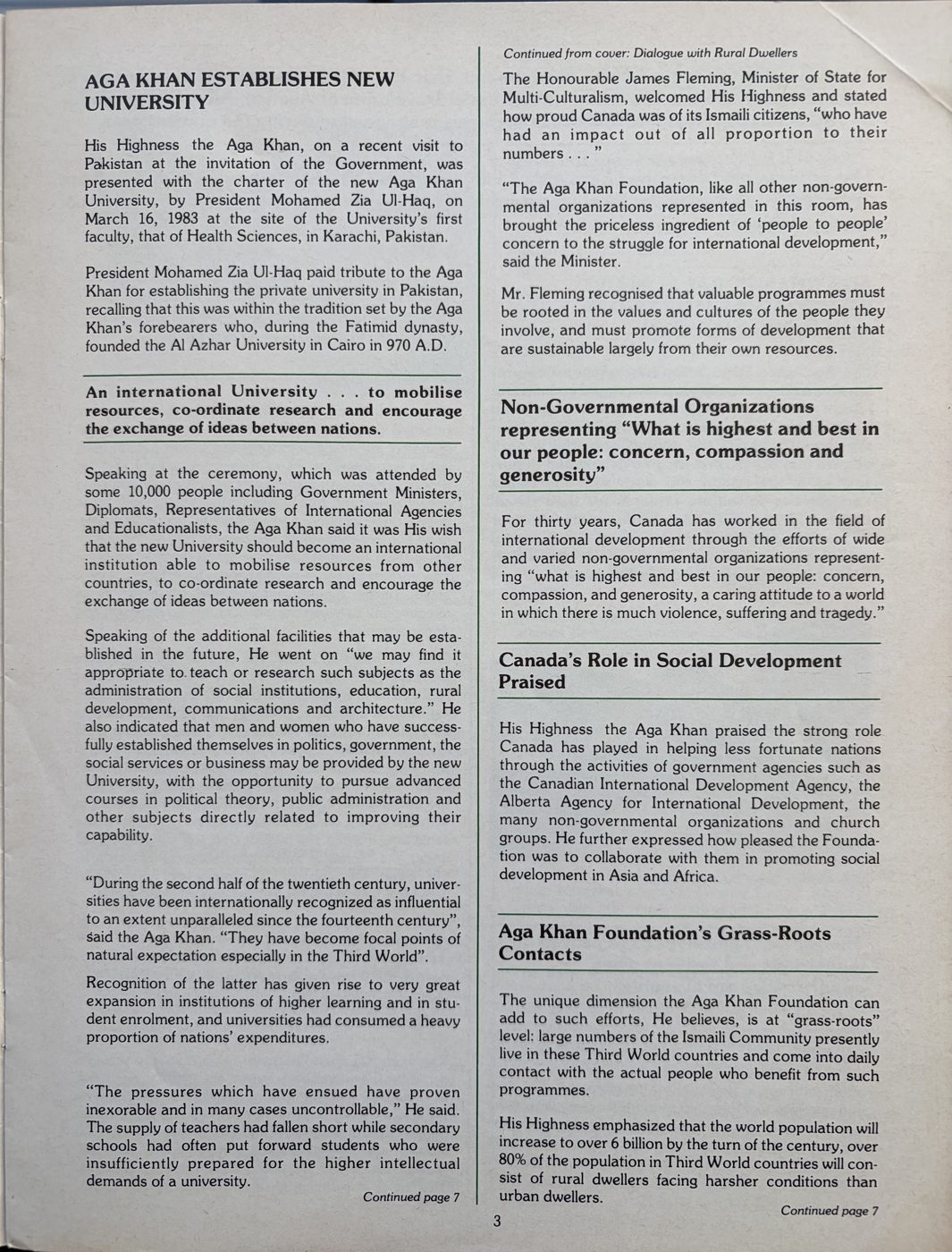
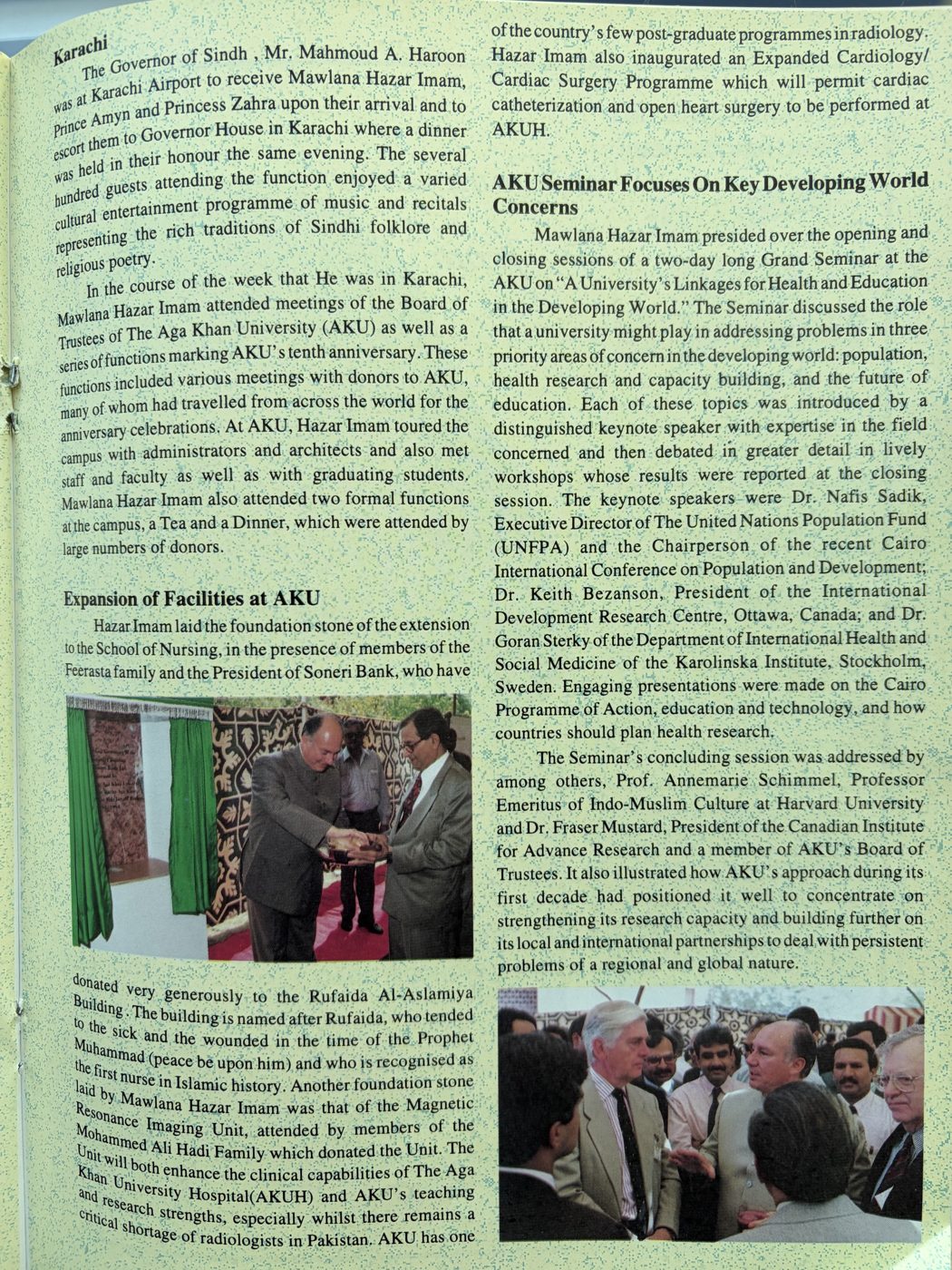
In March 1983 the President of Pakistan granted the university charter, creating the Aga Khan University as an international, independent, private university. His Highness the Aga Khan formally inaugurated the Hospital on 11 November 1985, when it was already in operation. The first issue of the Aga Khan Foundation Canada newsletter, in the summer of 1983, reports the announcement and the Foundation’s relationships with Canadian and international development agencies.
Dr. Abdulla visited Karachi in December 1983 for a first interview. The hospital was still being built and the medical college had no clinical sciences yet, so it was not the right time for a clinician to join. In 1984 he decided to move back to Canada following his very productive years in California. He took up his post at Sudbury Memorial Hospital, in Ontario, Canada (see New Services and Leadership at Sudbury Memorial, 1984–1994).
The tertiary Cardiovascular Subspecialty Program at AKU was first planned in 1990.
Recruited, 1990–1994
The Cardiovascular Program was first planned in 1990. Dr. Cheves Smythe, then Dean of the Faculty of Health Sciences, came to Sudbury with the full program plan and equipment list and spent time with Dr. Abdulla on how it would be implemented. Then the Gulf War came, and the plans were put on hold.
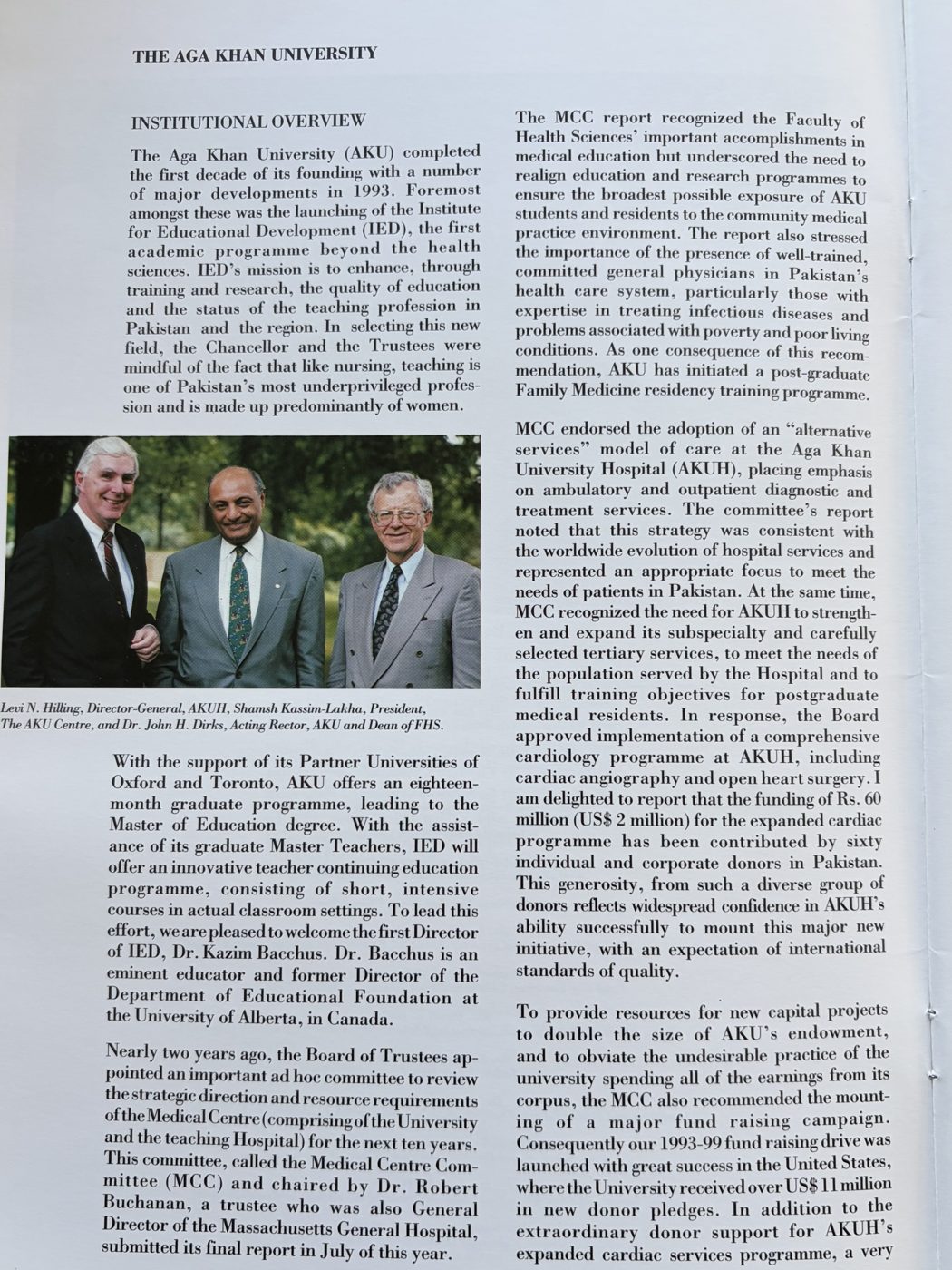
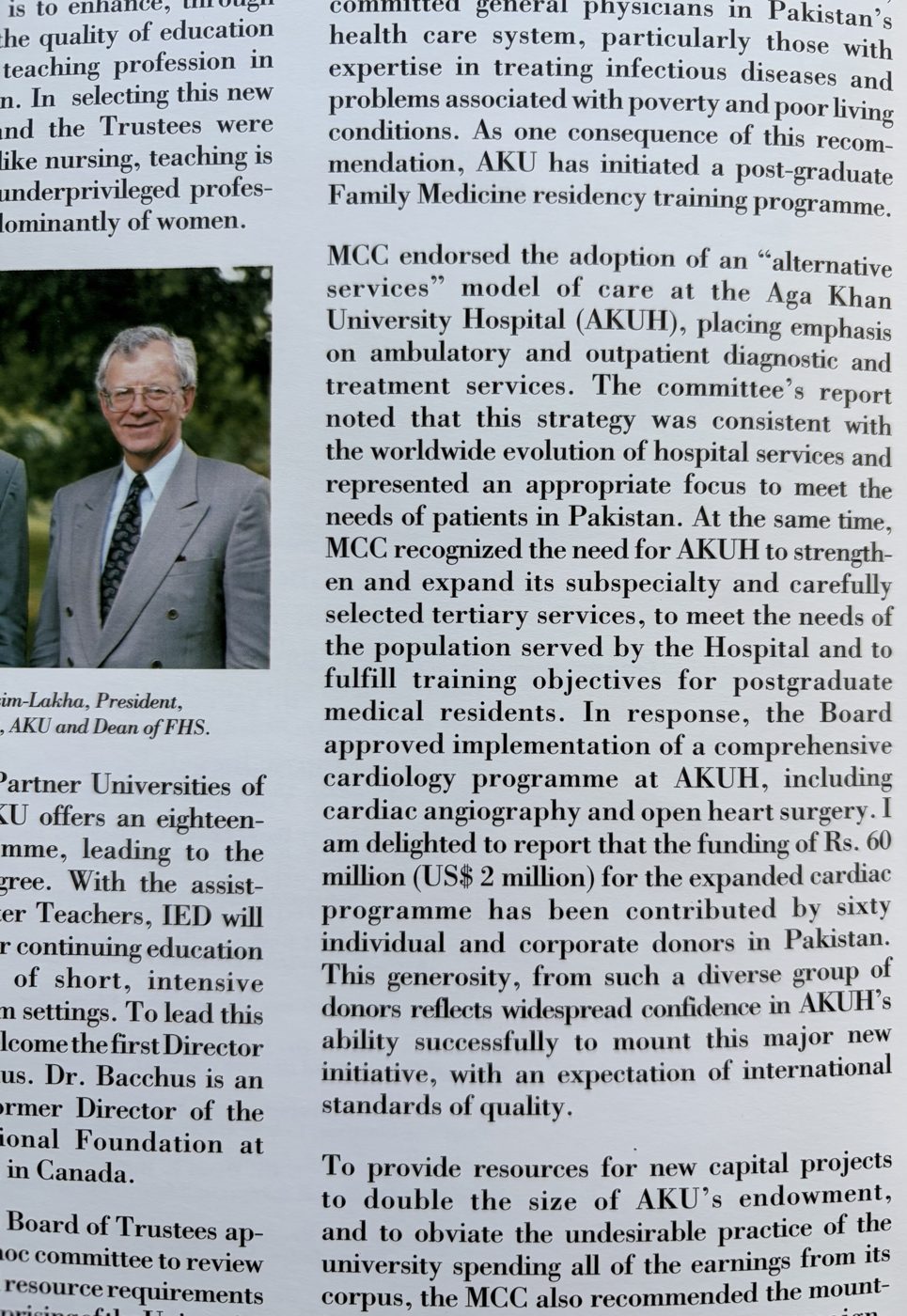
The plan was revived in 1993. AKU’s 1993 Annual Report records that the Board had approved a comprehensive Cardiology Program with Cardiac Angiography and Open Heart Surgery, and that Rs. 60 million (about US$2 million) had been raised from sixty individual and corporate donors toward the expanded Cardiac Program. In December 1993 and again in the spring of 1994 Dr. Abdulla went to Karachi to help update the program and the equipment, and advised the University to find a head for it. By the summer of 1994 no one else had been recruited. Dr. John Dirks, who was by then Dean of the Faculty of Health Sciences and had been Dr. Abdulla’s Head of Medicine when he was a resident at UBC, came to Sudbury to recruit him, and so did the University’s President, Shamsh Kassim-Lakha, who spent several days to see what had been built there. His Highness the Aga Khan decided that he wanted Dr. Abdulla to set up the program, and once that was decided, Dr. Abdulla agreed to go.
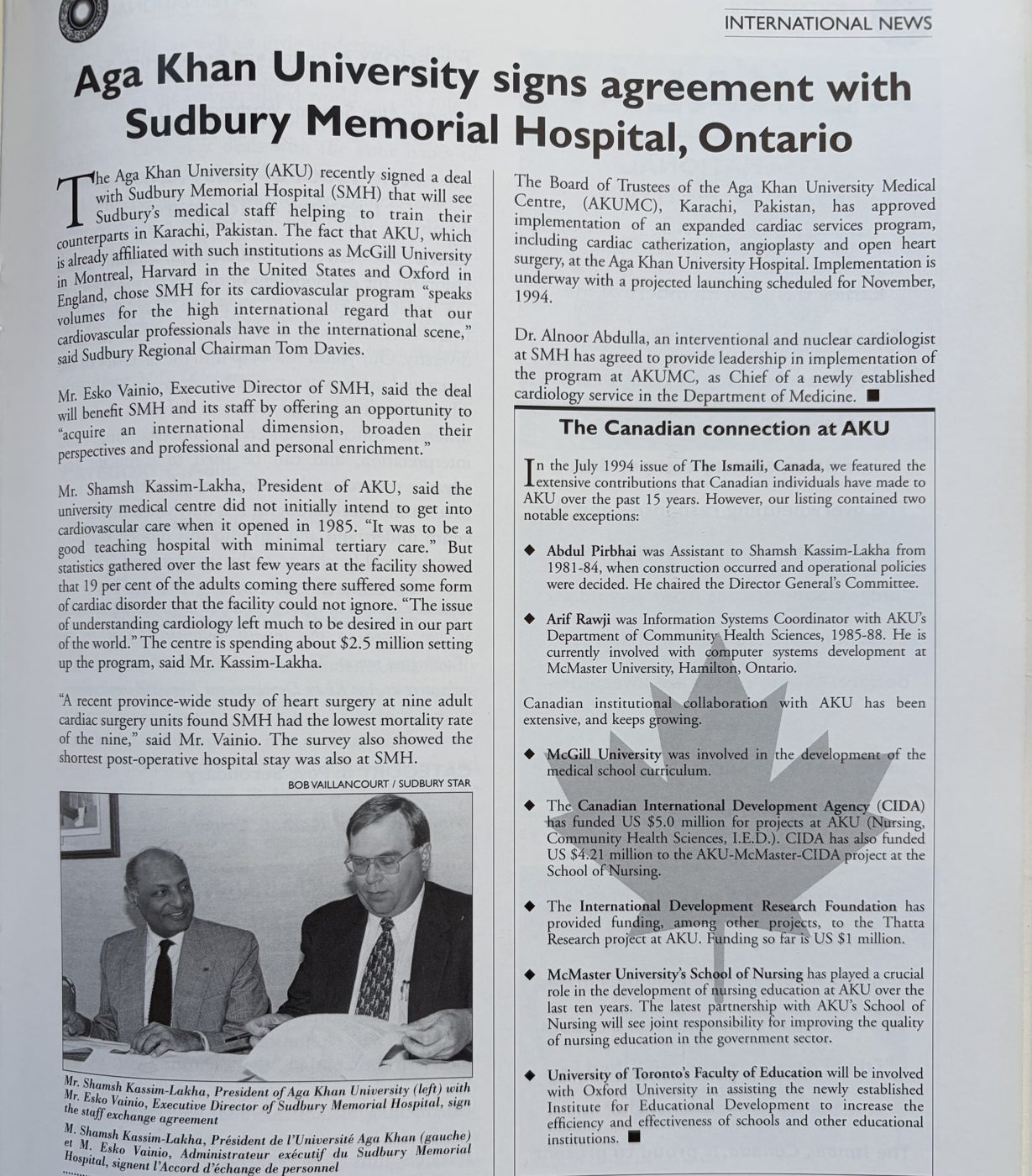
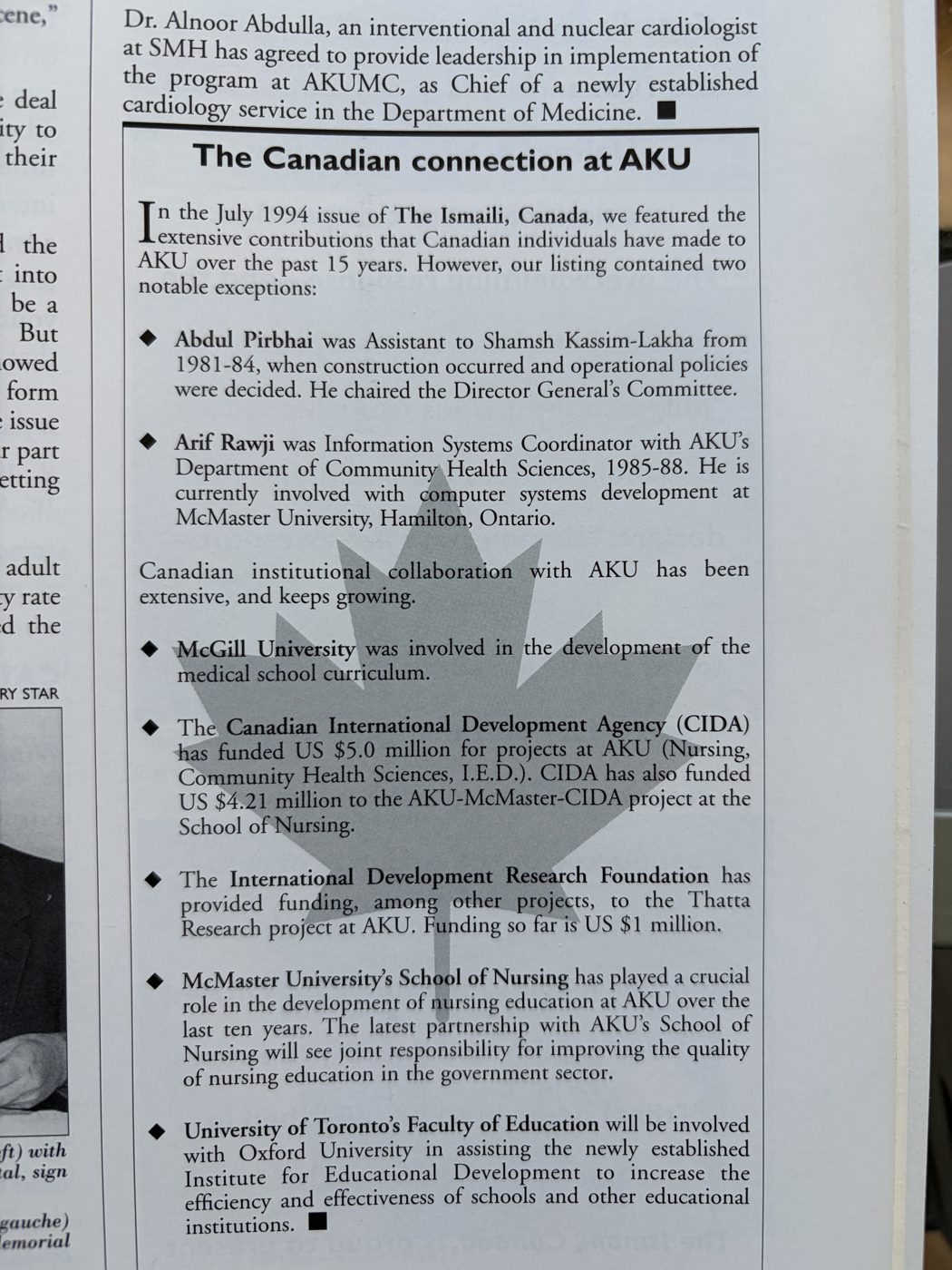
In December 1994 The Ismaili, Canada reported the agreement between the University and Sudbury Memorial Hospital, under which Sudbury staff helped train AKU staff (the Sudbury story is on the Sudbury page). The same page lists the long record of Canadian partnership with AKU.
Opening day, 1994: why a heart program in Karachi?
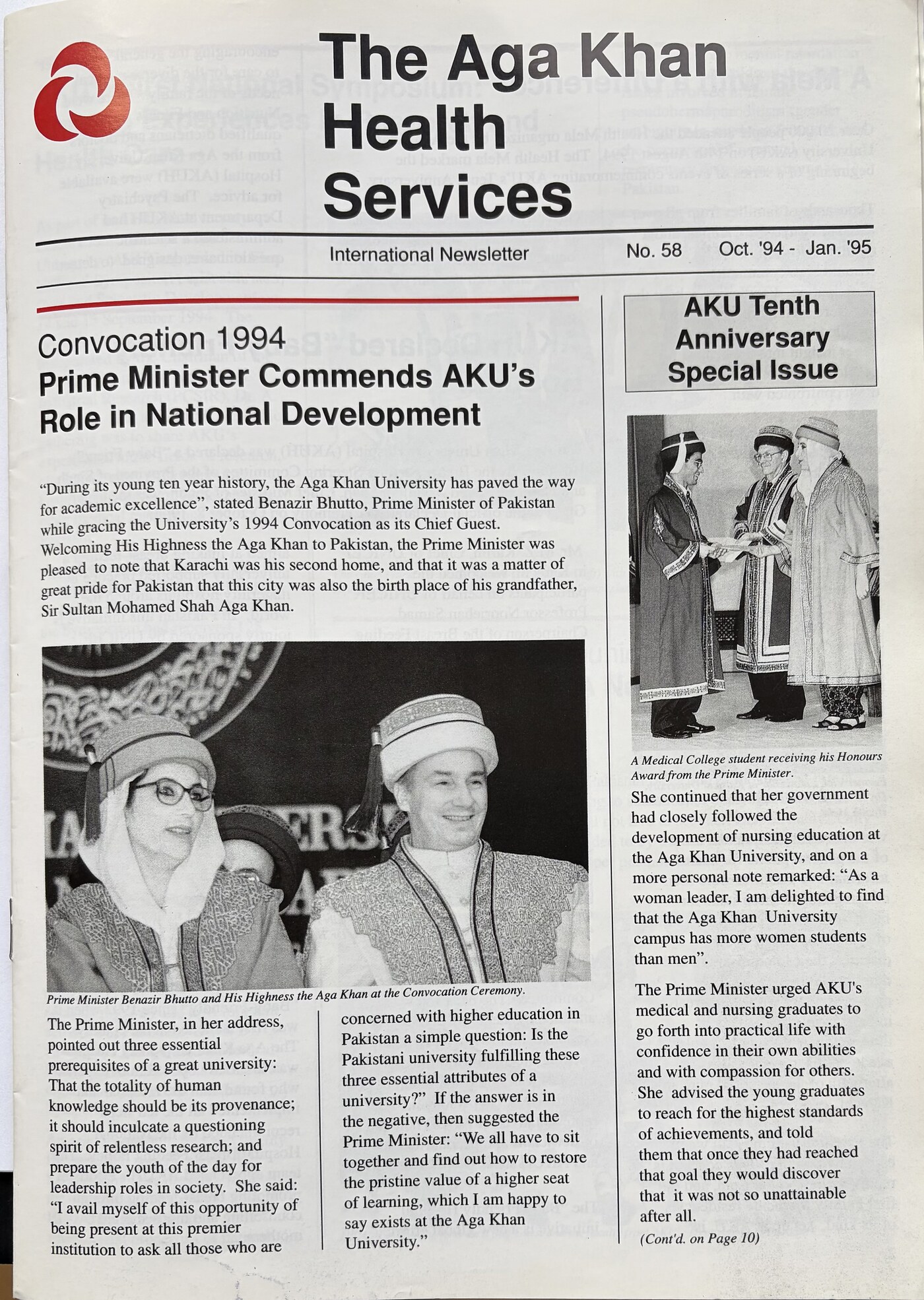
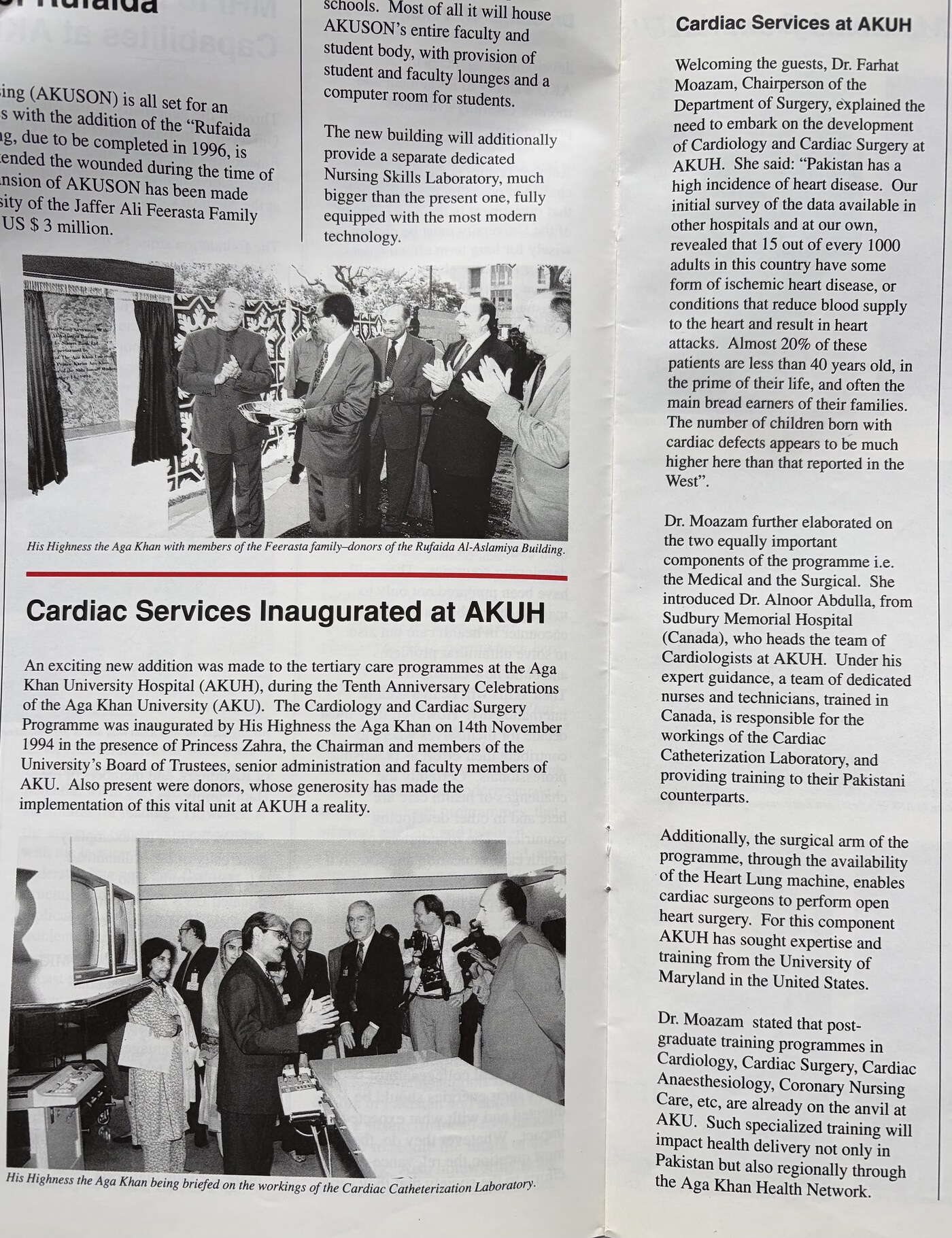
His Highness had two conditions: the program had to be running by the University’s tenth-anniversary convocation in November 1994, and it had to be funded from inside Pakistan. Both were met. The first patient was treated the day before His Highness arrived, and the Aga Khan Health Services’ own newsletter recorded the opening. The full story is on the opening day page.
Standing across the table in the new catheterization laboratory, with the national press present, the Aga Khan asked Dr. Abdulla why a developing country that still faced infectious disease, malnutrition and maternal and infant mortality should build a Tertiary Cardiac Program. Dr. Abdulla’s answer, given on the spot, was this: those problems were still real, but the pattern of disease was changing fast. Populations were ageing, moving to cities and adopting Western diets, with less exercise and more smoking, so non-communicable disease, led by cardiovascular disease, was coming for very large populations. Its rate of rise was greater in the developing world than in the developed world, and it was becoming the leading cause of death everywhere. Those millions could not travel abroad for care. The tertiary program therefore had to be in place early, before the epidemic arrived, so that the best care would be available in the developing world itself.
Building the program
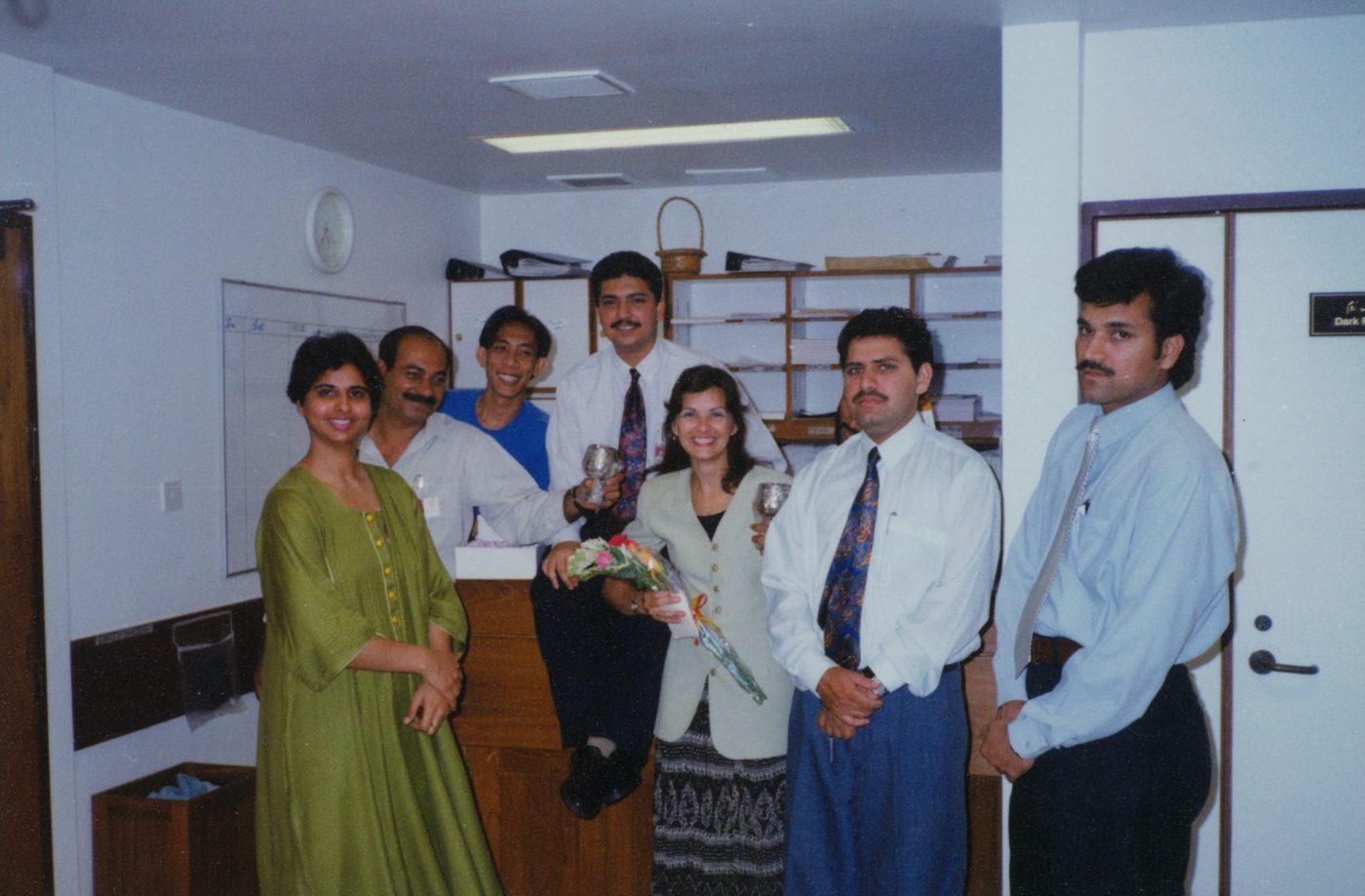
Dr. Abdulla started the program in 1994 with diagnostic angiography and invasive work, and spent the first year stabilizing it, always planning to add the interventional part when the team was ready. The cath lab was run on a nurse-based model like that of North American teaching hospitals: the procedures were done by credentialled cardiologists, with properly trained cardiovascular nurses handling hemodynamic monitoring, patient care and lab administration. At the opening, AKU’s Chairperson of Surgery, Dr. Farhat Moazam, said that a team of nurses and technicians trained in Canada was running the laboratory and training their Pakistani counterparts. The nurse who built that team was Monique May, from Sudbury (her story); on opening day she wheeled in the first patient, and His Highness blessed her (see the AKU Cardiac Program opening).
The original cath lab team, 1994
The nurse who built this team was Monique May, from Sudbury (her story). On opening day she wheeled in the first patient, and His Highness blessed her (see the AKU Cardiac Program opening).
Angioplasty and the first stents, 1995
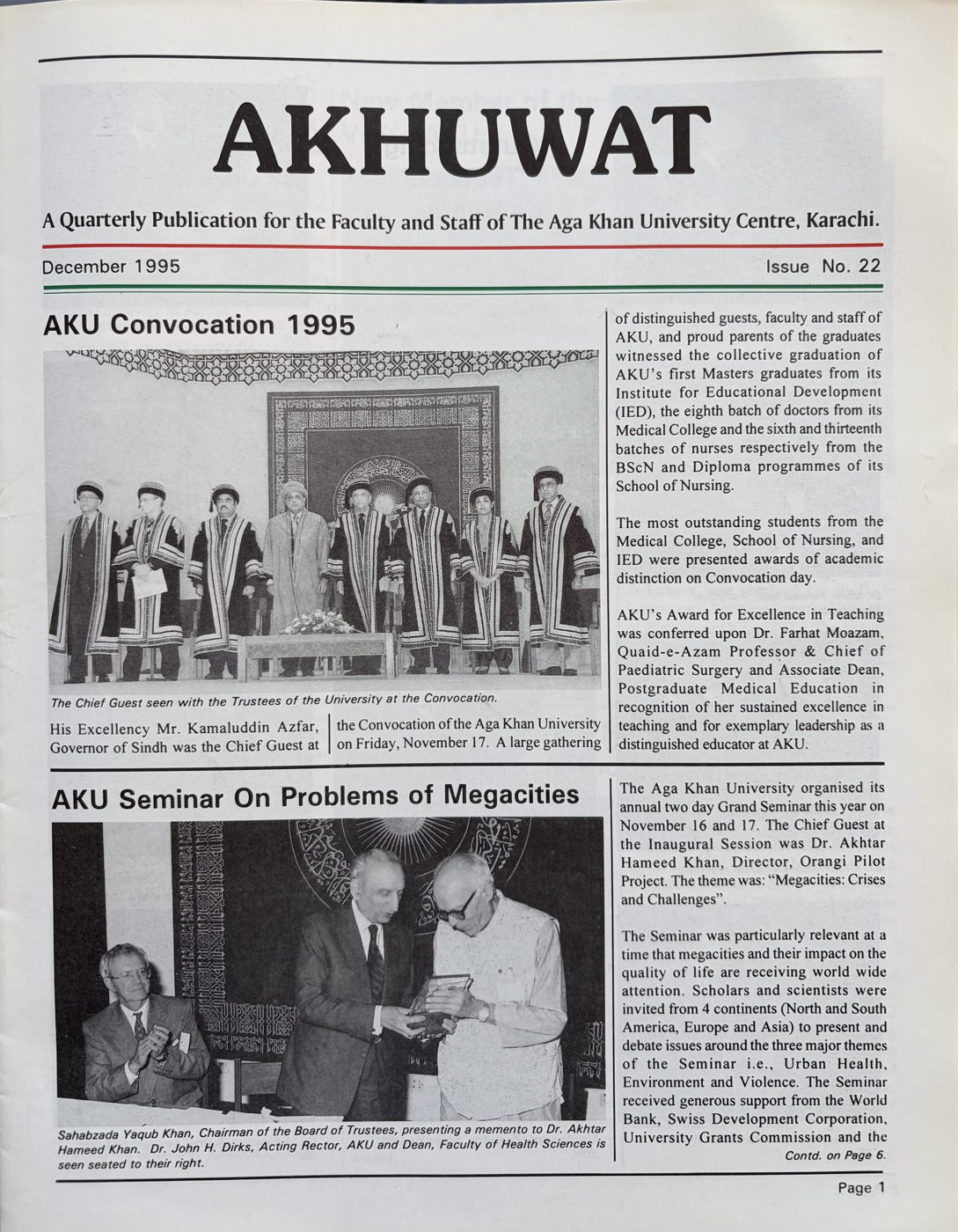
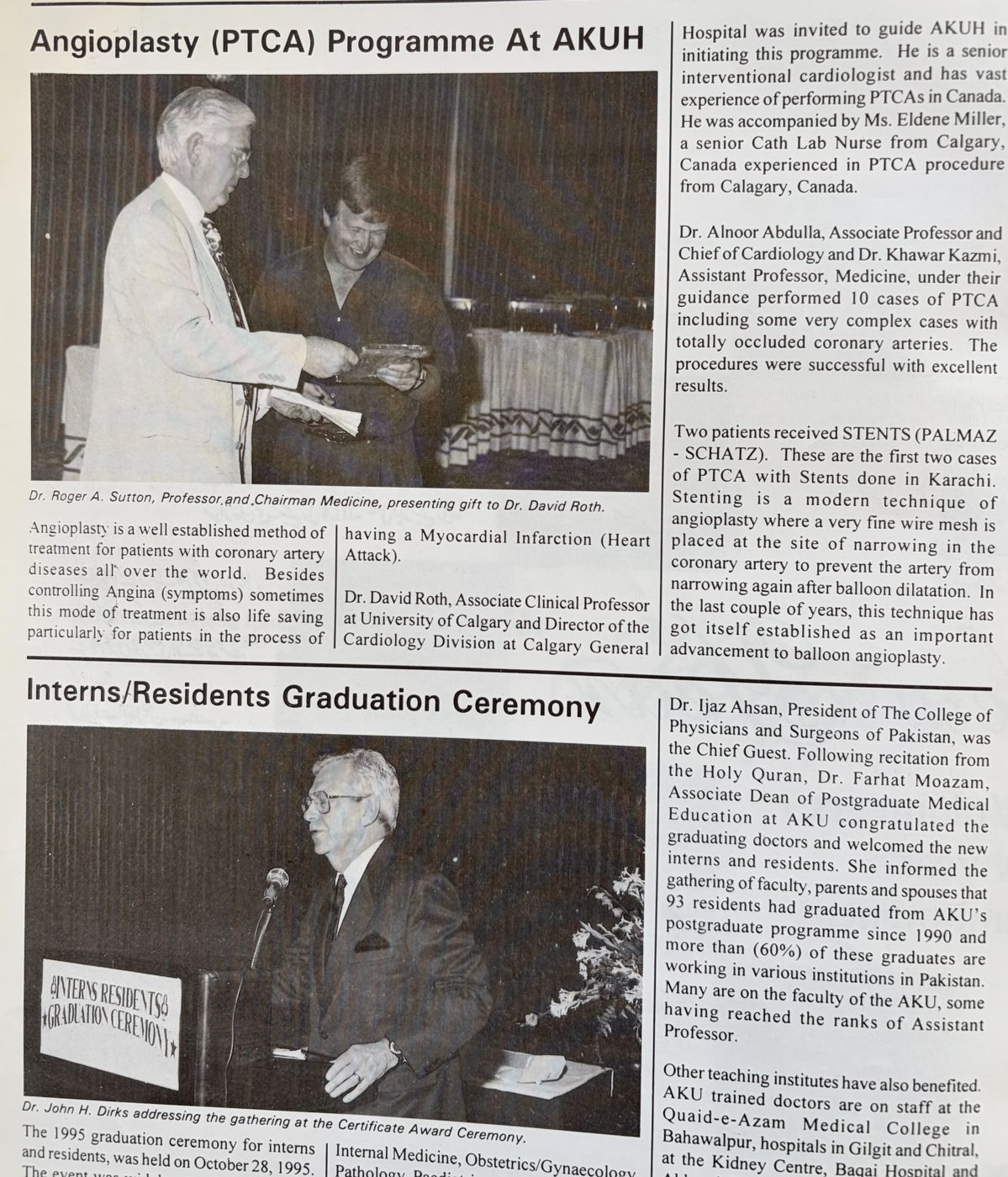
In October 1995, once diagnostic angiography was done well, the team was trained and cardiac surgery and anaesthesia support were in place, Dr. Abdulla started the angioplasty program. He invited his friend and colleague Dr. David Roth, an experienced interventional cardiologist from Calgary, who came for a few days with a senior Calgary cath lab nurse, Eldene Miller. Dr. Roth was not licensed to practise in Pakistan and did not treat patients; he was there to watch and to make sure the program was being started the right way. The University’s staff newsletter reported ten angioplasties by Dr. Abdulla and Dr. Khawar Kazmi, including very complex lesions with totally blocked arteries, and the first two intracoronary stents (Palmaz–Schatz) in Karachi.
The program in Dr. Abdulla’s own words, 1996
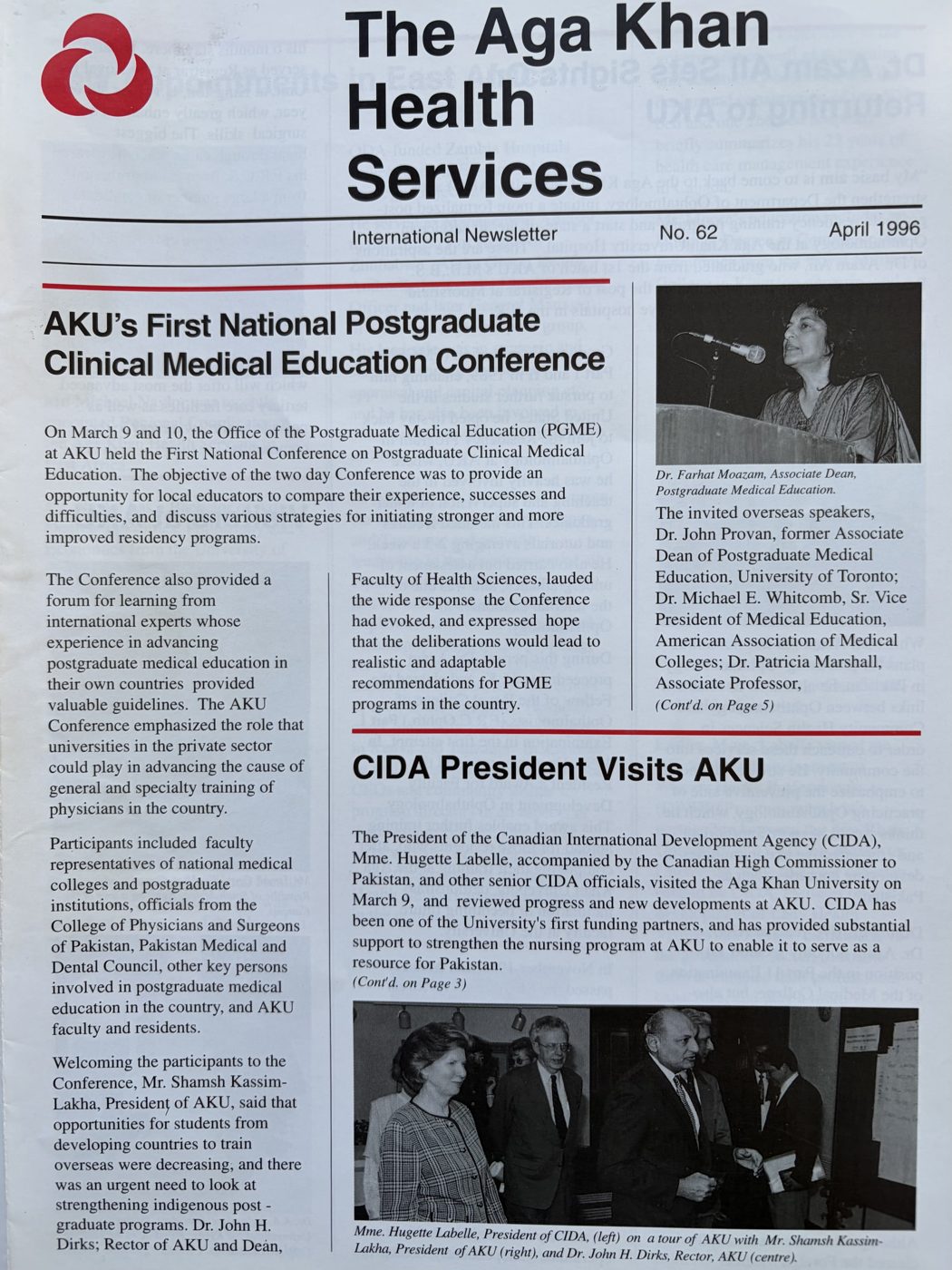
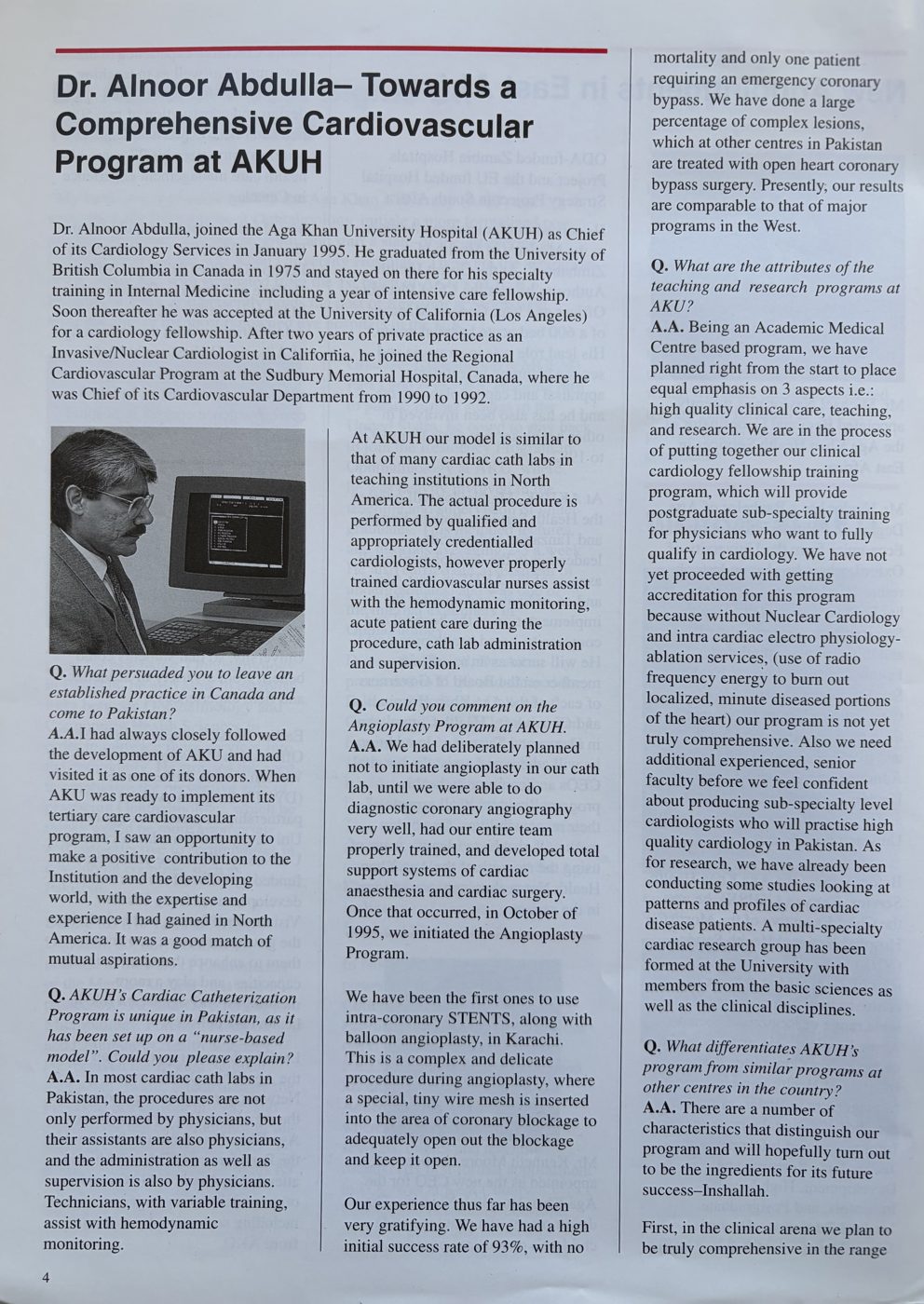
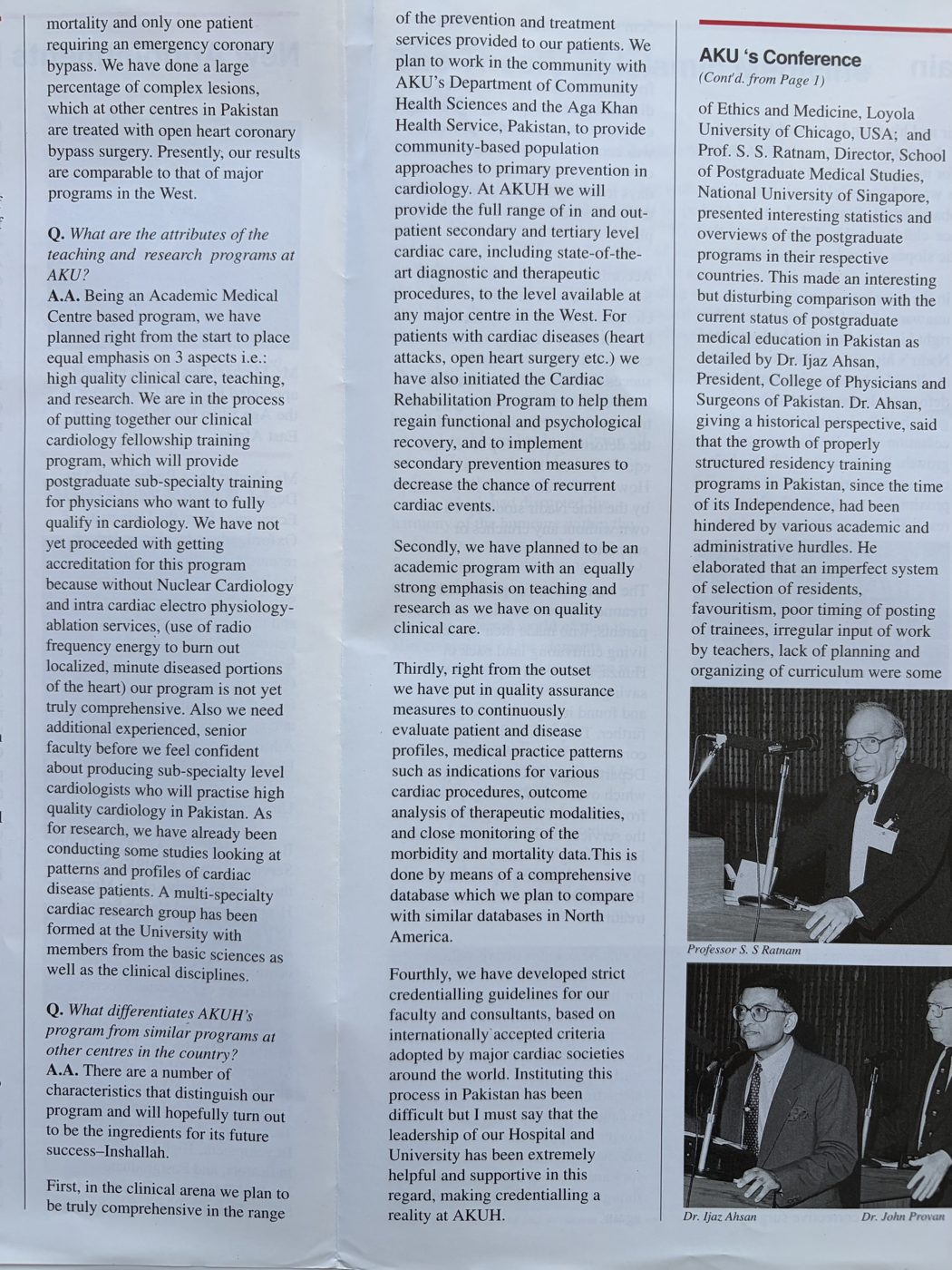
In April 1996 the Aga Khan Health Services newsletter published an unscripted interview with Dr. Abdulla, “Towards a Comprehensive Cardiovascular Program at AKUH,” verbatim. He explained why he came (he had followed AKU’s development as a donor, and it was “a good match of mutual aspirations”); why angioplasty waited until the diagnostic work, the team and the surgical support were ready; and the results to that point, a 93% initial success rate for angioplasty with no deaths and only one emergency bypass. He described the plan for the program: equal emphasis on clinical care, teaching and research; a fellowship program to follow once nuclear cardiology and electrophysiology were added; prevention in the community with AKU’s community health sciences department; cardiac rehabilitation; a quality-assurance database to compare outcomes with North America; and strict credentialling of faculty and consultants.
Faculty rank
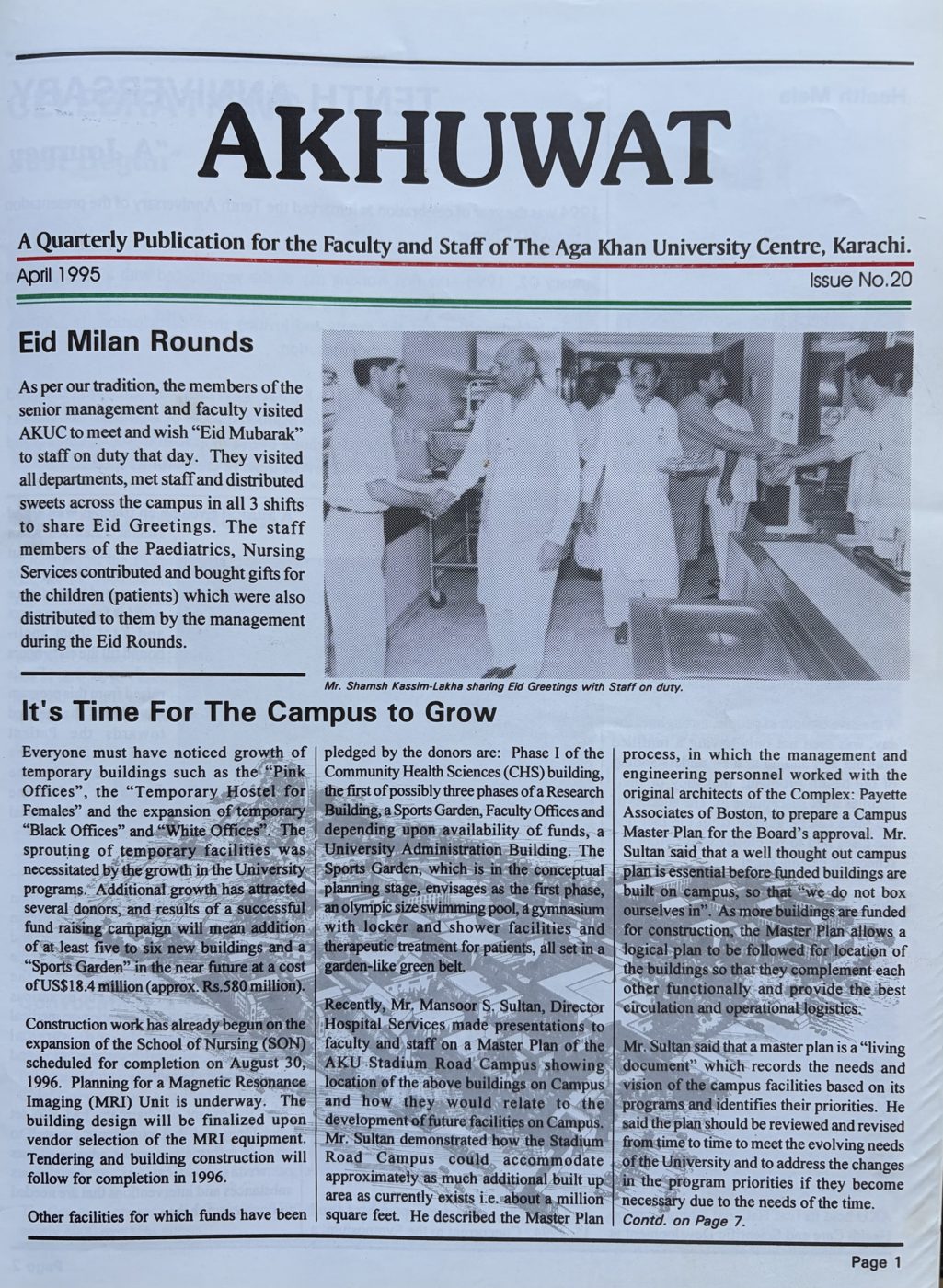
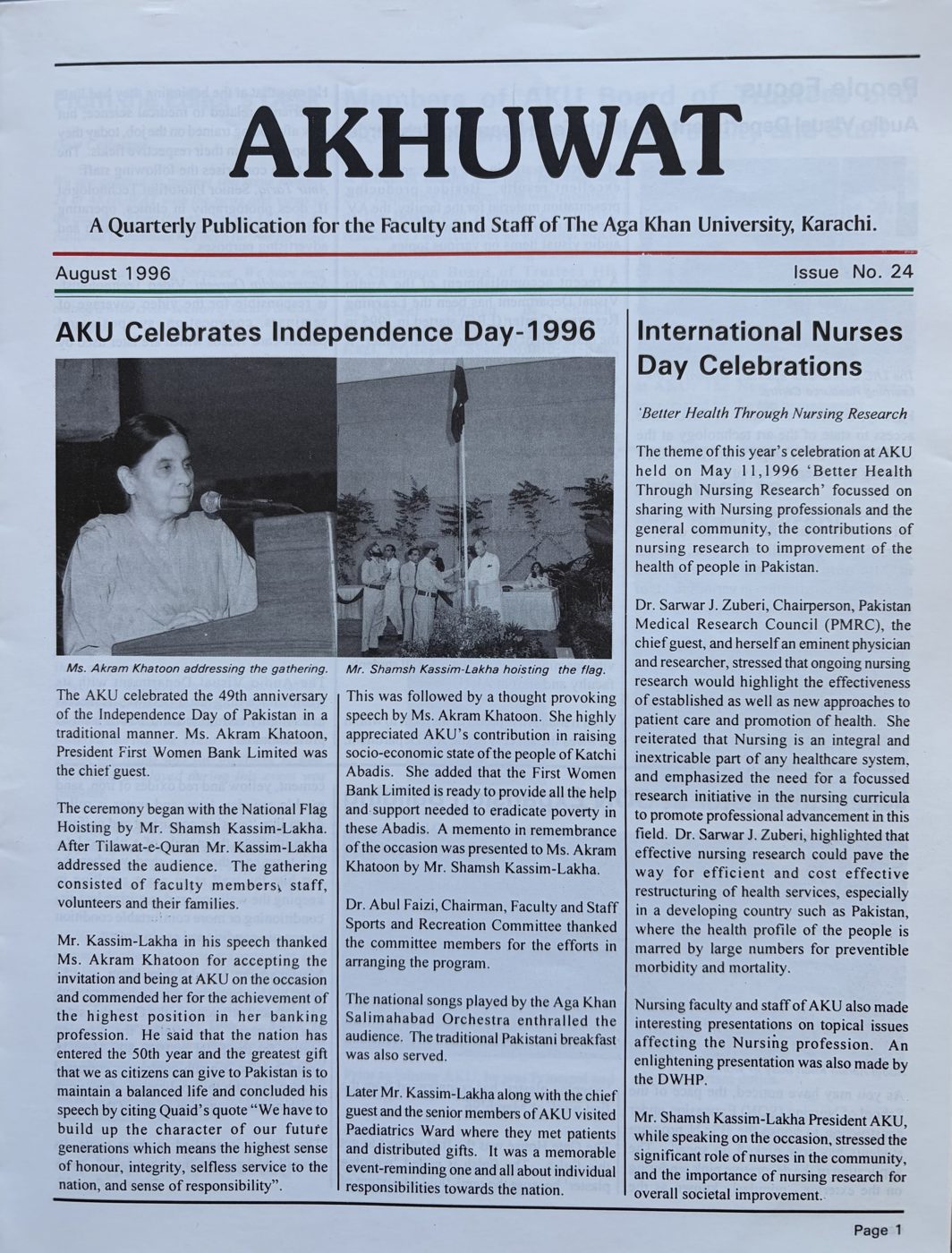
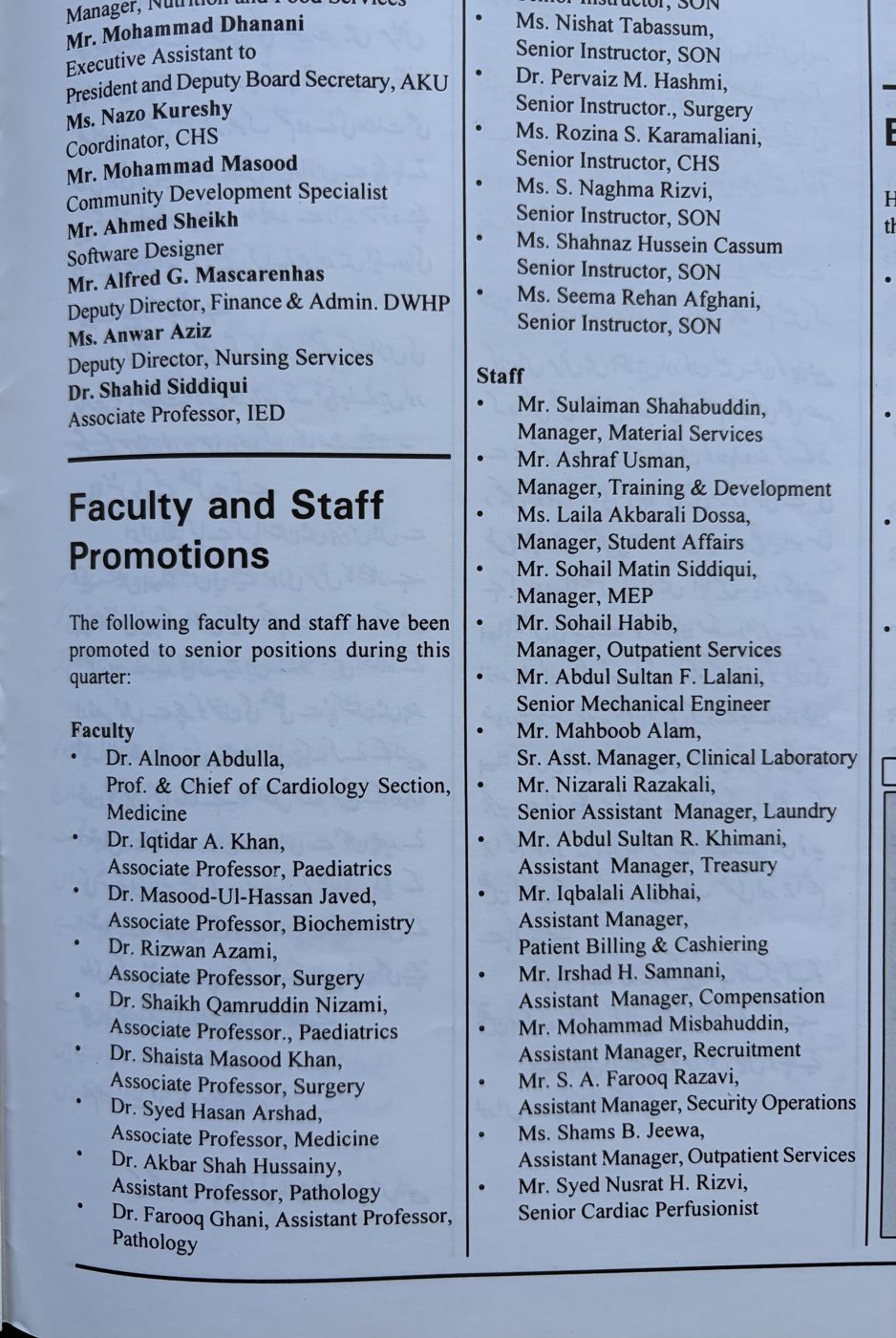
The University’s staff newsletters record Dr. Abdulla’s initial academic appointment at AKU as Associate Professor and Chief of the Cardiology Section in the Department of Medicine (April 1995), and his promotion to full Professor of Medicine and Head of Cardiology in August 1996. The April 1995 notice lists him among those who joined in 1995; that is the date of the formal appointment. He had been at AKU, seeing patients and building the program, since the autumn of 1994.
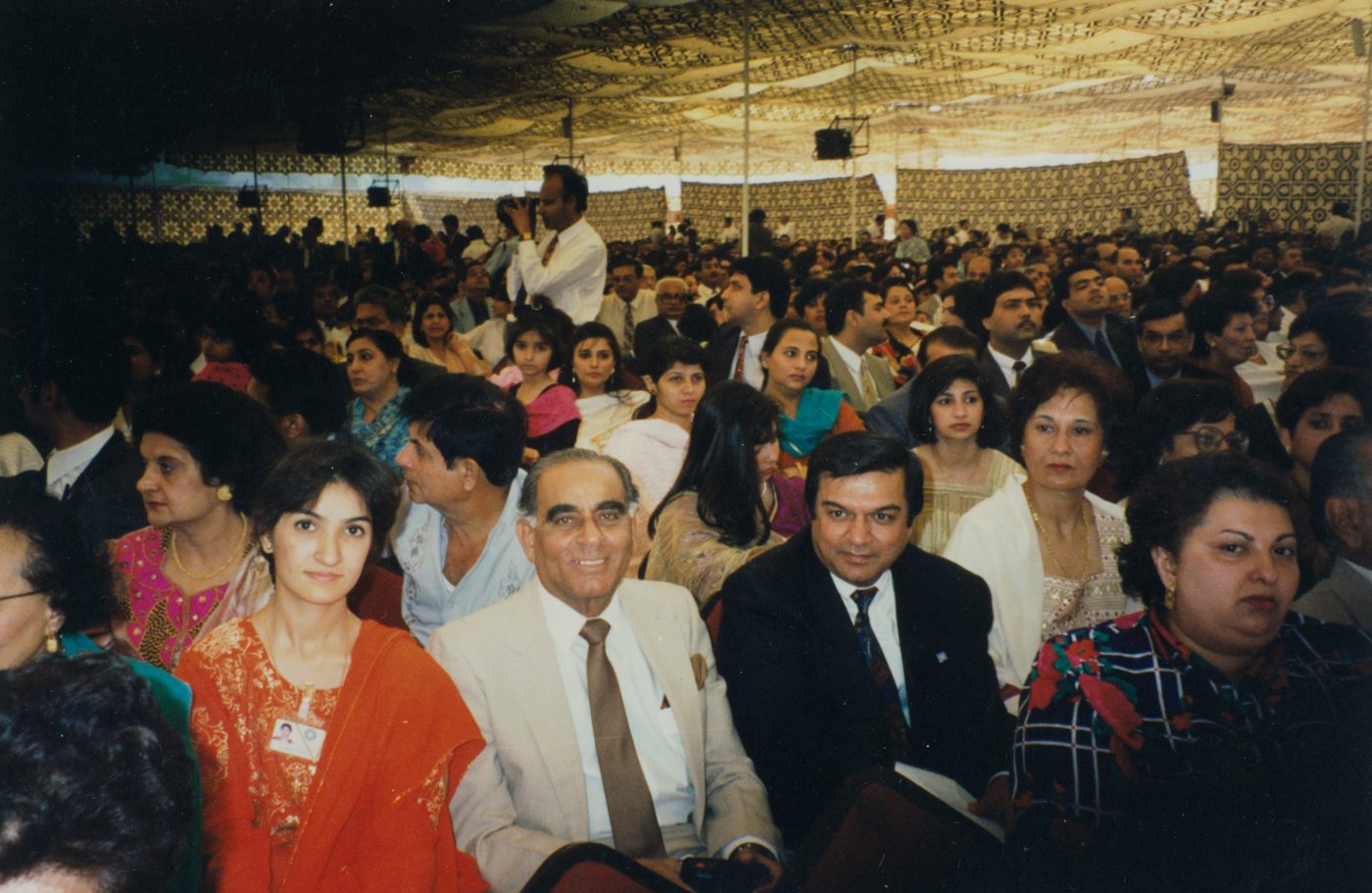
A father’s pride
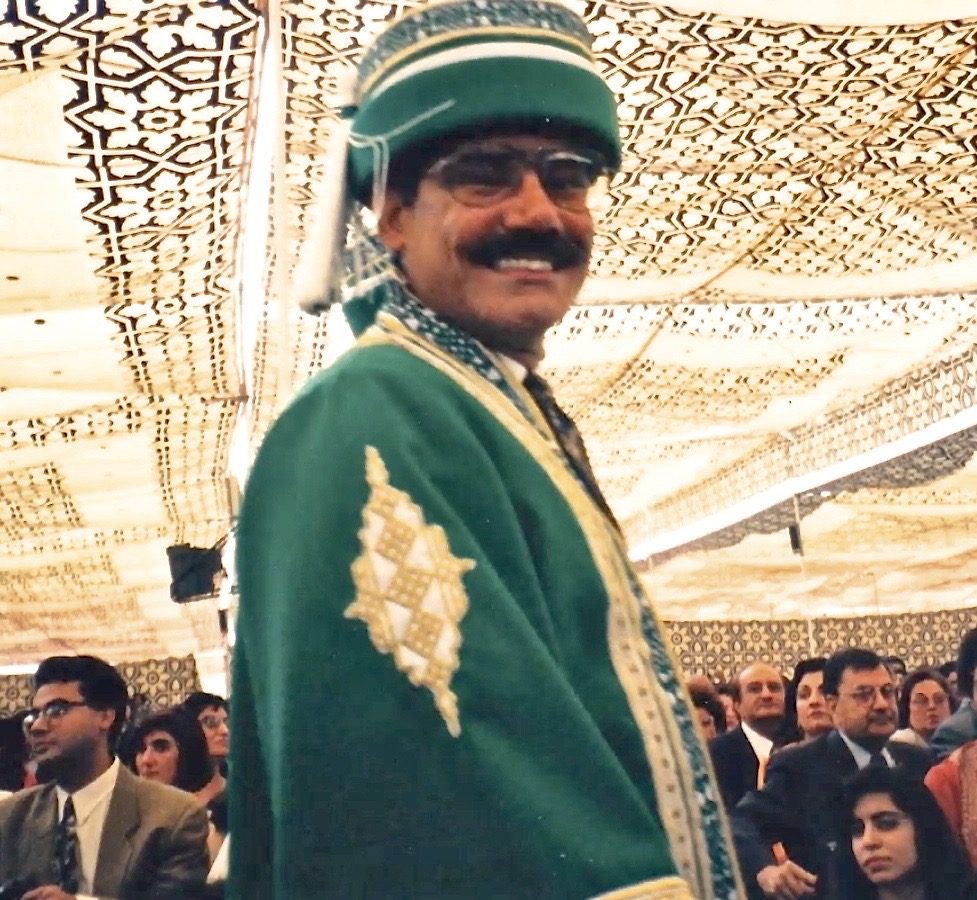
Dr. Abdulla’s father attended the University’s tenth-anniversary convocation in Karachi in November 1994, when the Cardiac Program was ready and His Highness the Aga Khan opened it. He took great pride in his son’s appointment to the University and in his leading the Cardiac Program.
Reaching beyond the hospital: telemedicine and research
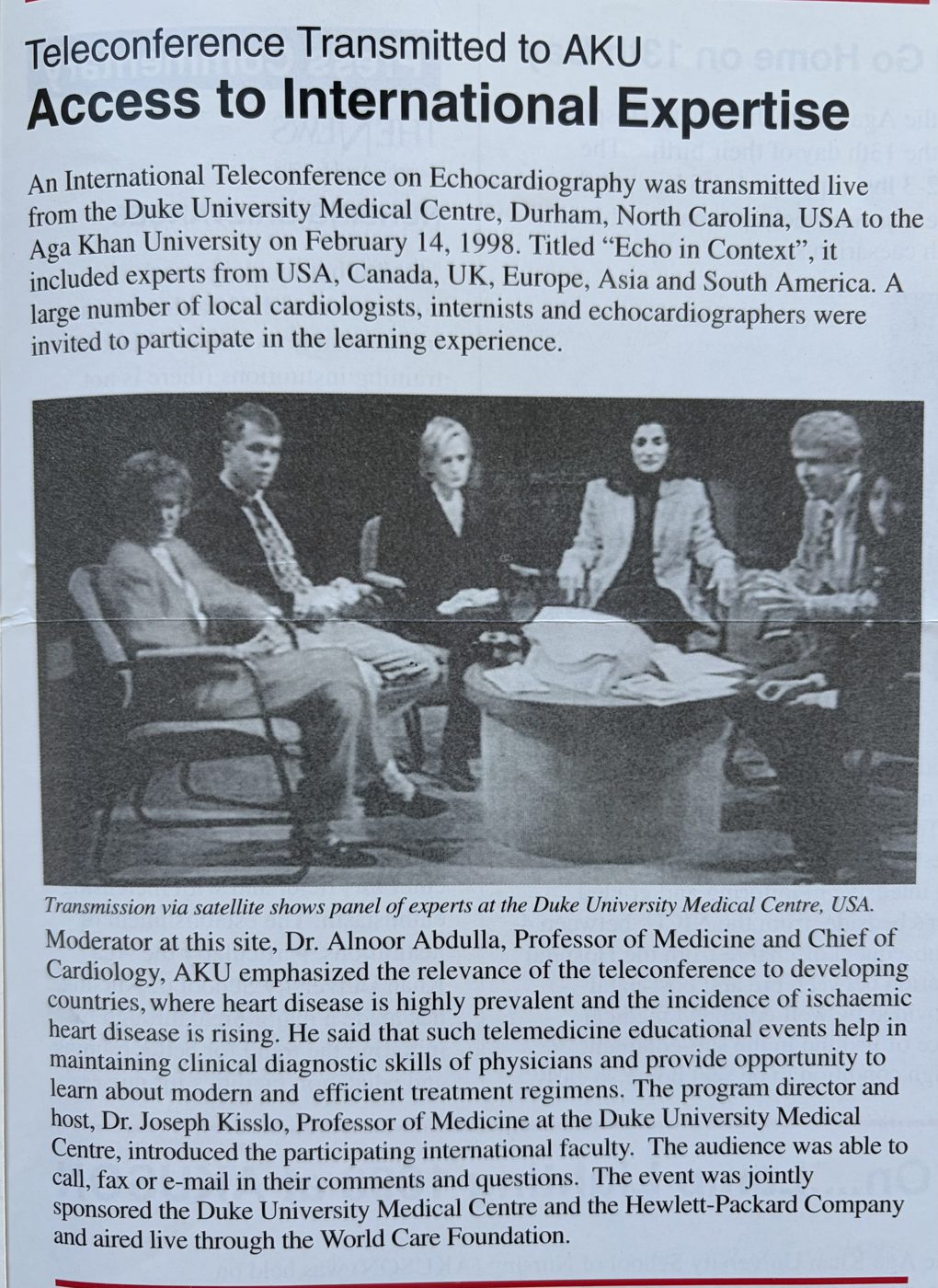
Teleconference from Duke, 1998
At an international seminar at AKU in February 1998, Dr. Abdulla organized and moderated a live echocardiography teleconference from Duke University Medical Center, in Durham, North Carolina, seen at AKU as it happened. His point was that telemedicine could connect AKU with its primary and secondary care facilities across the country, with expertise and teaching transmitted just as they were from North America to Karachi that day.
INTER-HEART and THE CARVEDILOL HEART FAILURE TRIAL
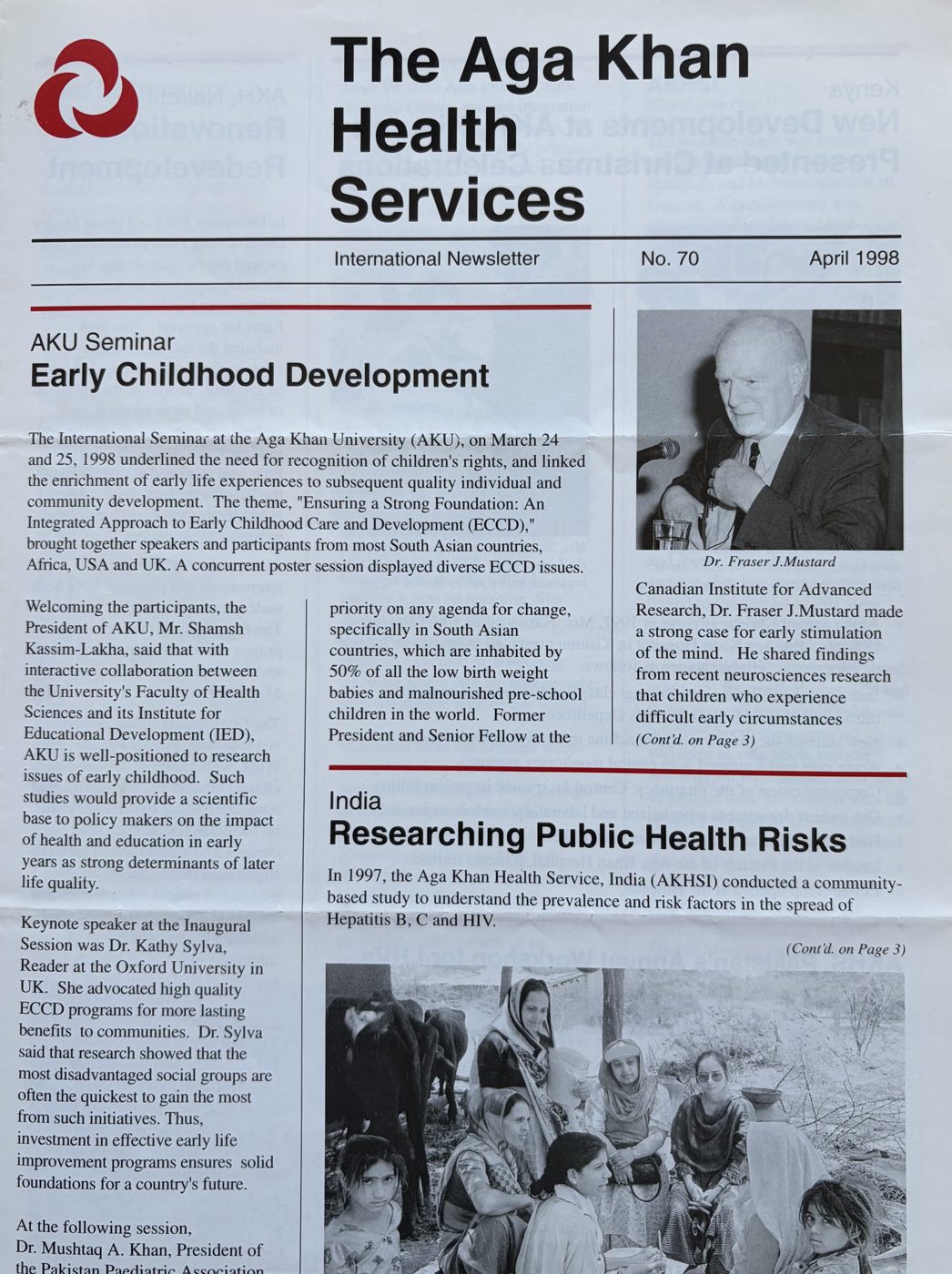
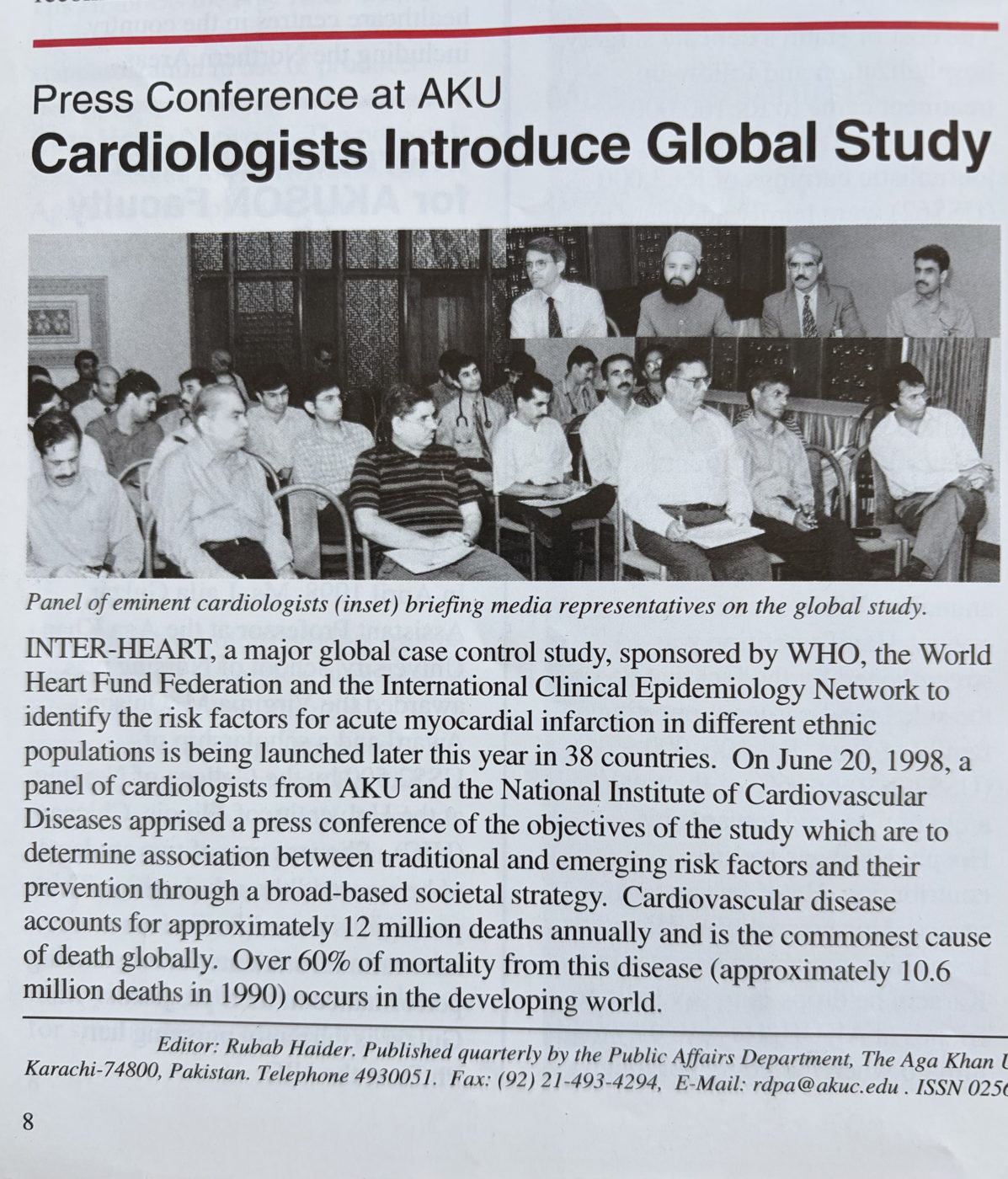
Dr. Abdulla was the site Principal Investigator for two long-running international studies, the INTER-HEART Study of the risk factors for heart attack and the Carvedilol Heart Failure Trial. He was already the appointed investigator at Sudbury. When he moved to AKU he set up the AKU site for both studies and carried on as Principal Investigator, so the studies went with him; they were never studies of Sudbury Memorial Hospital. He brought the hospitals and cardiologists of Pakistan into the INTER-HEART Study. In June 1998 a panel of cardiologists from AKU and the National Institute of Cardiovascular Diseases announced the launch of INTER-HEART in Pakistan at a press conference at AKU. These and his other trials are listed on the Publications page.
Building bridges between Pakistan’s cardiac programs
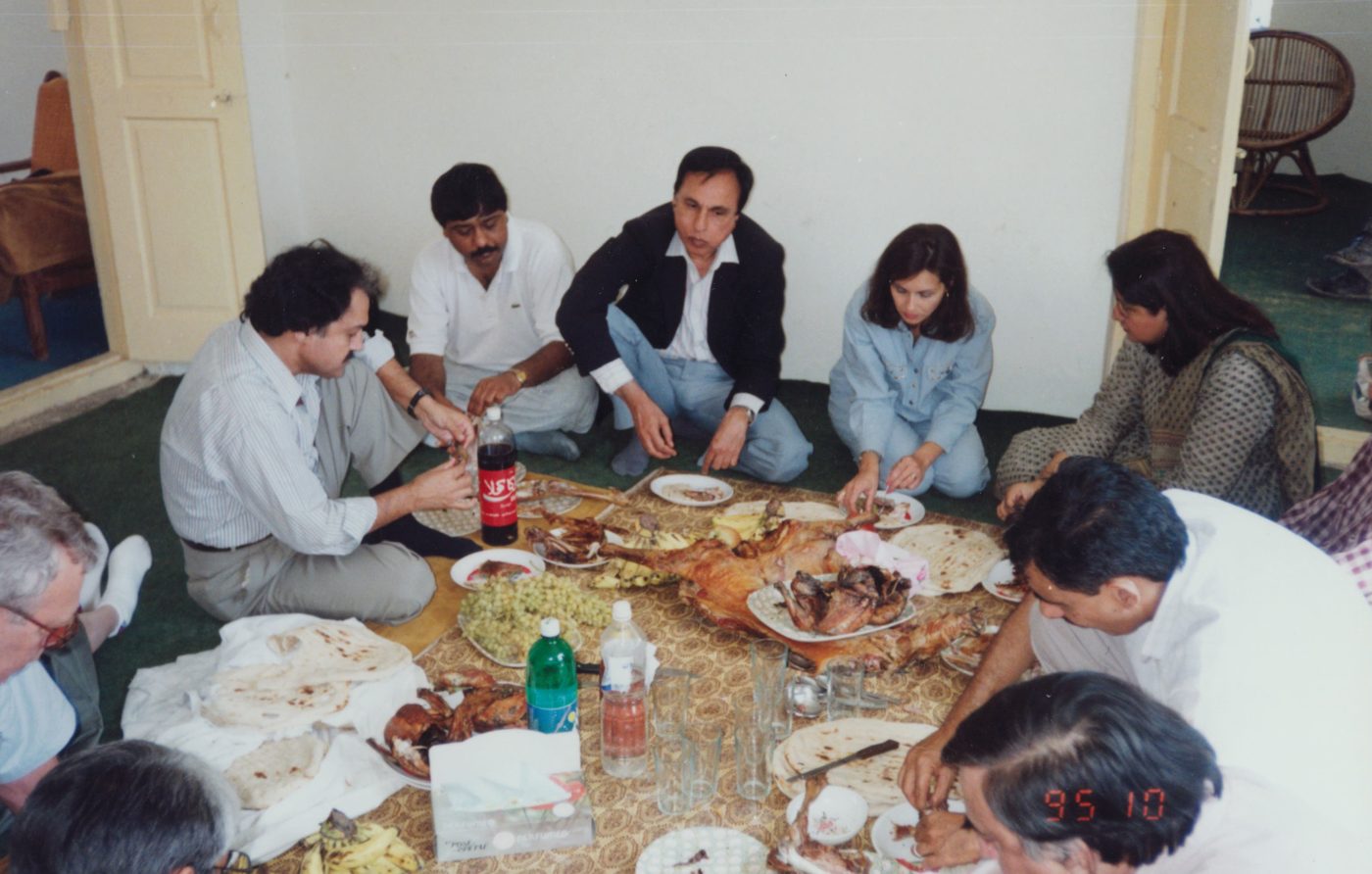
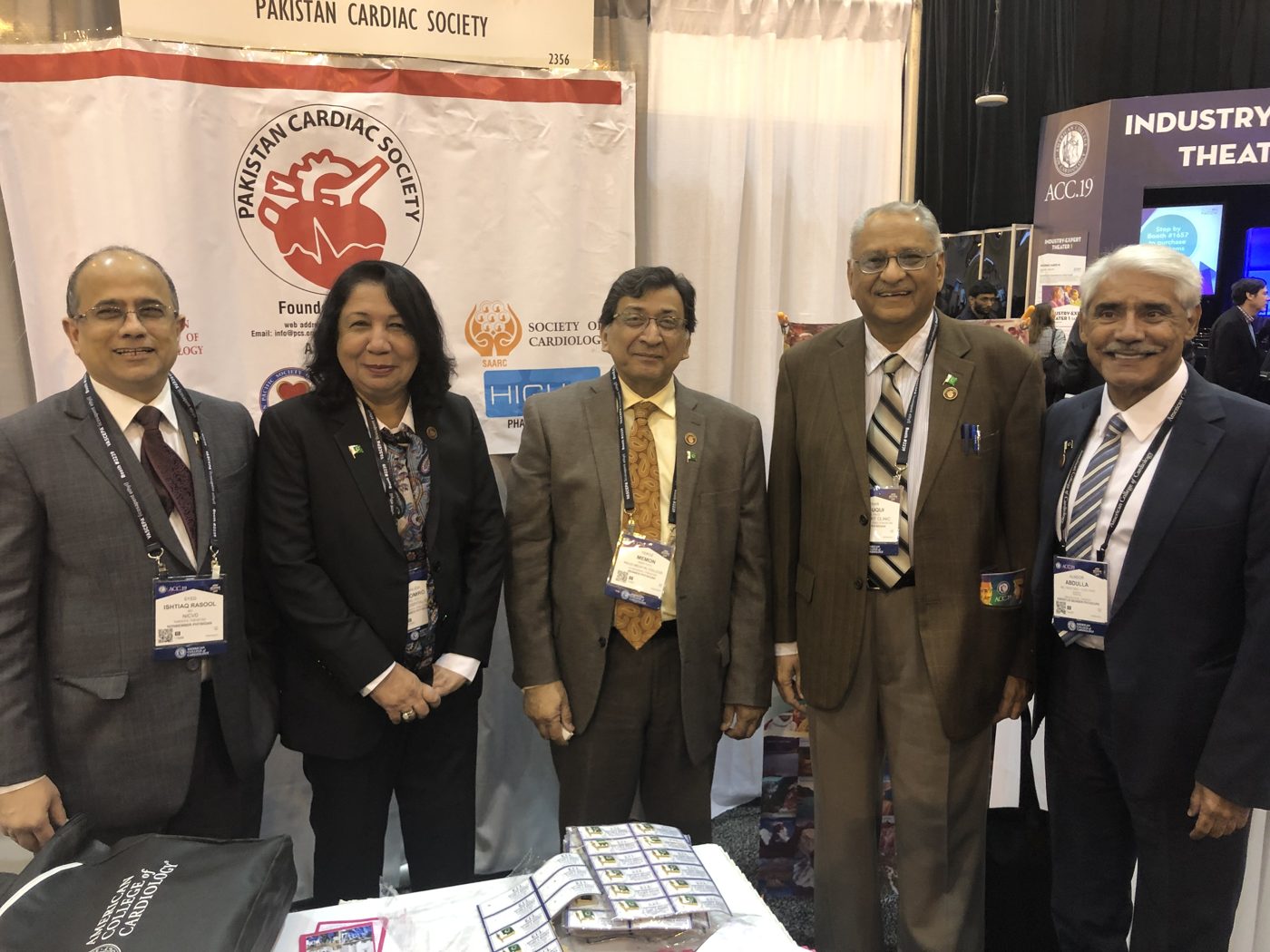
Dr. Abdulla’s aim in Pakistan was never only AKU’s own program. He worked to bring the country’s cardiovascular programs into harmony with one another. With his friend and colleague Dr. Azhar Faruqui, then Director of the National Institute of Cardiovascular Diseases (NICVD) in Karachi, he helped set up a conference in Quetta, in the west of the country near the border with Afghanistan, in the mid-1990s. It was a very successful meeting. He and his colleagues also went up to the Afghan border to see the refugee camps for themselves, and were given lunch there, a barbecued goat prepared for them on the spot.
What it became
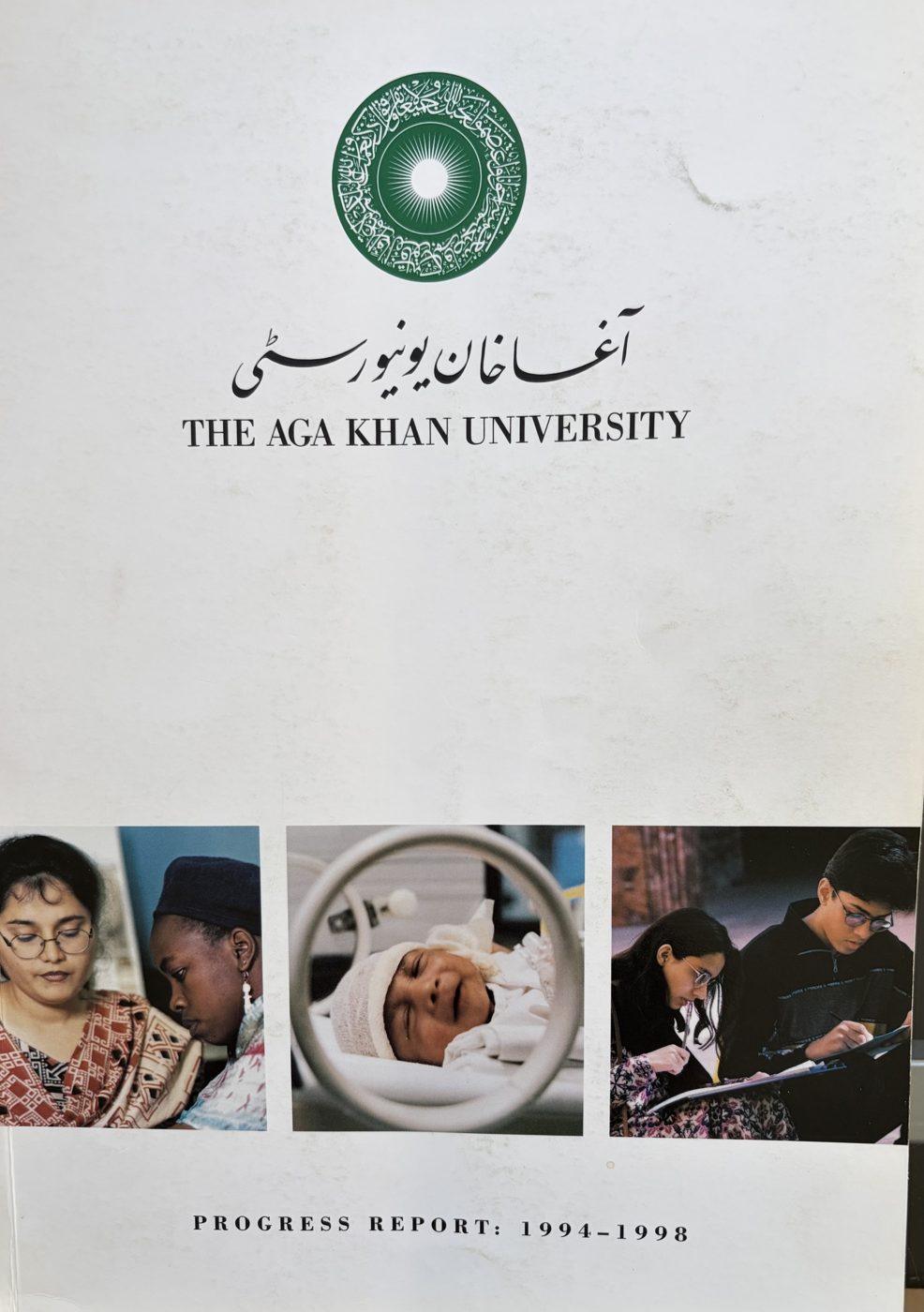
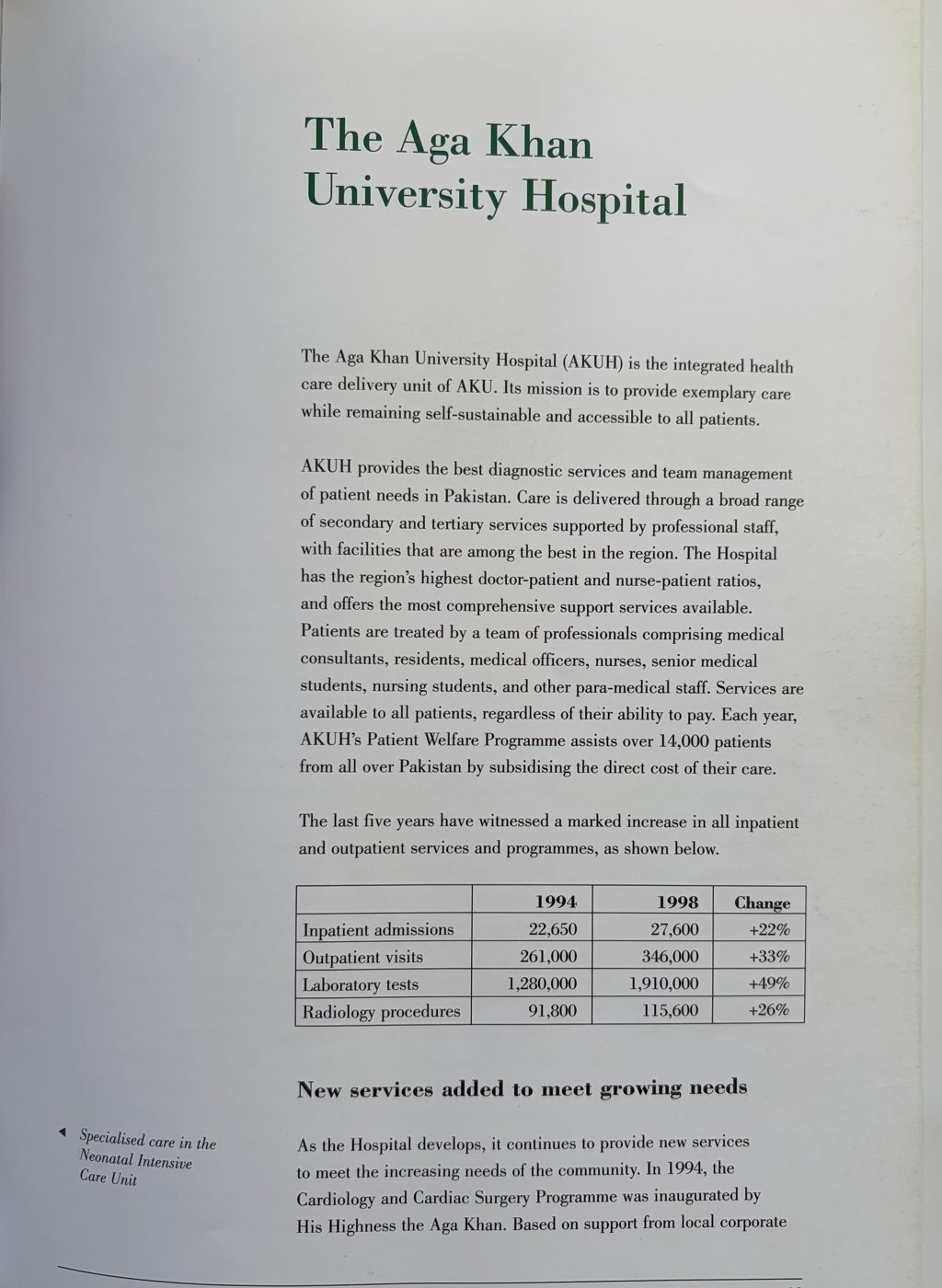
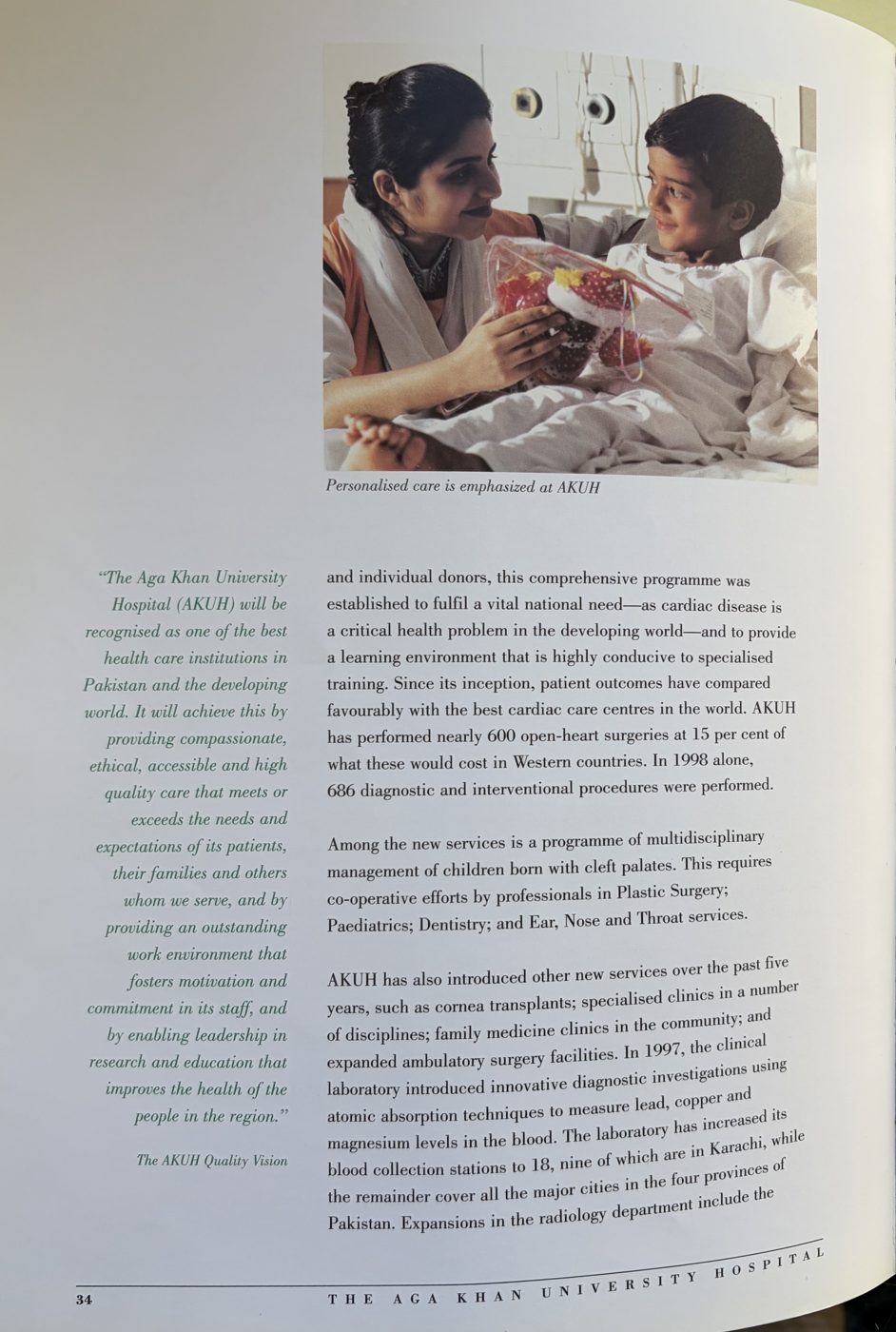
AKU’s Progress Report 1994–1998 records that the Cardiology and Cardiac Surgery Programme was inaugurated by His Highness in 1994, “based on support from local corporate and individual donors,” and that its patient outcomes had compared favourably with the best cardiac care centres in the world. The report counts nearly 600 open-heart operations, at about 15 per cent of what they would cost in Western countries, and 686 diagnostic and interventional cardiac procedures in 1998 alone.
The dedicated cardiac centre
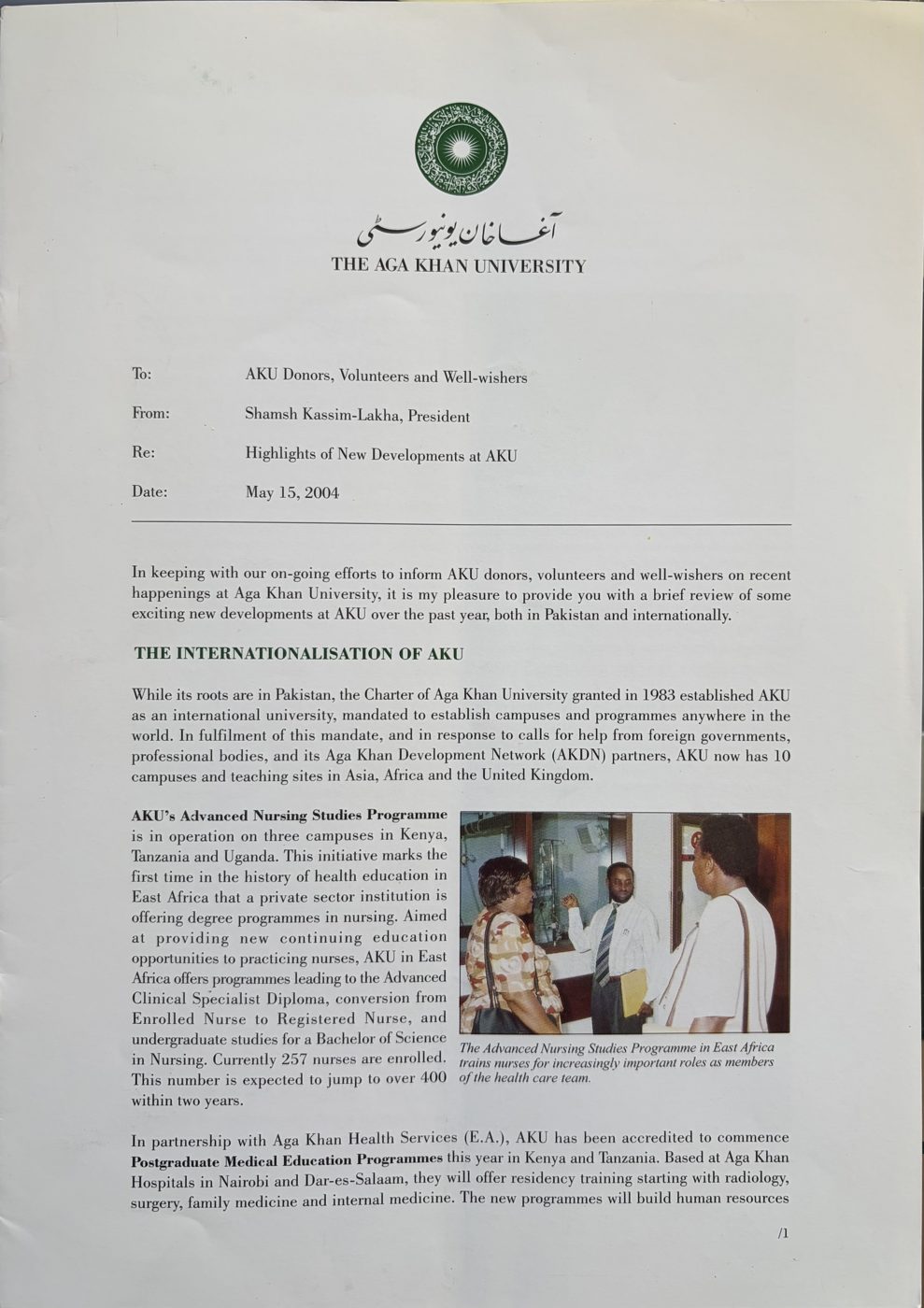
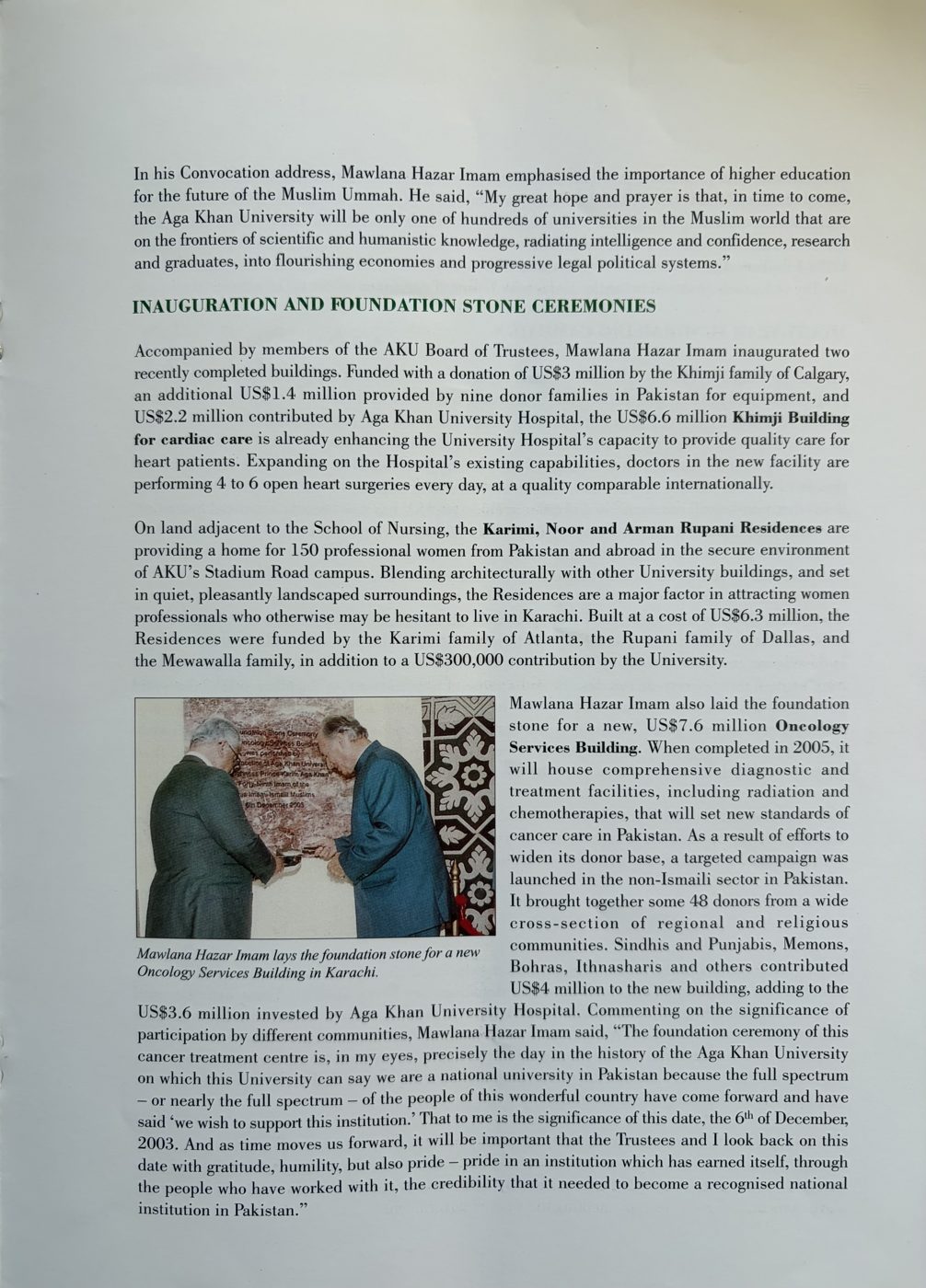
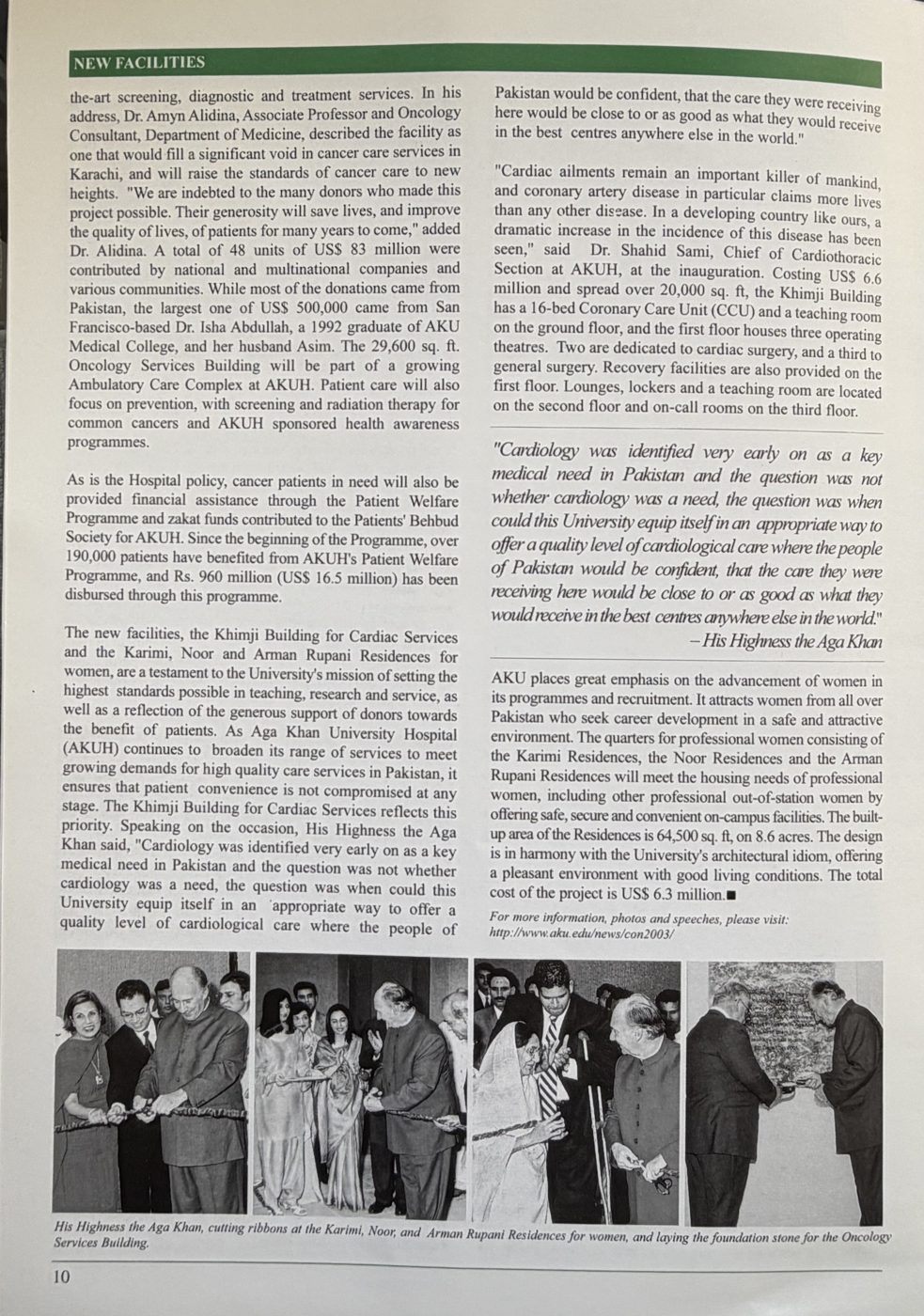
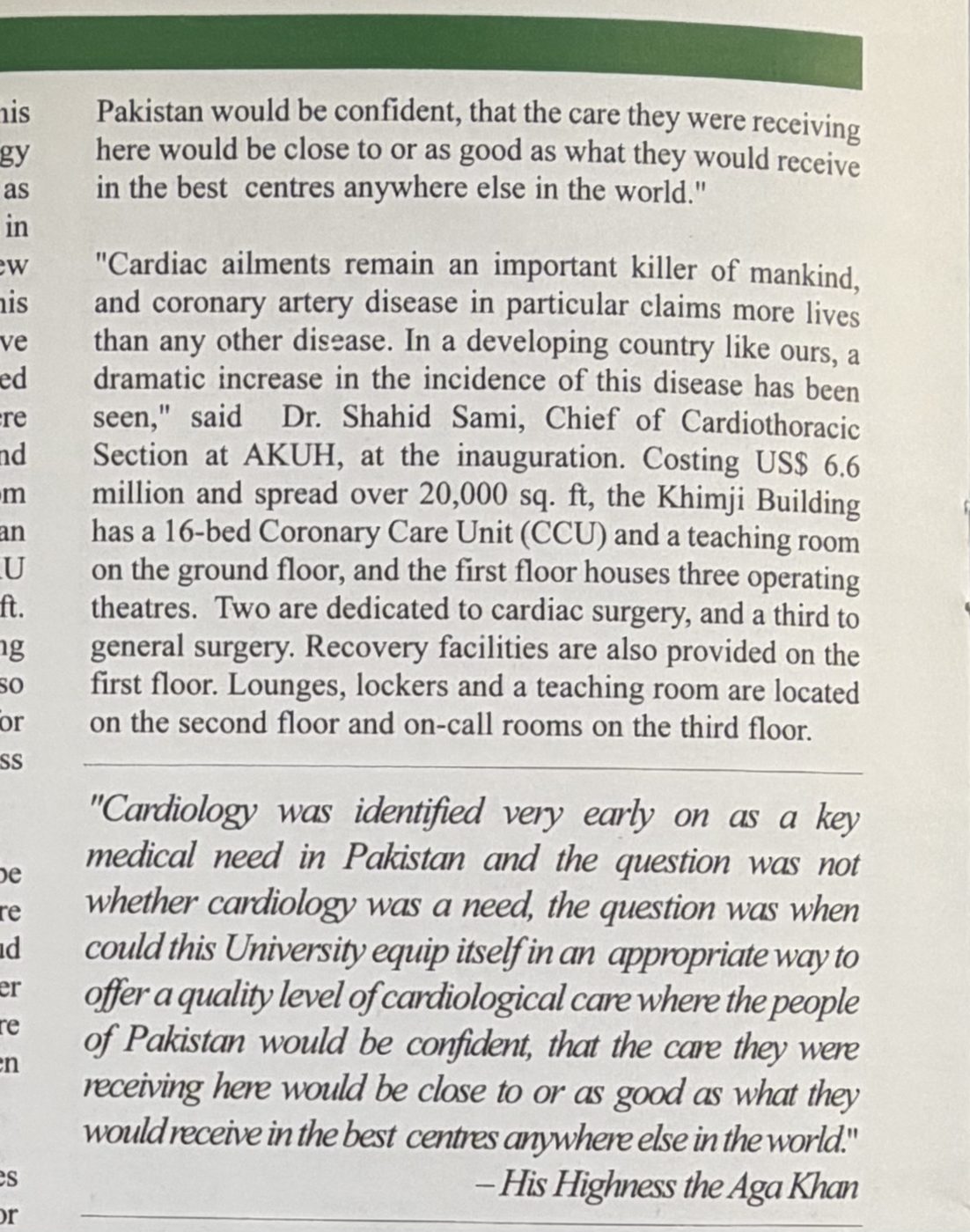
By 1997 Dr. Abdulla was arguing strongly that the program should have a dedicated cardiac centre, with cardiology, cardiac surgery, the coronary care unit and the operating theatres together in one building, and in 1998 he put forward a full plan for how it would be built and what it would contain. He then returned to Canada. The centre was built after he left. The Khimji Building for Cardiac Services was inaugurated by His Highness in December 2003: a 16-bed coronary care unit and three operating theatres, funded by a donation of US$3 million from the Khimji family of Calgary, with contributions from nine donor families in Pakistan and from the University Hospital. Mr. Khimji was someone Dr. Abdulla knew from his years at AKU and afterwards, and he agreed to give toward the new centre. In a 2004 report to donors, the University’s President described it, and quoted His Highness: the question about cardiology “was not whether cardiology was a need, the question was when could this University equip itself” to offer care that the people of Pakistan could trust to be as good as anywhere in the world.
What the Karachi years made possible
The Aga Khan University program became a major cardiac service for Pakistan, and the reasoning behind it is set out in the cardiovascular strategic plan Dr. Abdulla later prepared for the Aga Khan University in East Africa. It was built from the ground up, in a developing country, with local donors and with local doctors, nurses and technicians who were trained to run it. Three of the cardiology fellows he trained, who went on to lead cardiology elsewhere, are described on the Aga Khan community page.
How it began is told in New Services and Leadership at Sudbury Memorial, 1984–1994. The opening day and Dr. Abdulla’s lifetime of service to the Aga Khan and the community are on the Aga Khan & Community page.