The Aga Khan & Community
The Aga Khan University, the AKDN, and a Lifetime of Community Service
A lifelong personal history with the Aga Khan and the Ismaili community that runs the length of Dr. Abdulla's own life — from a first encounter as a six-year-old boy in Dodoma in 1957, to a wartime promise made in Kampala in 1972 that was kept exactly as given, to an audience with Prince Amyn in Vancouver in 1973, to the Sick Bay later that decade, to the Silver Jubilee visit in Los Angeles in 1983, to a quarter-century partnership building tertiary cardiac care at the Aga Khan University, to a personal tribute written in 2025.
Fifteen stories on this page
Click or tap any title to go straight to it. The “Back to top” button, lower right, brings you back here.
- 1957 · DodomaA First Encounter
- 1972 · KampalaA Promise, Before Anyone Knew
- 1973 · VancouverThe Promise Continues
- 1978 · VancouverA Historic First: The Sick Bay
- 1976–1994Serving as Mukhi Saheb
- 1979–1985First Official Tie to the AKDN
- 1983 · Los AngelesA Personal Trust
- 1983The Al-Ummah Camp, a First for Ismaili Youth
- 1989AKF Canada’s Volunteer Awareness Trip
- 1992Youth Awareness Trip to East Africa
- 1994 onwardA Twenty-Five-Year Partnership with the AKDN
- 1988–2005Three Named Gifts to AKU, and Letters of Blessing
- 1994Opening Day, AKU Cardiac Program
- 1994–1998The Fellows He Trained
- 2025A Personal Tribute to Aga Khan IV
A First Encounter — Dodoma, 1957
Age Six, and a Moment His Mother Prepared Him For
The earliest of Dr. Abdulla's encounters with the Aga Khan — the first link in a chain that would run the rest of his life.
In 1957 — the same year His Highness Prince Karim Aga Khan IV succeeded to the Imamat — the new Imam made his inaugural tour of the Jamat and came to Dodoma, in what was then Tanganyika. The community gathered to give him their oath of allegiance, the children filing past him one by one in a lineup, Dr. Abdulla — Alnoor — among them at six years old.
His mother had coached him beforehand: if the Imam spoke to him, he might ask this, that, or the other, and she rehearsed the answers with him until he had them ready. As Alnoor moved through the lineup, sunlight streamed in through a window ahead of him, and he still remembers the feeling of walking straight toward the light — toward the Imam himself.
Then the Aga Khan did something almost no other child in that lineup experienced: he placed his hand on Alnoor's shoulder and began speaking with him directly — asking him, one by one, the very questions his mother had prepared him for. Alnoor answered them, and the Aga Khan, pleased, blessed him before he moved on and the lineup continued behind him.
It was a rare thing at that time for Aga Khan IV to single out a child that way, stopping to hold a real conversation rather than simply blessing each one in passing. Nearly seventy years and a lifetime of service later, it stands as the first of a series of encounters with the Aga Khan and his family that would go on to shape the entire course of his life, from a wartime promise in Kampala fifteen years later to a personal audience of his own in the Sick Bay in Vancouver two decades after that.
1957, By the Numbers
A Promise, Before Anyone Knew — Kampala, 1972
The Mehmani Ceremony, and a Word About Canada Months Before the Decree
A personal reassurance about his medical education, given in February 1972 — before anyone in the world knew what Idi Amin was about to do.
In February 1972, Dr. Abdulla was in Kampala, Uganda, for a Mehmani ceremony, alongside Nasir and his cousin Nuri. It was there that he received a direct, personal reassurance about his medical education — that he would complete it, in countries including Canada.
At the time, the words carried no particular urgency. Nobody — not Dr. Abdulla, not the Ismaili community in Uganda, not the government of Canada — had any idea what was coming. It was not until August 1972, months later, that Idi Amin announced the decree expelling Uganda's Asian population, upending tens of thousands of lives with little warning.
What followed reads, in hindsight, like the promise working itself out in real time. Dr. Abdulla was accepted to medical schools across three continents — Guy's Hospital Medical School in London, a medical school in the United States, and, in Canada, the University of British Columbia, the University of Western Ontario, and the University of Alberta. Complicating things further, he held a Tanzanian passport rather than a Ugandan one, even though Uganda was where he was living and being expelled from — a status that made securing a place on one of the refugee evacuation flights out of Uganda anything but straightforward. He found his way onto one anyway, landing in Montreal as a refugee, and from there made his way to Vancouver and the University of British Columbia — Canada, exactly as he had been told in Kampala seven months before.
1972, By the Numbers
The Promise Continues — Vancouver, 1973
An Audience with Prince Amyn, and a Foreword for Forum
Barely settled in Canada as a refugee and still a fledgling medical student, Dr. Abdulla was already at work building institutional structure for the young Ismaili community itself — and his first personal connection to the Aga Khan's family followed the same year.
Dr. Abdulla arrived in Canada as a refugee from Uganda in 1972 and, while still a fledgling medical student putting himself through school, was quickly volunteering across the Vancouver Jamat. But he didn't stop at volunteering within structures that already existed — the following year, in 1973, before the Aga Khan Regional Council for B.C. itself had even been established, he took the initiative to build one of the community's own institutions from scratch: he founded the Ismaili Youth Organization and served as its chairman.
That same year, Prince Amyn Muhammad, the Aga Khan's brother, visited Vancouver to meet with the community. Functioning as a semi-official body, the Youth Organization was granted its own audience with Prince Amyn at the Hotel Vancouver, where Dr. Abdulla told him about the organization he had just founded. Prince Amyn was pleased to hear of it.
By the time Forum was published, the Aga Khan Regional Council for B.C. had been established, and the Youth Organization had become a formal committee under Amin Jamal, the Council's member for youth. The organization had, at the same time, been preparing Forum, the first Ismaili community magazine of its kind in Canada. Dr. Abdulla asked Prince Amyn whether he would write its foreword, and he agreed. Worked on through the latter part of 1973 alongside his chairmanship of the Youth Committee, Forum was distributed that December, timed to the Aga Khan's birthday celebrations, carrying Prince Amyn's foreword under his own name and signature — five years before Dr. Abdulla's Sick Bay brought him face to face with the Aga Khan himself, and a decade before he served as personal physician to the Aga Khan's family in Los Angeles. He stepped down and handed the chairmanship to a committee member in 1974.
“My name is Aziz Haji. I have held many leadership positions both in the religious aspects of our community and in the secular aspects of our Agakhan Shia Ismaili community here in Canada. Most of my work has been in the province of British Columbia, but I have held National positions in Canada as well. We developed and set up many youth activities to bring the youth cohesively within our community in those early years of settlement in Canada.”
— Aziz Haji, fellow community leader, on the Youth Organization's early years
“That was published under the editorial leadership of Dr. Alnoor Abdulla, and Prince Amyn Muhammad wrote the foreword for that first magazine. The magazine was printed and distributed to the Jamat during the Khushali celebrations of the Aga Khan's birthday in December 1973.”
— Aziz Haji, on the publication of Forum
1973, By the Numbers
A Historic First — Vancouver, 1978
The Aga Khan's first inaugural visit to Canada as Imam — “The Sick Bay”
Something never done before at any Aga Khan visit anywhere in the world — and now the standard.
In 1978, His Highness Prince Karim Aga Khan IV made his first official visit to Canada as Imam of the Shia Ismaili community. At the time, Dr. Abdulla — then a medical resident at St. Paul's Hospital (already a licensed physician) — was already deeply engaged as a community volunteer, including as library convenor for the National Religious Education Board. Two years earlier, building his own structure ahead of the visit much as he had founded the Youth Organization in 1973 before the Regional Council itself existed, he had founded the Aga Khan Health Committee in Vancouver. As health convenor for the visit, he assembled a team of health professionals to provide emergency medical coverage for the thousands of community members expected to gather at the PNE Colosseum. His work that day led directly to his formal appointment as Member for Health on the Aga Khan Regional Council for B.C. in 1979–80 — confirming a role he had, in effect, already been performing.
He then went a step further. Community members who were hospitalized or in palliative and nursing care would ordinarily have been left out entirely — unable to attend and denied their Deedar, their audience, with the Imam. When Dr. Abdulla proposed bringing those patients to the visit, Sir Eboo Pirbhai, then the highest-ranking secular leader in the global Ismaili community, told him directly that the Imam did not like to see such ill patients in the midst of the congregation. Rather than abandon the idea, Dr. Abdulla adapted it: he and his team converted the Vancouver Canucks' dressing room at the Colosseum into its own separate medical facility — the “Sick Bay” — where the patients could be cared for apart from the general congregation, brought in on a day-pass basis under his own medical responsibility and returned to their institution every evening for the three days of the visit. Dr. Abdulla arranged for closed-circuit television to be installed so the patients and their caregivers could still see and hear the Deedar. An audience with the Imam is a deeply spiritual, highly charged experience, and the patients and health professionals working the Sick Bay — apart from the main congregation for three full days — would otherwise have missed sharing fully in it. Dr. Abdulla did not want the team members' spouses, who would otherwise have been out in the congregation alone, separated from their partners during something so spiritually significant, so he had those spouses join the Sick Bay team as well, staffing it alongside the doctors and nurses.
The idea was hotly contested. Dr. Abdulla could not accept Sir Eboo's objection: in his heart, he was convinced the Imam would never want his most vulnerable spiritual children neglected, especially knowing that for some of them, this would be their last opportunity for Deedar with him. What followed was, in effect, a confrontation between tradition and faith — institutional caution on one side, his own spiritual conviction about what the Imam himself would actually want on the other. He set up the Sick Bay anyway. Roughly twenty patients came through it: post-operative surgical cases, patients requiring IVs, elderly patients needing personal care, and a young man in a full body cast recovering from Harrington rod surgery for scoliosis, who went on to become a world-renowned orthopedic surgeon, known internationally for the club-foot repair technique he later devised.
There was no time set aside in the Imam's three-day program for a visit to the Sick Bay — but Dr. Abdulla was convinced, from his own spiritual understanding, that the Imam would not leave Vancouver without seeing these patients, and told Sir Eboo as much: the real test would be whether the Imam himself chose to come when the time came, and he would not be stopped by anyone short of the Imam's own word.
Through all three days of the visit, the Imam did not come. Then, on the final day, as the Aga Khan walked down the red carpet toward the edge of the Colosseum to get into his car and leave, he stopped abruptly, turned off the carpet, and walked quickly toward the stands and underneath them into the Sick Bay — his entourage rushing to keep up. Dr. Abdulla, caught behind in the narrow corridor, was not even at the front of it. The Aga Khan stood at the entrance and asked: “Who is in charge here?” The President of the National Council, Zinat Virani, answered, “Ya Hazar Imam, it is Dr. Alnoor.” Everyone turned, and Dr. Abdulla was pushed forward through the corridor to stand beside him. That was when the two of them began to speak — he blessed and visited with the patients, some of whom would never see him again, and, standing next to Dr. Abdulla, the Aga Khan spoke to him directly for the third time in his life (not the last), giving him personal guidance he has carried through his entire career: to cure if possible, but always, above all, to relieve suffering — the extreme importance, he said, of relieving suffering in the Jamat. He then turned to address all the health professionals present and repeated the same charge to them as a group. Before leaving, he asked for the medical reports on all the patients — Dr. Abdulla had them all ready in a file.
That moment is documented as an official Firman from the visit: “Help those who are sick and above all, seek to assist them, so that they neither suffer nor are in discomfort. This is the most important thing, the most important thing you can do.” — His Highness Prince Karim Aga Khan IV, Sick Bay Visit, Vancouver, B.C., Wednesday, 15 November 1978.
It was, by every account, an incredible thing for the patients and those health care couples to experience the Imam in their midst, and to be together with each other.
Nothing like the Sick Bay had been done at any Aga Khan visit anywhere in the world before. It is now the norm at Aga Khan community visits internationally. Dr. Abdulla went on to set up the same emergency health infrastructure for the Aga Khan's Silver Jubilee visit to Los Angeles in 1983 and his visit to Toronto in 1992 — and the personal charge given to him that day in the middle of the Sick Bay has stayed the throughline of his entire career in medicine, from Vancouver to Los Angeles to Sudbury to the Aga Khan University to Ontario, and now to Medical Navigation & Patient Advocacy, which he practices today from Vancouver.
The Sick Bay, By the Numbers
Serving as Mukhi Saheb — Vancouver & Sudbury, 1976–1994
Leading Jamatkhana congregations, alongside every other role
Running through the same years as his health committee, youth organization, and AKDN work, Dr. Abdulla also repeatedly took on one of the community's most direct, hands-on forms of service.
Alongside his growing list of institutional and health-related roles, Dr. Abdulla was repeatedly called on to serve as Mukhi Saheb — the lay leader who conducts and leads congregational prayers in the Jamatkhana — first in Vancouver and Victoria in the late 1970s, and then again through his Sudbury years in the mid-1980s and early 1990s. He returned to the role six separate times across nearly two decades, even as his medical career and his other Ismaili institutional responsibilities grew increasingly demanding.
Mukhi Saheb Appointments
His First Official Tie to the AKDN — 1979–1985
From Nuclear Cardiology Fellow to Canada's ISP Alumni Coordinator
Before Los Angeles, before Sudbury, before AKU — his first formal connection to the Aga Khan Development Network came through a scholarship, and the alumni network he later helped build from it.
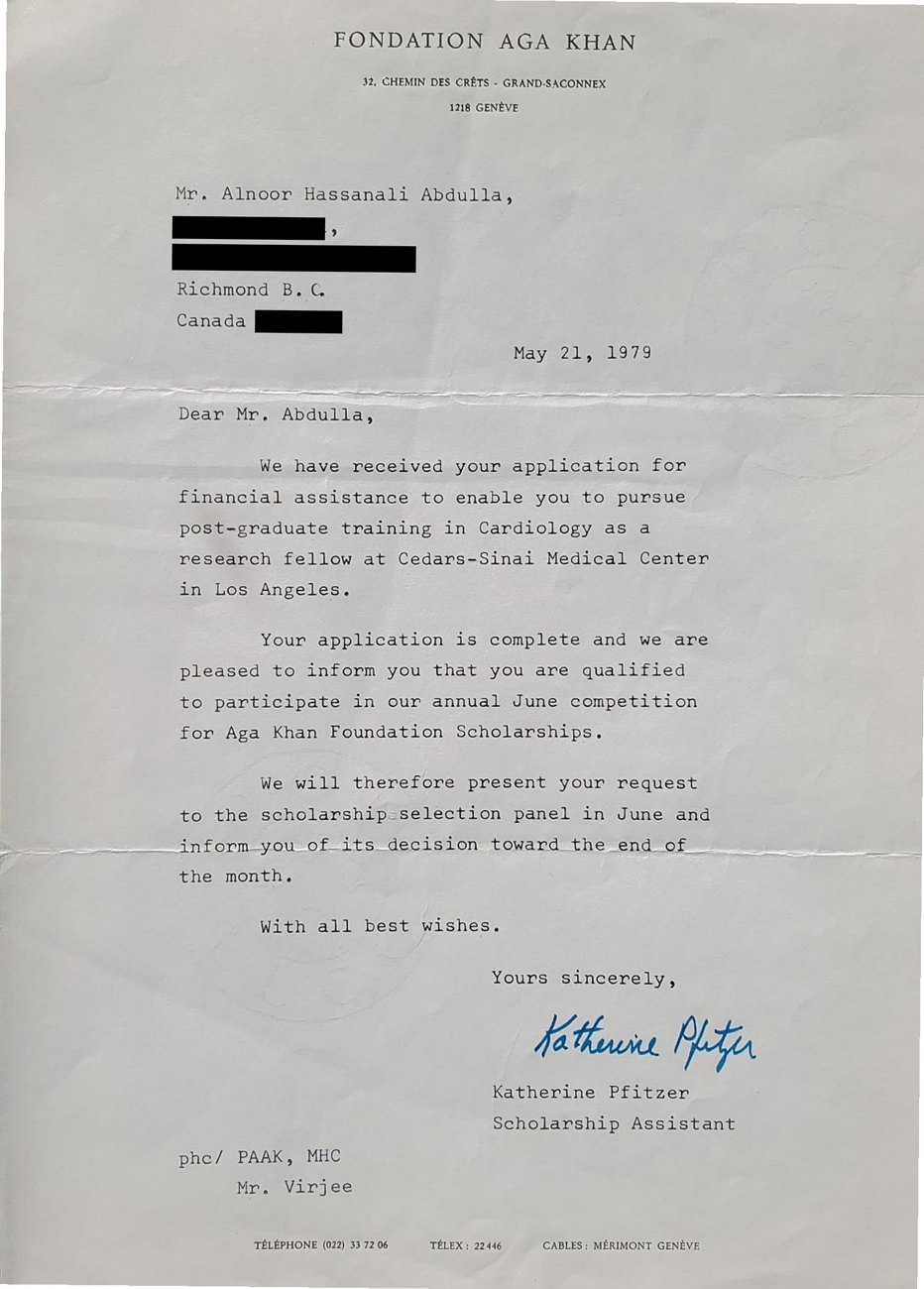
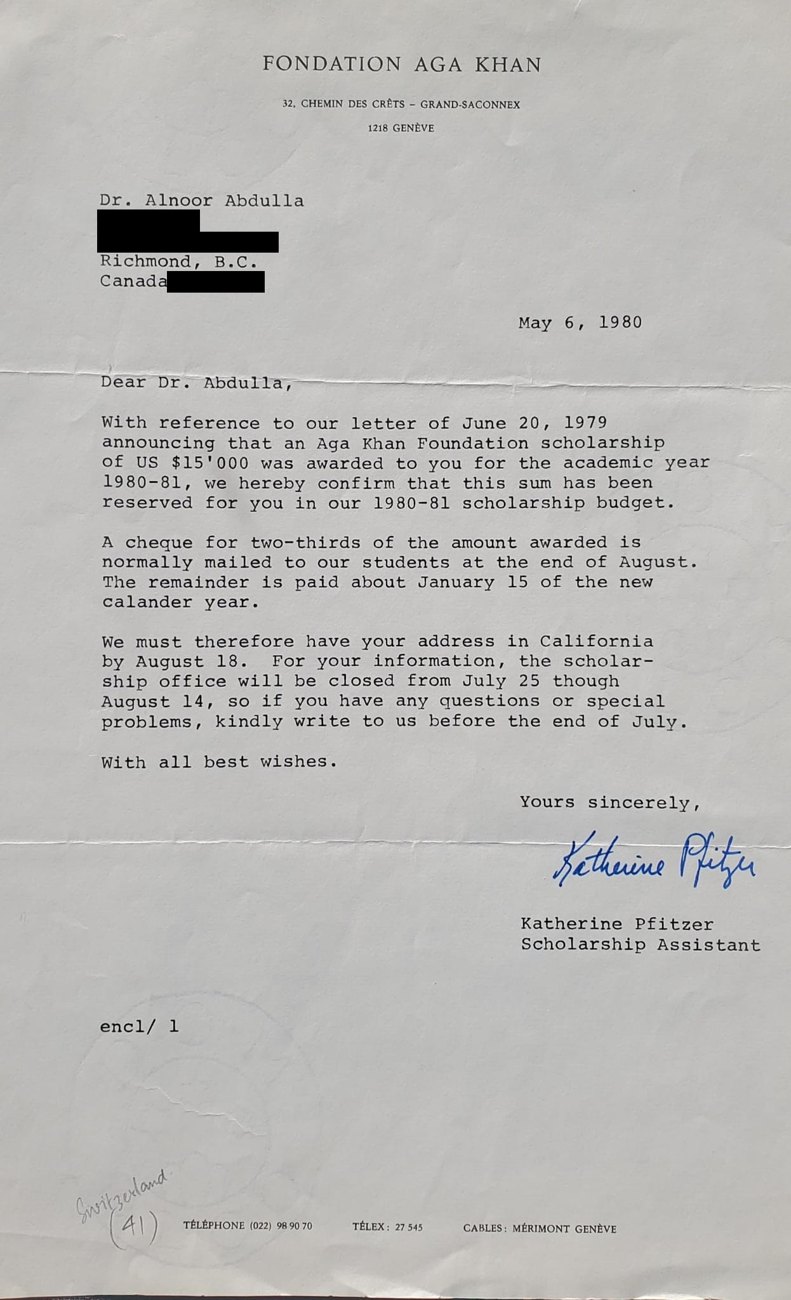
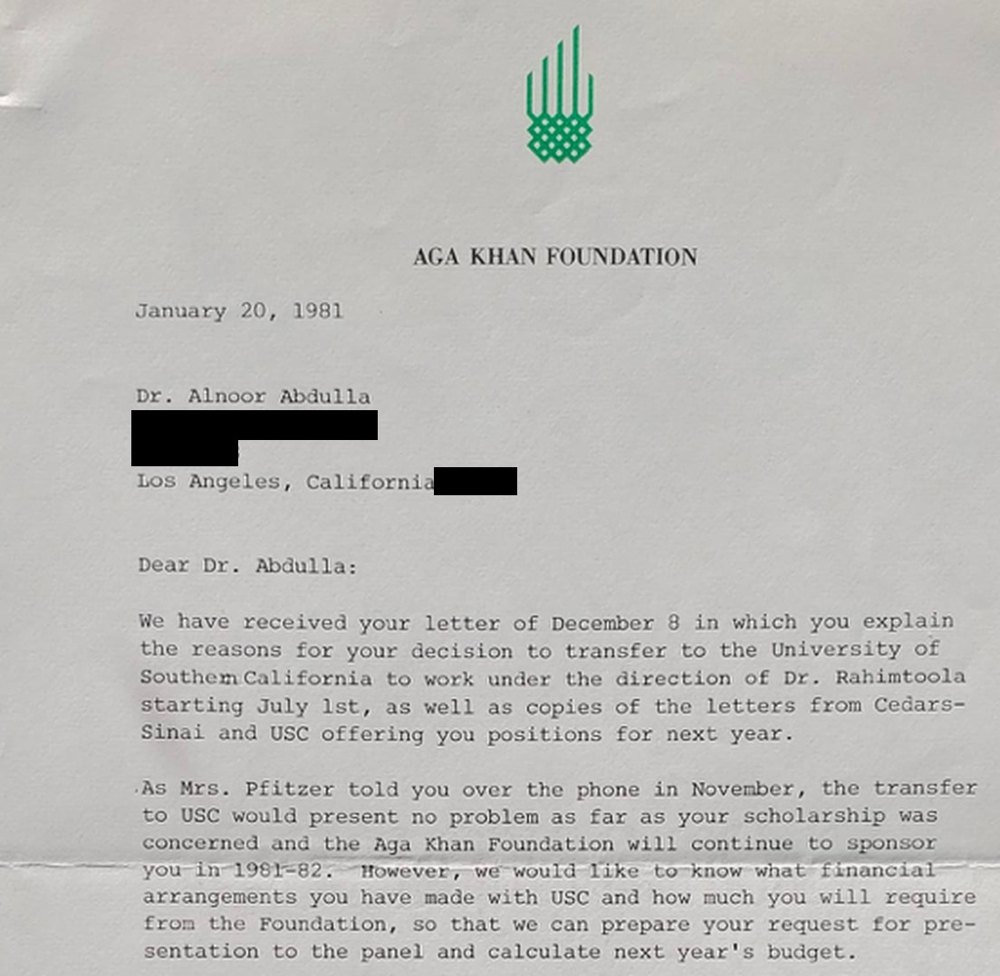
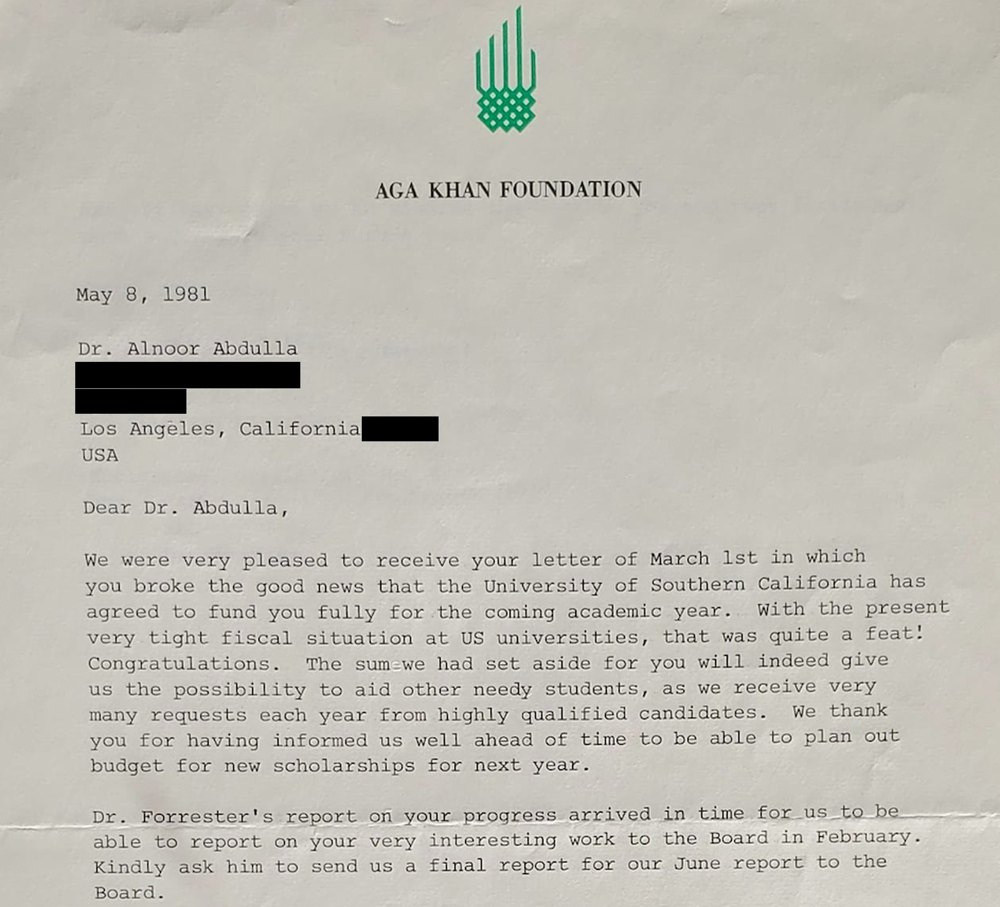
In 1979, Dr. Abdulla applied for the Aga Khan Foundation International Scholarship Programme, administered from Geneva — at the time the sole source of AKF scholarships worldwide, years before AKF Canada or any other national affiliate began awarding scholarships of its own. Against stiff international competition, he was awarded two years of funding (1980–81, 1981–82) for a Nuclear Cardiology Research Fellowship at Cedars-Sinai Medical Centre, UCLA — his first formal tie to the AKF/AKDN network.
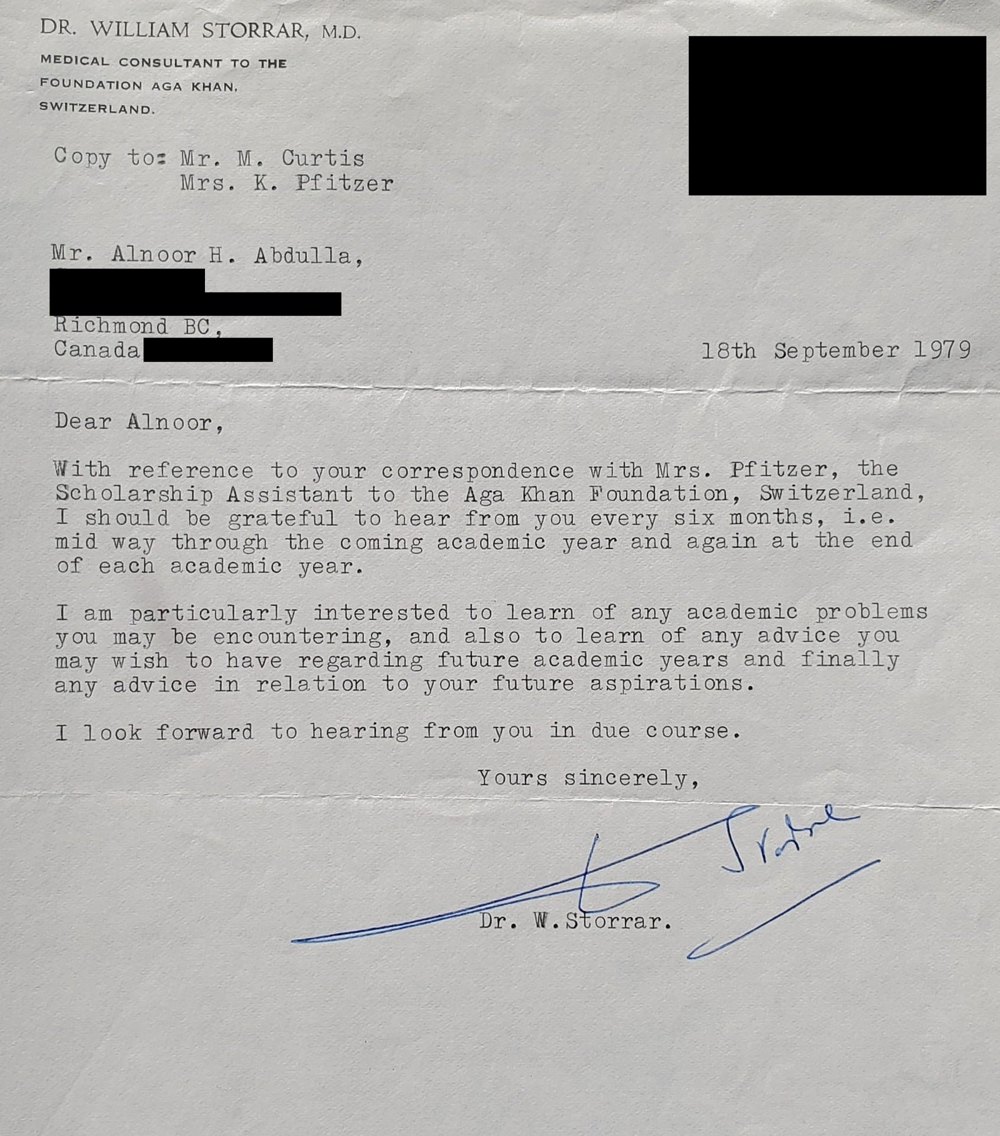
The fellowship connected him to two distinct contacts within the network, on two different sides of it. On the scholarship side in Geneva, his contact was Katherine Pfitzer, Scholarship Assistant, later succeeded by Catherine Hieronymi. Separately, on the health side, the Foundation’s Medical Consultant, Dr. William Storrar, wrote to him in September 1979 asking for a progress report every six months — on any academic problems, and on his advice and future aspirations — and Dr. Abdulla kept in touch with him through the fellowship years.
He completed every requirement of that fellowship — full certification, his nuclear license, and his published research — inside a single year. For the second year, rather than draw on the remainder of his AKF award, he moved to the University of Southern California to finish his cardiology training, including invasive cardiology, under Dr. Shahabudin Rahimtoola, this time on funding he had secured independently from USC itself. He then returned the unused second year of his Aga Khan Foundation scholarship to Geneva.
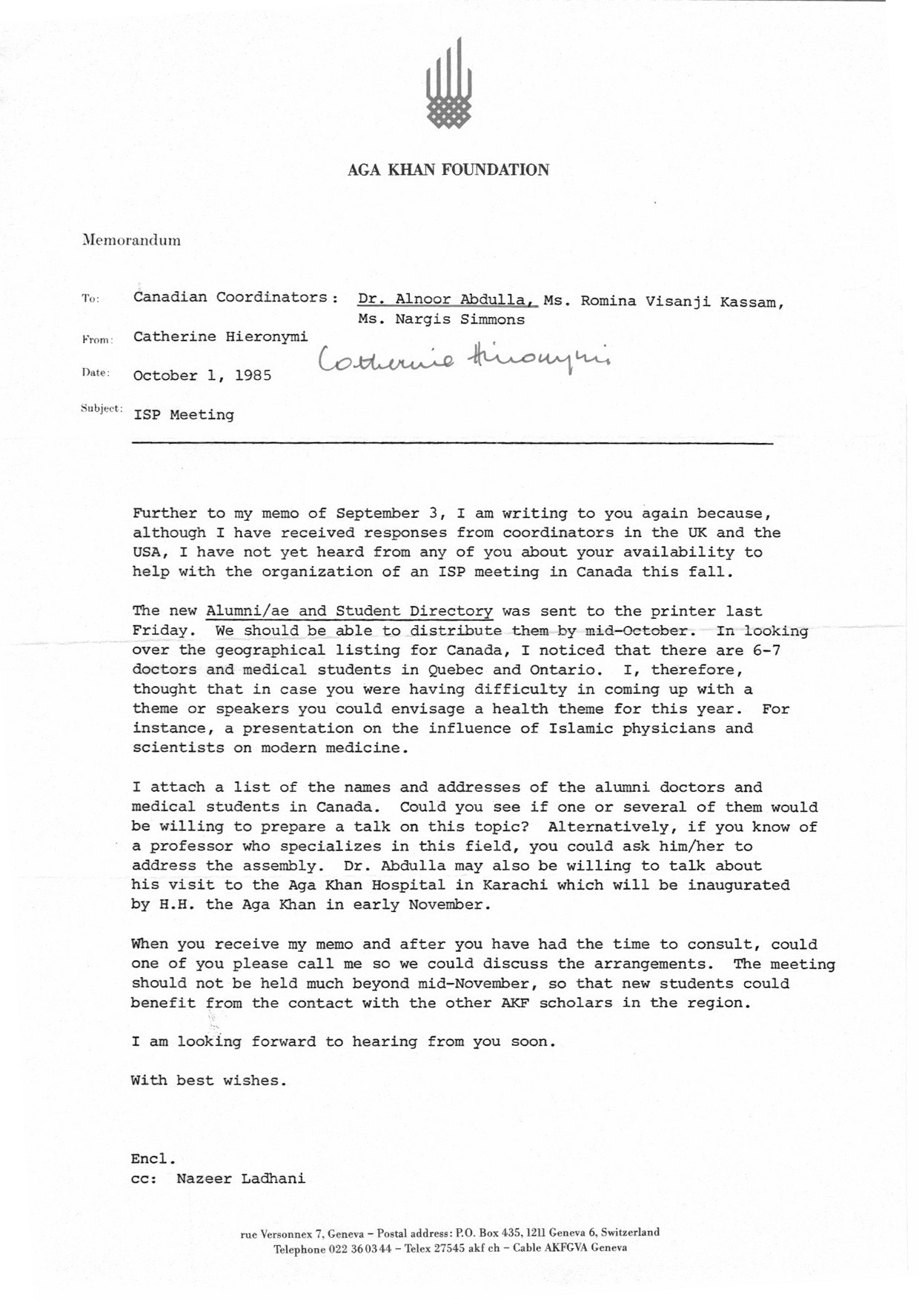
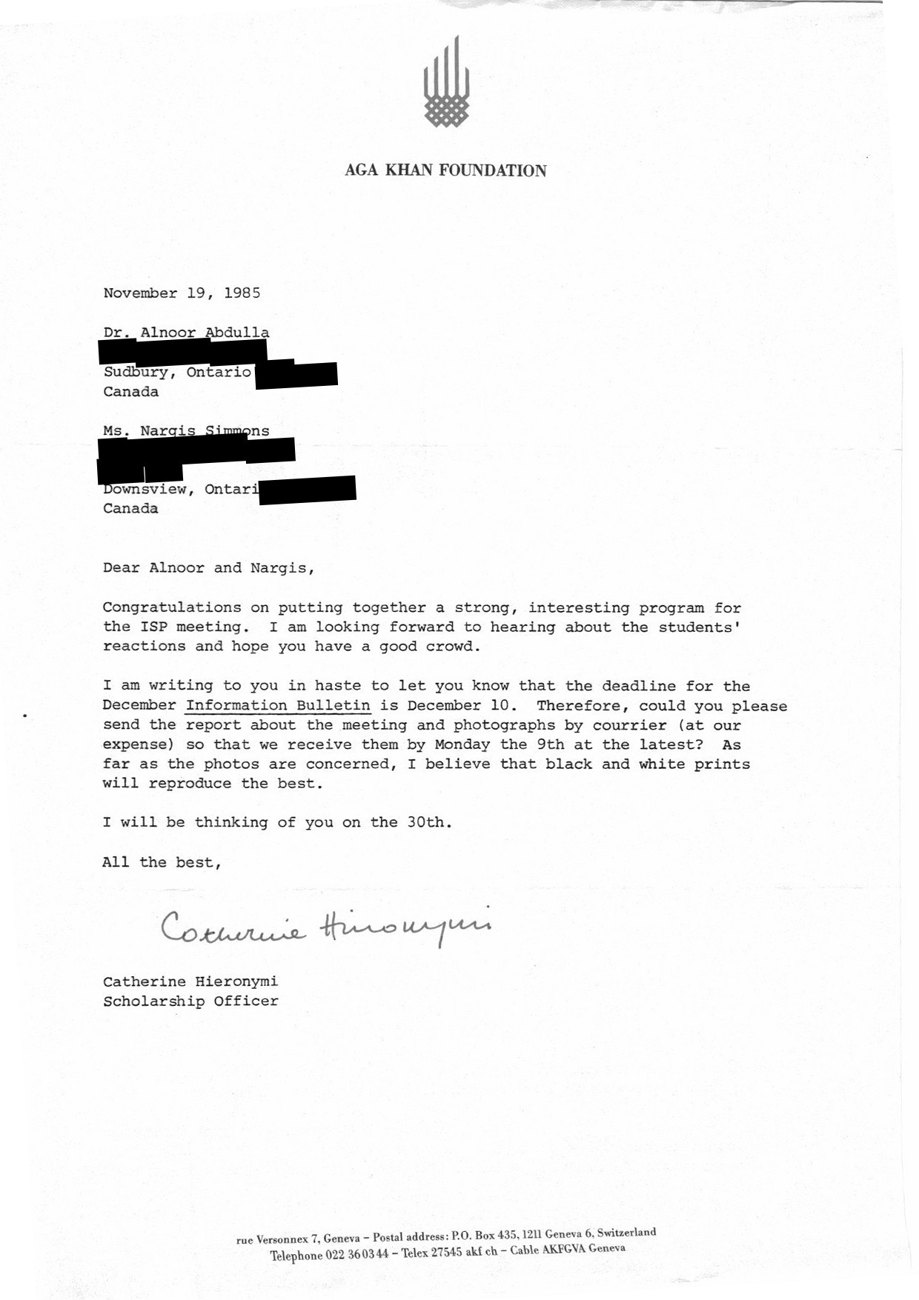
Some years later, settled in practice in Sudbury, discussions between Dr. Abdulla and Aziz Bhaloo — then the education member on the Aga Khan Regional Council for Ontario — raised the idea of bringing Canada's scattered ISP scholars together, an idea that dovetailed with Geneva's own wish, from Scholarship Officer Catherine Hieronymi, to compile a directory of ISP alumni across the country. By October 1985, the Foundation had named Dr. Abdulla, together with Nargis Simmons and Romina Visanji Kassam, as the Programme's Canadian coordinators, organizing under the auspices of the Ontario Regional Council. Dr. Abdulla organized and ran the group's first meeting, held in Toronto that November, with Simmons handling its documentation.
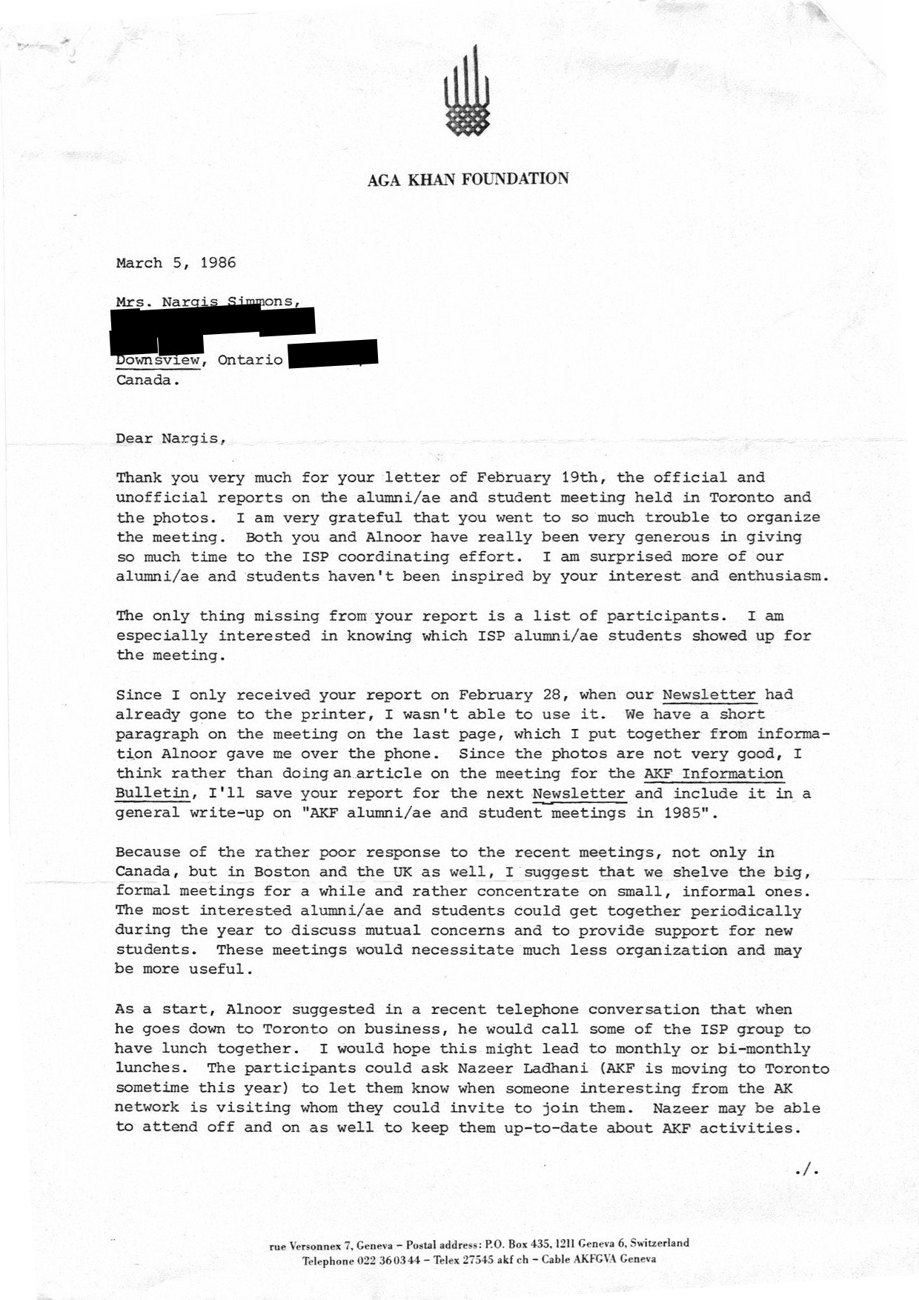
Response to the formal, large-scale meetings was modest — in Canada as well as in similar gatherings Geneva was running in Boston and the UK — and in March 1986 Hieronymi wrote to suggest shelving the big get-togethers in favor of small, informal ones instead, while still telling the Toronto pair, “Let's not give up on the ISP Association idea yet.” When Simmons later moved away, Kassam carried on the coordination function along with Dr. Abdulla.
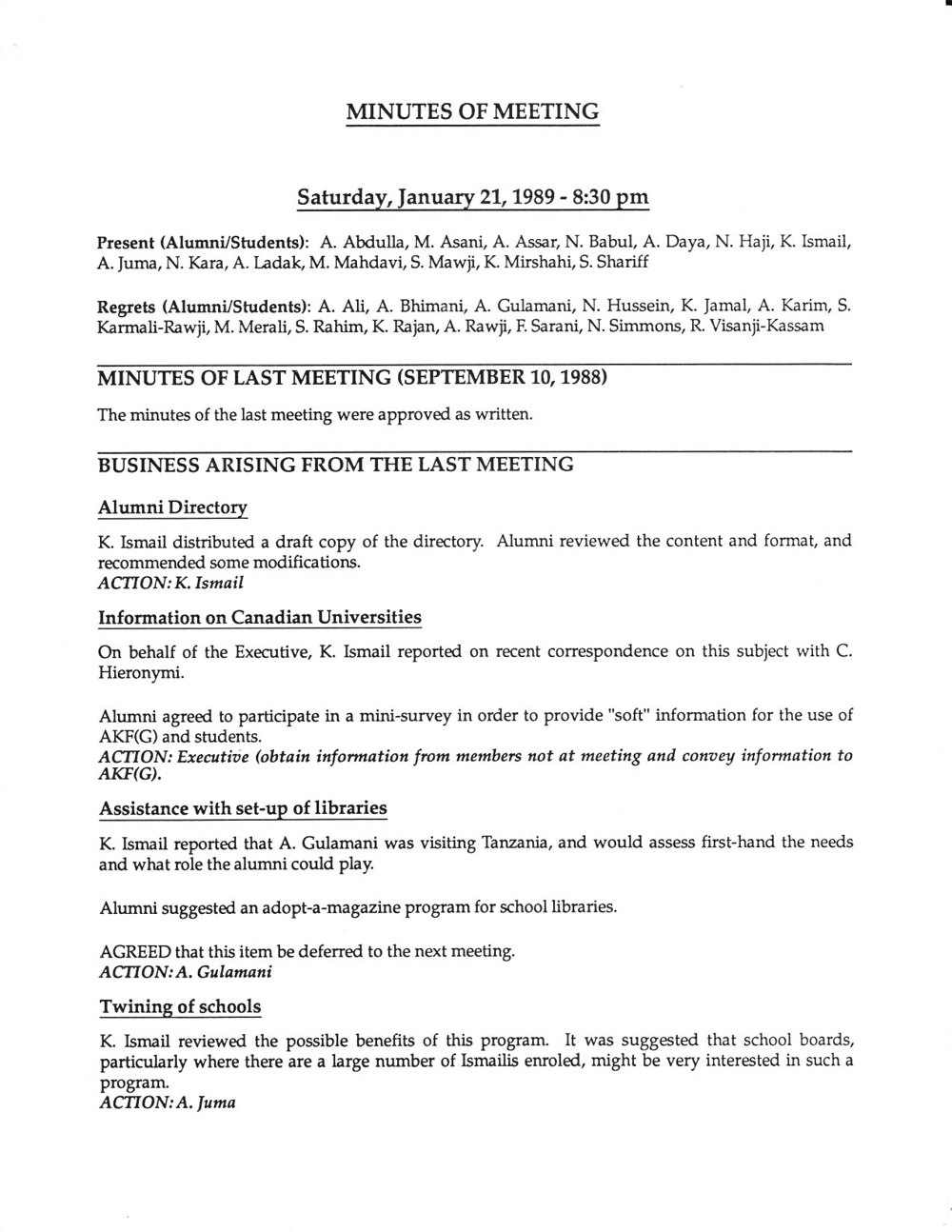
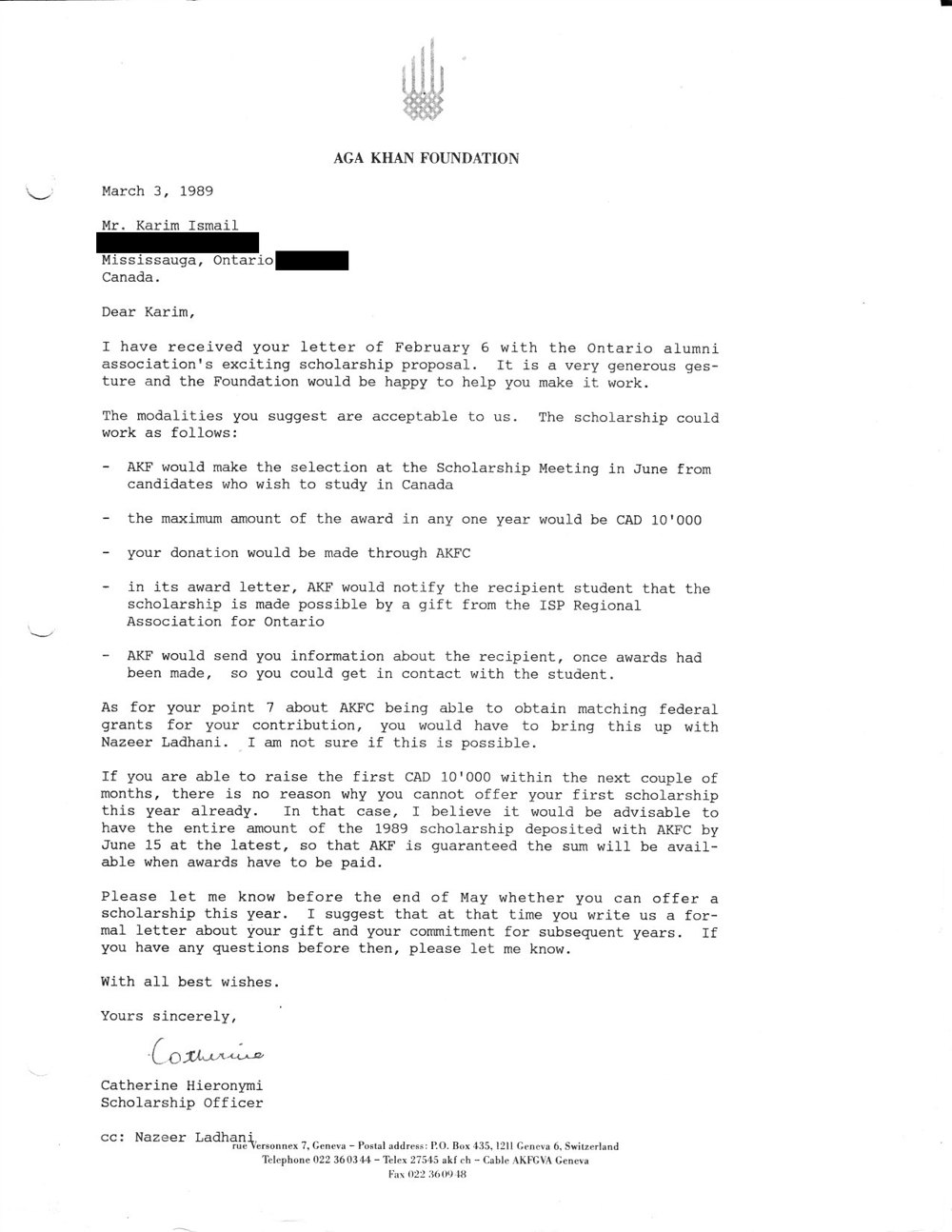
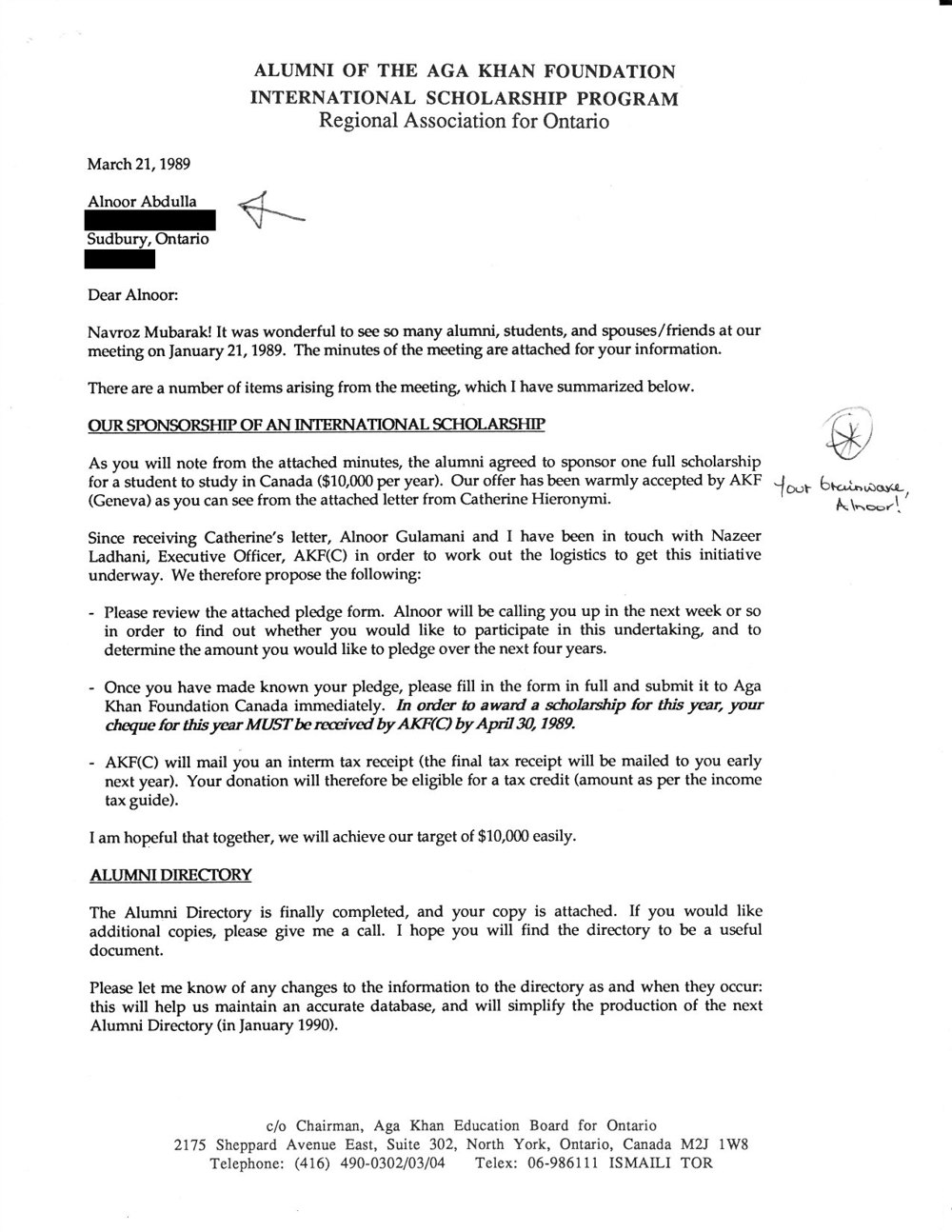
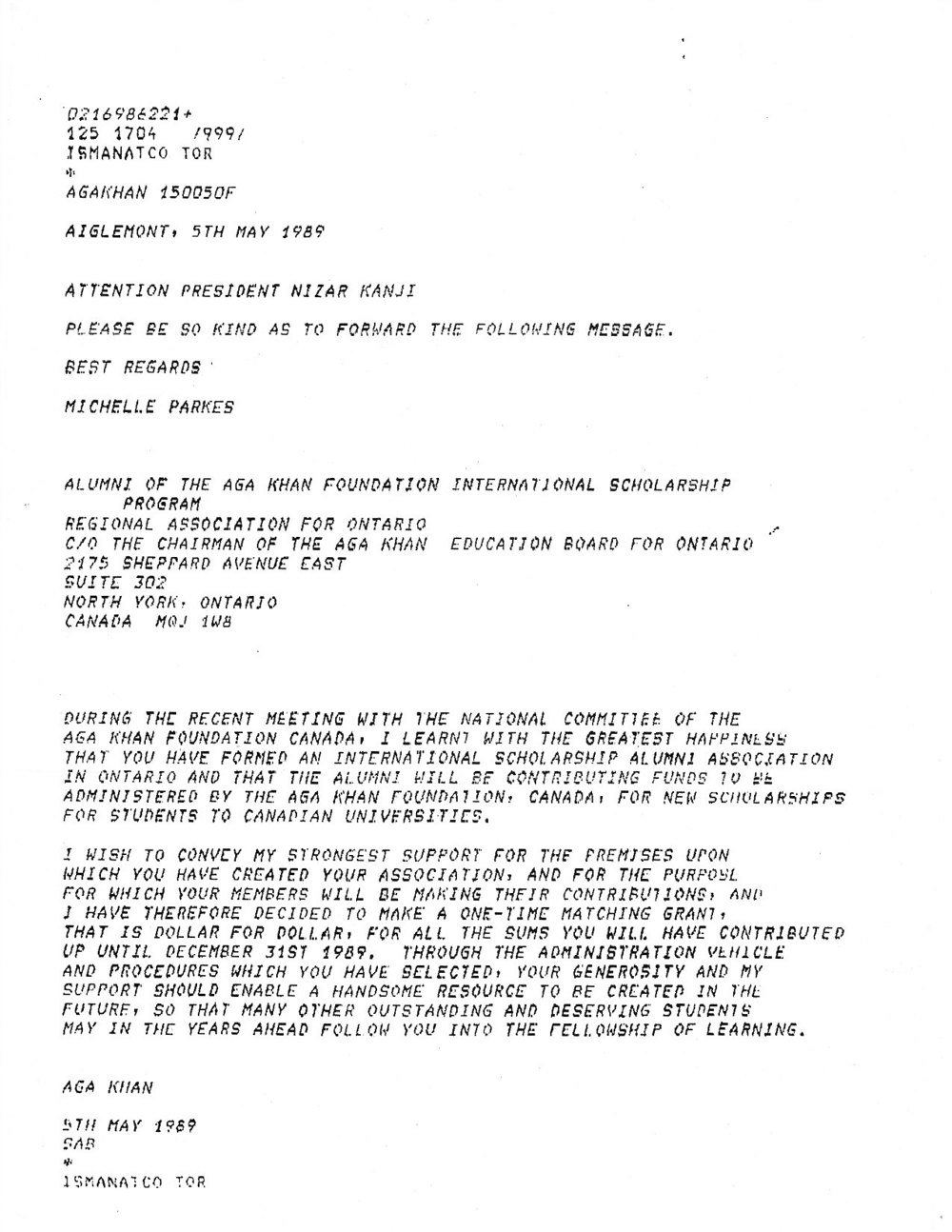
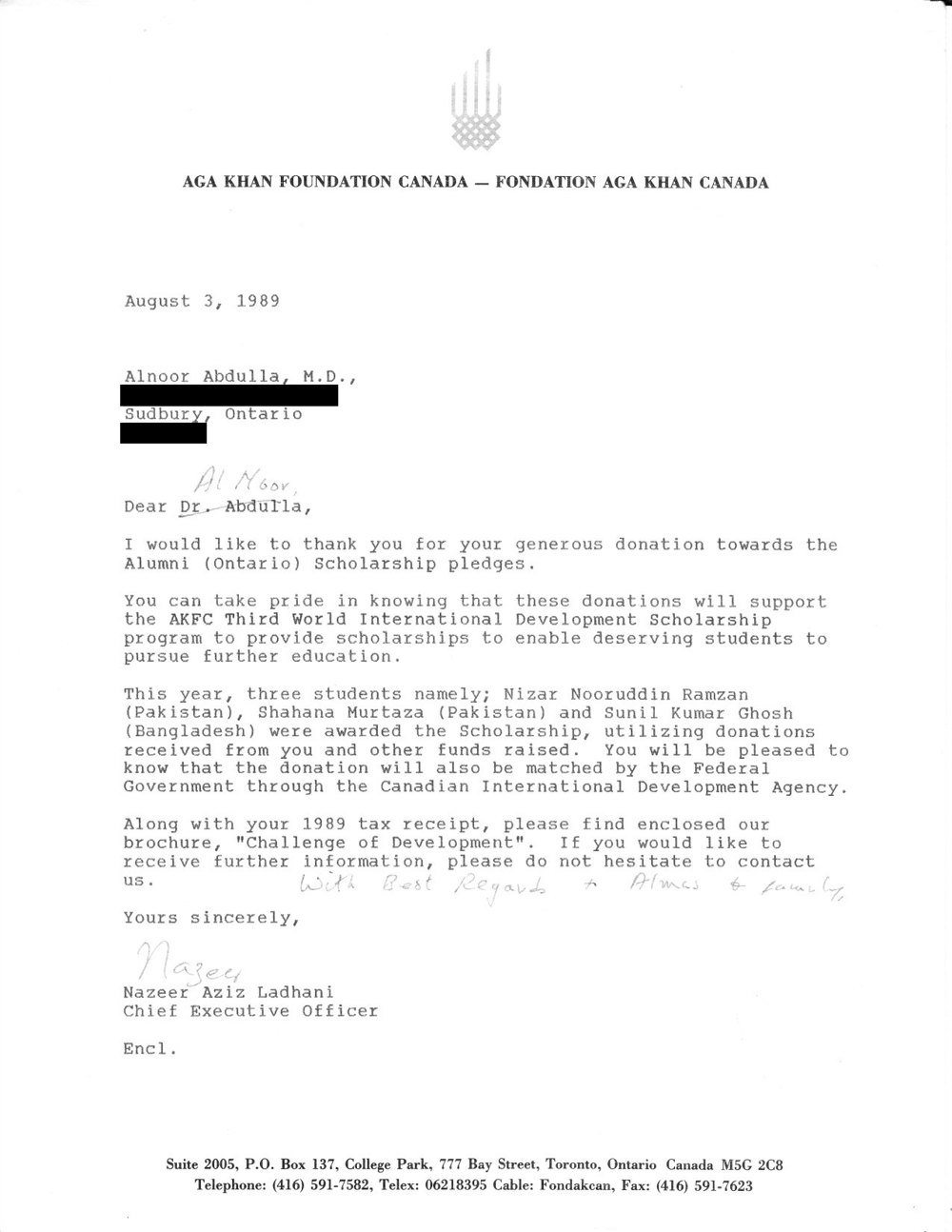
The idea did not die. Dr. Abdulla kept the informal alumni meetings going in the years after, and at one of them, on January 21, 1989, he put forward the recommendation — recorded in the group's own minutes — that the Ontario alumni association sponsor a scholarship of its own, up to $10,000 a year, for a student to study in Canada. Geneva accepted within weeks: Scholarship Officer Catherine Hieronymi wrote on March 3, 1989 confirming that AKF would select the recipient from that year's Canada-bound candidates and credit the award as a gift from the ISP alumni of Ontario — a letter to Dr. Abdulla enclosing the minutes carried a handwritten note beside the proposal calling it “your brainwave, Alnoor.” Then, on May 5, 1989, the Aga Khan himself replied by telex from Aiglemont, pledging to match every dollar the alumni raised before the end of that year, dollar for dollar. By August, Nazeer Ladhani, CEO of the Aga Khan Foundation Canada, wrote to thank Dr. Abdulla for his own donation toward the pledge and to report that the first three scholarships had gone to Nizar Nooruddin Ramzan and Shahana Murtaza of Pakistan and Sunil Kumar Ghosh of Bangladesh, with the Canadian government matching the gift again through CIDA.
1979–1985, By the Numbers
The Documents Behind the Story
Letters, memos and minutes from Dr. Abdulla’s own files follow the story from the scholarship application in 1979 to the Aga Khan’s pledge in 1989, in the order they were written. Private home addresses have been blacked out.
1979–1981 — The Scholarship
1985–1986 — Canadian ISP Coordinator
1989 — The Alumni Scholarship
A Personal Trust — Los Angeles, 1983
The Aga Khan's Silver Jubilee Visit — First-Responder Physician to the Imam
A request that came directly from Aiglemont, naming a cardiology fellow still in training.
In 1983, His Highness Prince Karim Aga Khan IV made his Silver Jubilee visit to Los Angeles, marking twenty-five years since he had assumed the Imamat. Dr. Abdulla was living in Los Angeles at the time, in the midst of his fellowship in nuclear cardiology at Cedars-Sinai Medical Center, part of UCLA. As he had in Vancouver five years earlier, he was asked to set up emergency health care for the congregation, and once again assembled a team of doctors, nurses, and spouses to provide medical coverage and support for the community throughout the visit.
About a week before the visit, Dr. Abdulla was summoned to the Aga Khan Council office to meet with the President of the Los Angeles Council, Kurji — who today lives back in Vancouver, BC — and several senior council members. He had no idea why he was being called in, and on the drive over found himself worried he had done something wrong.
Instead, the council asked him whether he could hand over the entire congregational emergency health system — the team, the setup, all of it — to another physician to run during the visit. Dr. Abdulla was taken aback, until they explained why: word had come from Aiglemont, outside Paris, where the Aga Khan's secretariat was based, that His Highness had personally requested Dr. Abdulla — by name, a cardiology fellow still in training at Cedars-Sinai — to serve as first-responder physician for himself, Begum Salima, and Prince Amyn throughout the visit, should any medical or traumatic emergency arise.
Dr. Abdulla left that meeting overwhelmed. On the drive home, he was panicked and unsure how he was even going to approach a responsibility of this scale — for the Imam of his faith, and the Imam's wife and brother, with no fixed setting, no hospital ward, nothing but himself and whatever he could put in place in a week.
He worked through it step by step. First, preparing himself: thinking through every category of medical or traumatic emergency that could plausibly arise, and assembling the instruments and medications he might need to have on hand at any moment. Then the personal logistics: a hotel room at the Beverly Wilshire, next door to where the Aga Khan's party was staying, so he could be within reach around the clock; his wife, Almas, at his side as his partner throughout; and a bag packed and ready at all times.
Then came the external logistics: an ambulance on standby wherever he was, and a full list of the medical specialists who might be needed for any conceivable emergency involving the Aga Khan, Begum Salima, or Prince Amyn.
There was also the travel itself to plan for. The Aga Khan was staying at the Beverly Wilshire, while the congregation gathered at a large arena-style venue in South Los Angeles — meaning the entourage would be moving through Los Angeles traffic and freeways, under police escort, for each leg of the visit. Dr. Abdulla asked for, and was granted, permission to have his own car driven by someone else, arranged through the visit committee, so that he could ride in it himself positioned immediately behind the Aga Khan's vehicle in the police motorcade — close enough to respond instantly if anything happened on the road.
Behind it all was one more question: if a hospital admission was ever needed, where would they go? The answer was Cedars-Sinai, where Dr. Abdulla was training — a hospital already built for exactly this kind of care, with a VIP floor reserved for visiting heads of state and dignitaries, and specialists in nearly every field on staff. He went first to the late Dr. Jeremy Swan, the world-renowned cardiologist and head of cardiology at Cedars-Sinai, who knew him well from his fellowship. Dr. Swan gave his full support and personally called the hospital's CEO on Dr. Abdulla's behalf. The CEO, in turn, approved reserving the VIP inpatient facility for the Aga Khan, Begum Salima, or Prince Amyn should it be needed, and gave Dr. Abdulla his blessing to approach whichever specialists he required.
One by one, using Dr. Swan's name, Dr. Abdulla went to each specialist he had identified and asked them to be on twenty-four-hour standby for the two days of the visit. Not one of them said no. And in the end, neither Cedars-Sinai nor any of the specialists charged a single cent for any of it — their own tribute, Dr. Abdulla believes, both to the standing he had earned at the institution during his training and to their respect for the Aga Khan himself.
For the full two days of the visit, Dr. Abdulla stayed within reach of the Aga Khan, Begum Salima, and Prince Amyn around the clock. By grace, he was never tested — no emergency arose, and not one specialist ever had to be called in. The entire structure he had built stood ready and, in the end, unused.
After the visit, Dr. Abdulla was presented with the Aga Khan Silver Jubilee Service Medal — recognition for his work building emergency health services for the Los Angeles congregation, for the earlier Sick Bay work in Vancouver in 1978, and for his personal role as first-responder physician to the Aga Khan's family throughout the visit. As far as Dr. Abdulla is aware, it has never happened before that an Ismaili community member was personally named by the Aga Khan to serve as his own first-responder physician — remarkable given that His Highness has his own health department and connections to leading hospitals and specialists worldwide. He believes it was, simply, a mark of trust in the service he had given his community.
Los Angeles, 1983 · By the Numbers
A First for Ismaili Youth in USA — 1983
Founding sponsor, the Al-Ummah Program's first national summer camp
The same year he served as the Aga Khan's personal physician in Los Angeles, Dr. Abdulla helped fund a very different kind of first.
On August 22, 1983, the Aga Khan Shia Imami Ismailia Council for U.S.A. wrote to Dr. Abdulla — then living in Lancaster, California — thanking him, on behalf of the Al-Ummah Program Committee and its sponsors, for financially supporting “the first Summer Camp of its kind for Ismaili Youth.” Forty-one campers and eight counsellors, drawn from across the United States, took part in that inaugural camp. The letter was signed by Salim A. L. Bhatia, Member for Education, and Amirali G. Mamdani, President of the Ismailia Association for USA.
It happened to be the same year Dr. Abdulla served as the Aga Khan's personal physician during the Silver Jubilee visit to Los Angeles — one first in his medical career unfolding alongside a very different one, as a founding financial sponsor of what has grown since into a long-running institution for Ismaili youth in America.
It was that same auspicious year that Dr. Abdulla was invited to AKU for his first interview on the university faculty — see A Twenty-Five-Year Partnership: Aga Khan University & the AKDN.
The Al-Ummah Camp, By the Numbers
One of the “Firsts” — AKF Canada's 1989 Volunteer Awareness Trip
India & Pakistan, October–November 1989 — a report from the field that helped shape how AKF Canada would raise funds and share skills
The first Volunteer Awareness Trip AKF Canada ever organized — and a report Dr. Abdulla faxed from Sudbury between patients that the Aga Khan himself is said to have read in full.
On September 8, 1989, Taj-ud-Deen Kurji, Chairman of the National Committee of Aga Khan Foundation Canada, wrote to Dr. Abdulla in Sudbury inviting him to join AKFC's first-ever Volunteer Awareness Trip — a visit to Aga Khan Foundation social development projects in India and Pakistan running from October 22 to November 6, 1989, with an optional extension to attend the AKU Convocation in Karachi. As Kurji's letter explained it, the purpose was to give Dr. Abdulla, “as a key member of the Jamat, an increased understanding and appreciation of Imamat” Third World development activities, allowing him “to see, on a first hand basis, the beneficial impact of these for the Jamat and the various other communities.”
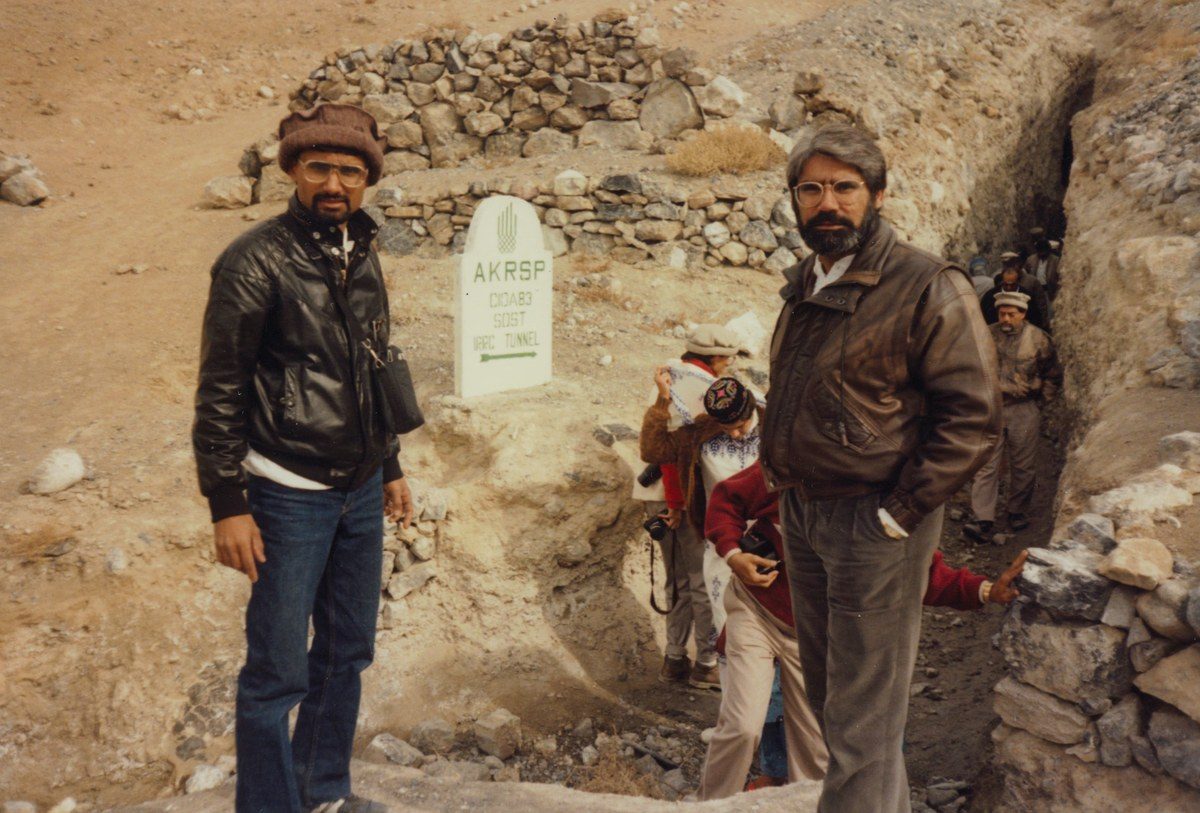
Twenty-one AKFC Partnership Volunteers took part. Over two weeks the group visited health, education, and rural-development projects in Karachi and Gujarat, India, and spent three days in the Gilgit/Hunza area of northern Pakistan with the team from AKRSP, the Aga Khan Rural Support Programme — among the sites, the irrigation-channel and tunnel projects pictured below, cut through the mountainside to bring water to villages that had none. Knowing the trip would take them through tribal areas of northern Pakistan, where every man wore a beard, Dr. Abdulla grew his own beforehand — a small gesture meant to put people at ease and build rapport on sight, before a word was even exchanged.
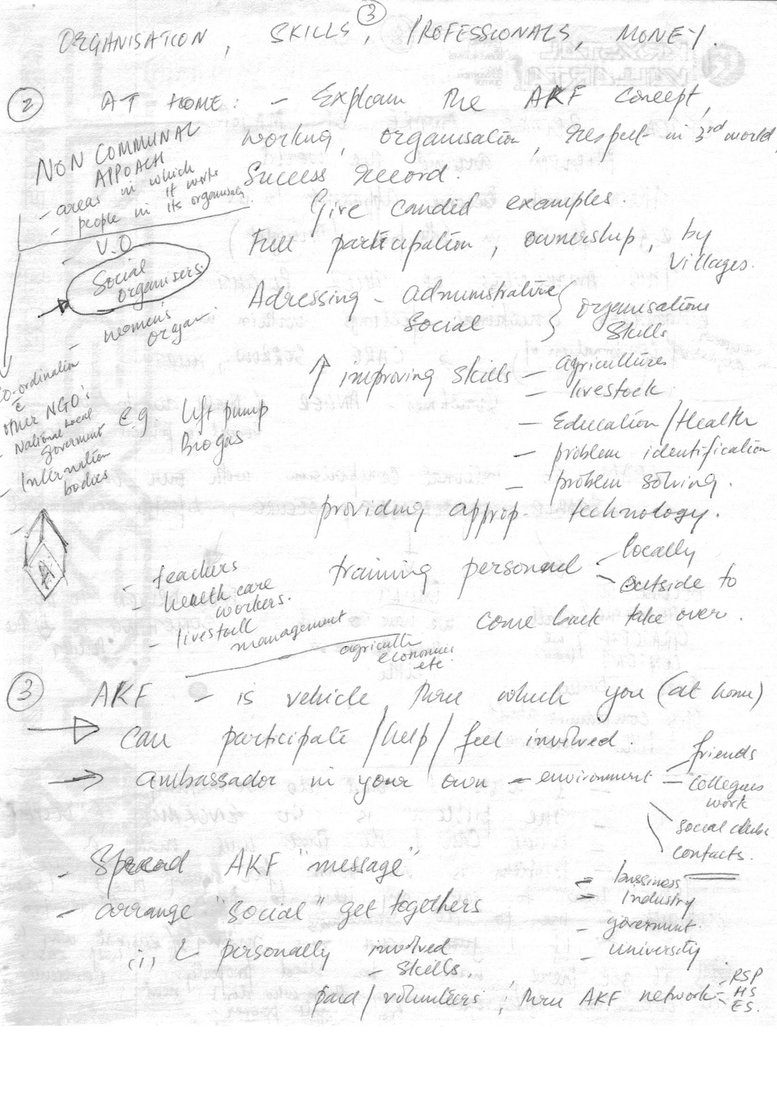
Back home in Sudbury, Dr. Abdulla wrote up his observations and recommendations by hand, between patients and procedures, then faxed the finished pages to Kurji at the last minute, on Kurji's way to meet the Aga Khan — which is the only reason, he says, that he still has his own original handwritten draft. He mailed a formal covering letter and typed report the following March. According to Kurji, the Aga Khan read the report in full, making notes in the margins as he went along. The Aga Khan sent a personal letter to Dr. Abdulla expressing His gratitude and His Blessings, through the AKF chairman, Kurji.
The written report made recommendations on a wide range of subjects — future Awareness Trips, AKF Canada's own structure, AKRSP's work in the field, fundraising, and communication with donors and volunteers — but three in particular have proven especially noteworthy over time. On its eighth page, recommendation 2 proposed arranging “apprenticeship type training” so that people from the developing world could gain skills — as lab technicians, pharmacy assistants, bookkeepers, child care workers — either by coming to the West or by moving from rural areas to urban centres within their own countries. “This concept evolved into the International data bank and the ‘Time and Knowledge’ program,” Dr. Abdulla notes. The same page's recommendation 3 argued that Foundation fundraising should broaden beyond the Ismaili community itself: “effort should be made to improve the network of fund raising within the Canadian community at large rather than concentrating within our own community (Jamat) … these activities of Aga Khan Foundation, which are international and totally noncommunal, should involve the Canadian public at large when it comes to fund raising.” Dr. Abdulla considers that recommendation an early seed of shifting the fund raising sources to what, in time, grew into government-matched funding models — beginning with the Canadian International Development Agency's dollar-for-dollar matching program with AKF — and eventually funding support from other governments and organizations, channelled through AKF and, later, the wider Aga Khan Development Network.
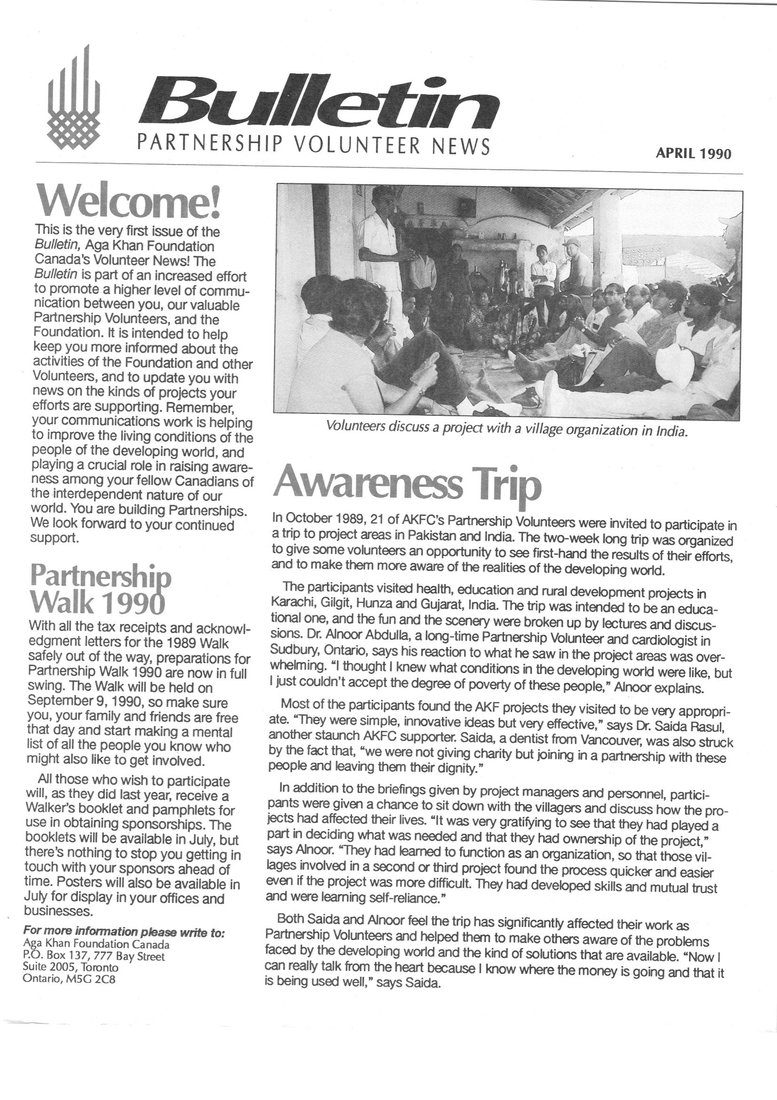
The third, on page 12 under the heading “Recommendation,” proposed that there was “very acute need for some form of a matching service” — some way of getting information about specific project needs, country by country, to donors and volunteers in the West so they could see for themselves where their help was needed, “initially… in the form of a simple newsletter.” Five months later, in April 1990, AKF Canada published the very first issue of its Bulletin: Partnership Volunteer News — leading with a front-page story on the Awareness Trip itself, quoting Dr. Abdulla by name: “I thought I knew what conditions in the developing world were like, but I just couldn't accept the degree of poverty of these people.” On what he had seen villagers themselves accomplish: “It was very gratifying to see that they had played a part in deciding what was needed and that they had ownership of the project … They had developed skills and mutual trust and were learning self-reliance.”
Dr. Abdulla counts this among a series of “firsts” across his Aga Khan community career — alongside founding and chairing Vancouver's Ismailia Youth Organization before the Aga Khan Regional Council for B.C. itself existed, and founding Forum, Canada's first Ismaili community magazine, in 1973, the Sick Bay in Vancouver in 1978, his role as the Aga Khan's personal physician in Los Angeles in 1983, and developing the first tertiary-care Cardiology Program at AKU, where he was the university's first Professor of Cardiology. This Volunteer Awareness Trip AKF Canada organized was also a first, and, by his account, his written recommendations from it were among the first field ideas that outlived the trip that produced them.
The 1989 Trip, By the Numbers
Another “First” — Co-Coordinating the 1992 Youth Awareness Trip to East Africa.
Britain, Egypt & Kenya, May–June 1992 — a month-long tour built to connect young Canadian Ismailis with their own community's roots and with each other
A trip Dr. Abdulla didn't just take part in but helped build from a single Firman he never heard in person.
The trip traces back to 1991. Aziz Haji happened to be visiting with his family in Dar es Salaam, Tanzania — his own hometown — when the Aga Khan made an unscheduled stop there. He had been expected in Nairobi, where most of the Jamat had gathered for his Deedar, leaving only a small congregation in Dar es Salaam to receive him instead, Aziz and his family among them.
In his Firman that day, the Aga Khan addressed head-on why he sends his own children to see the Developing World without having them meet the local Jamat: “My spiritual children may sometimes wonder why does the Imam take decisions such as sending His children all over the Developing World but hiding them from the Jamat. What I did was I treated them like any other student. I told them, ‘Go and see, go and learn, try to understand, try to perceive the needs, the problems, the requirements.’ … I would not have said, ‘Go and look.’ I would have said, ‘Go and learn.’ And the purpose of their visit to East Africa, to Pakistan, was to go and to learn … There is plenty of time, Inshallah, for them to meet the Jamat on future visits … I mention this because I am likely to do the same thing with My third child.” — His Highness Prince Karim Aga Khan IV, Firman, Dar es Salaam, Tanzania, 11 July 1991.
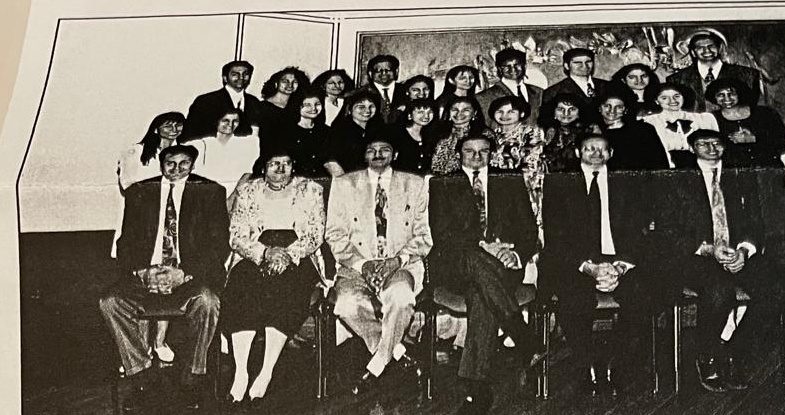
Aziz took it, in that moment, as an invitation of its own — reasoning that the Jamat's own children in the West should have the same chance to go and learn. He brought that charge home. In 1992 he set out to organize a youth trip to East Africa, enlisting his nephew, Alkarim Haji, to galvanize interest among the youth themselves. Announcements went out in Jamatkhanas across Canada, and the excitement was such that far more young Canadian Ismailis, mostly recent university graduates, applied than the eighteen spots originally planned. The group was expanded to the maximum the trip's logistics — bus travel among them — could accommodate: twenty-one youth, plus Aziz and Dr. Abdulla as co-coordinators. Mahmood Poonja, who ran his own travel agency, arranged the trip's travel throughout. Dr. Abdulla worked on preparations from a distance rather than travel with the group from the start: 1992 was, by his own billing and procedure records, the busiest year of his career, his Sudbury cardiology practice at that time among the highest-volume in the country by patients seen and procedures performed. The only stretch he could get away for was the middle of the trip — flying out to join the group in Cairo, and flying directly back to Sudbury and his practice at the end of the East Africa leg, rather than completing the full return with the others. Firoz Rasul — then President of the BC Ismaili Council, and later President of the Ismailia Council for Canada and of the Aga Khan University — gave the trip its formal blessing to proceed.
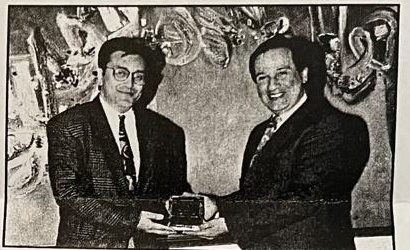
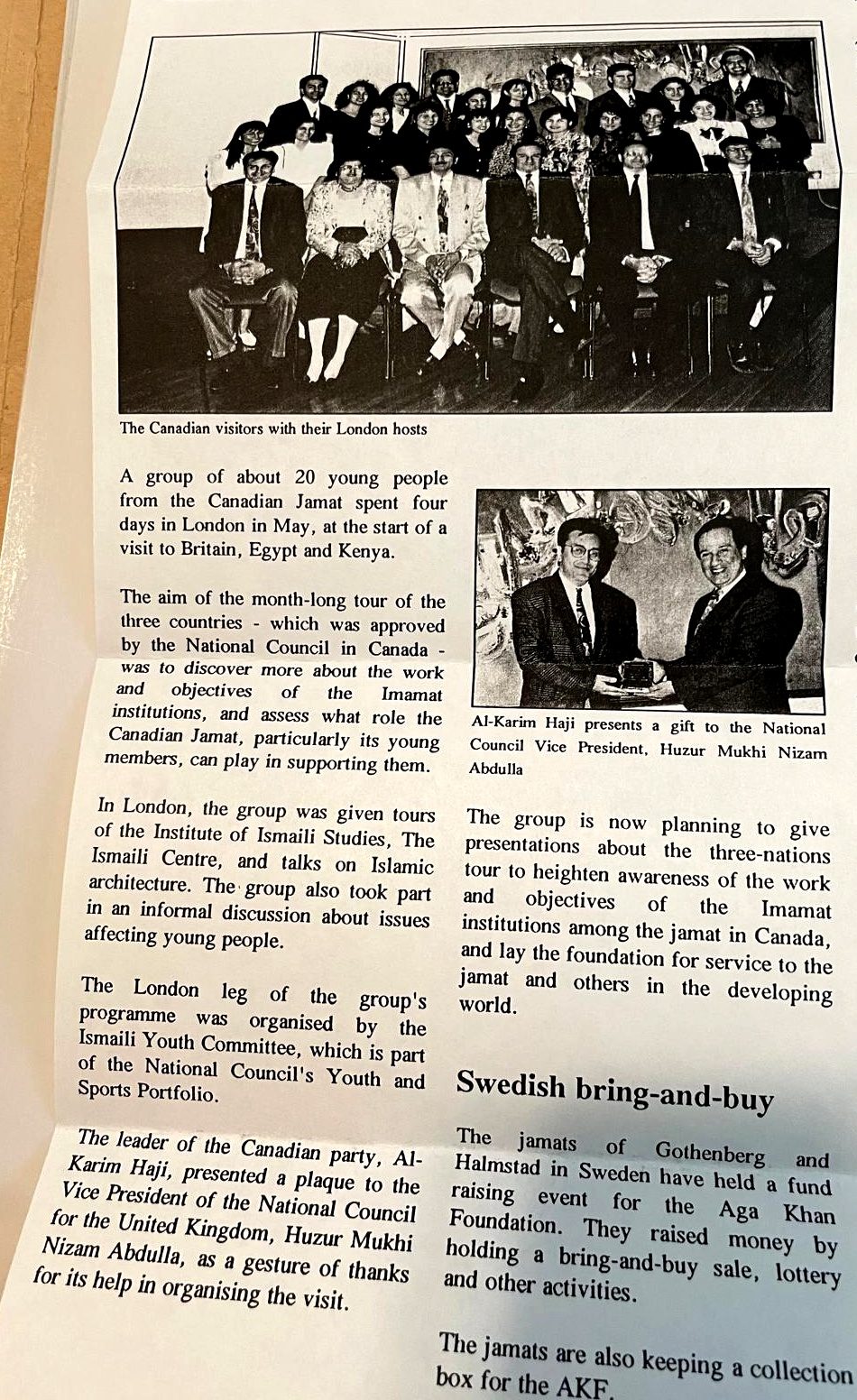
The tour opened in Britain. A contemporary Ismaili community newsletter from the United Kingdom — since kept among Aziz Haji's papers — records that a group of about twenty young people from the Canadian Jamat spent four days in London that May (a count that matches the twenty-one who ultimately took part), “at the start of a visit to Britain, Egypt and Kenya,” a month-long tour approved by the National Council in Canada to let the group “discover more about the work and objectives of the Imamat institutions, and assess what role the Canadian Jamat, particularly its young members, can play in supporting them.” In London, the group toured the Institute of Ismaili Studies and the Ismaili Centre — the first Ismaili Centre built anywhere in the world — heard talks on Islamic architecture, and took part in an informal discussion about issues affecting young people. The London leg was organized by the Ismaili Youth Committee, part of the National Council for the UK's Youth and Sports Portfolio, and Alkarim Haji, on behalf of the Canadian youths, presented a plaque to Huzur Mukhi Nizam Abdulla, Vice President of the National Council for the United Kingdom — a different Abdulla from Dr. Abdulla himself — thanking him for his help in organizing the visit.
From London the group flew to Cairo, where Dr. Abdulla joined them from Ontario. Cairo had been founded by the Ismaili Imams of the Fatimid era, and the group took in the mosques from that period alongside Al-Azhar University and, for the tourist side of the visit, the pyramids. In Aswan they visited the mausoleum of Aga Khan III, Sultan Mohammed Shah. There, the youth were overcome, chanting and in tears at the tomb of an Imam that none of them had ever seen or known. From Egypt the group flew into East Africa: Dar es Salaam, Tanzania first, then Zanzibar, home to what Dr. Abdulla believes is the oldest official Jamatkhana in Africa, then Nairobi, Kenya — at that time home to the largest concentration of Aga Khan Network institutions of any country, and the site of the trip's best youth-to-youth gathering, where Dr. Abdulla, at the Mukhi's request, gave an impromptu talk on heart health to the whole Jamat. From there the group went on to Kisumu, then a leading centre of the Ismailia Association (today's ITREB), to the Masai Mara game park, and finally to Mombasa, where a visit to a local Madrasa left a lasting impression — the group came away convinced these religious schools needed a secular curriculum alongside their religious teaching, an idea Dr. Abdulla says has since taken hold across a number of them.
At every stop, the pattern held: local Jamati and secular leadership turned out to welcome the group, and Dr. Abdulla — whose particular responsibility on the trip was the youth-to-youth programming — helped arrange the format for each city's gathering between the Canadian and East African youth. The trip was entirely self-financed, each participant paying into a shared pool; the hospitality shown everywhere they went left much of that pool unspent, and rather than refund the surplus, the group donated it to the Aga Khan Foundation Partnership Walk, held just days after they returned. Dr. Abdulla counts the trip among his career's series of “firsts” — this one built and coordinated by him, rather than simply attended — and notes that many of the youth on that trip went on to become leaders themselves, in their professions and across the community.
The 1992 Trip, By the Numbers
A Twenty-Five-Year Partnership
Aga Khan University & the AKDN
The AKU Cardiac Program wasn't a sudden recruitment in 1994 — it was the culmination of a relationship with the Aga Khan network that had already spanned more than a decade.
Dr. Abdulla's ties to the network began even before AKU itself, through the Aga Khan Foundation International Scholarship Programme that funded his nuclear cardiology fellowship at Cedars-Sinai/UCLA, and the years he then spent as the Programme's Canadian alumni coordinator — see His First Official Tie to the AKDN, 1979–1985 for the full story.
First contact about AKU itself came in 1981, through President Lutaf Bhatia of the Aga Khan Eastern U.S. Council. By December 1983 — by then running his first Nuclear Cardiology program in Lancaster, California — he was invited to Karachi to interview with Dean Cheves Smythe, Dr. Camer Vellani, and President S.K. Lakha. They mutually agreed the timing wasn't yet right: the medical school was still in its basic-science years, and the hospital was only beginning clinical services.
Over the following decade, while building his career in Sudbury, he continued to support AKDN institutions — including the Aga Khan Foundation, the Aga Khan Rural Support Programme, and Jamati institutions such as the Institute of Ismaili Studies and Jamatkhana building projects — with an endowment gift to AKU in 1988. In 1990, with AKU's Policy Board having approved development of an invasive cardiology and cardiac surgery program, Dean Cheves Smythe flew to Sudbury himself — the first of three AKU leaders who would eventually make that same trip in person — and stayed with him to go over the program in detail; talks grew serious enough that Smythe later wrote, “We would like to find a way to do business with you.” The program was then put on hold in the aftermath of the Gulf War — a pause Dr. Abdulla has come to see as fortuitous, given how much stronger the eventual 1994 program was for the delay.
The path resumed in March 1993, when President Shamsh Kassim-Lakha himself flew to Canada and spent three or four days as a guest in Dr. Abdulla's home in Sudbury, making the case in person for him to take up the position as Head of Cardiology. AKU's Dean at the time, John Dirks, made the same trip and stayed with him as well — in a coincidence neither man had planned for, Dirks had been Dr. Abdulla's Chief of Medicine during his residency at UBC years earlier, with Dr. Abdulla training under him as one of his residents. Between Smythe's 1990 visit and these two, three of AKU's most senior leaders had each personally travelled all the way to a small city in northern Ontario to persuade him to come. Dr. Abdulla spent the months that followed working two fronts at once: on-site at AKU bringing the clinical plan up to 1994 standards — formalized in a comprehensive blueprint he sent Acting Dean Camer Vellani that November and December — and in Sudbury building a formal institutional linkage between AKU and the Northeastern Ontario Cardiovascular Program, work that led the City of Sudbury and Karachi to be formally designated Twin Cities. Contract talks that summer were handled with rare grace by AKUH's CEO, Lee Hilling, and Dean Dirks — except once, when Hilling, having already told AKU's Board of Trustees the appointment was settled before the contract was actually signed, wrote to him half in jest: “Please confirm that your signed agreement is on its way to AKUH. If that is not the case, let me know right away and I will (a) resign from AKUH and (b) jump off the cliff.” He signed his AKU contract on 1 August 1994.
The four years that followed built the program's lasting foundations: its cardiology fellowship became AKU's first accredited subspecialty fellowship; he set up a prospective, ACC-standard clinical database — tracking every patient who entered the Cardiac Catheterization Lab — that has now run continuously for more than 25 years; and the program recorded only a single cath-lab fatality across his four years there. He was promoted from Associate to full Professor of Medicine during his tenure. By 1997–98 his focus had turned to a five-year vision for a dedicated AKU Cardiac Centre, a fully integrated academic heart centre he hoped would become a premier centre of excellence across South Asia; that particular goal didn't materialize on the timeline he had hoped for, and he chose not to renew his AKU appointment in 1998. The same integrated model he had championed was realized years later, both at AKU and, subsequently, in East Africa.
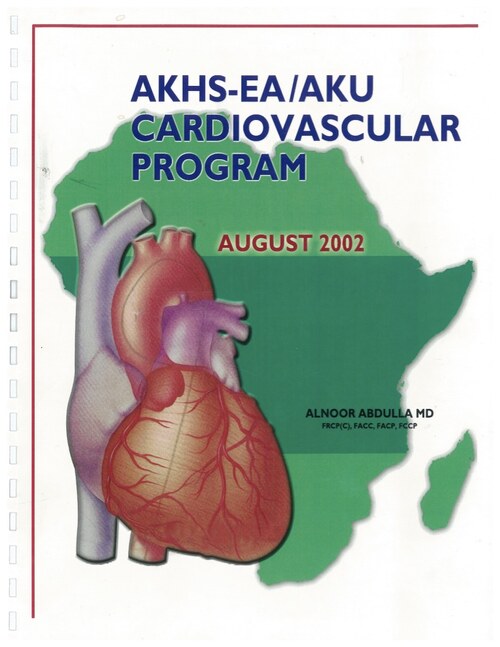
Even while still at AKU, he had begun extending that work to East Africa — developing the AKU/AKHS cardiac linkage there from 1997, and later authoring the full Strategic Plan for a Tertiary Cardiac Centre in Kenya, presented in 2002 to AKHS-EA, AKU, and AKDN's Aiglemont secretariat. When His Highness personally opened the AKU/AKHS-EA Cardiac and Oncology Centre in Nairobi in 2007, it followed the same integrated, space-consolidated model Dr. Abdulla had proposed years before.
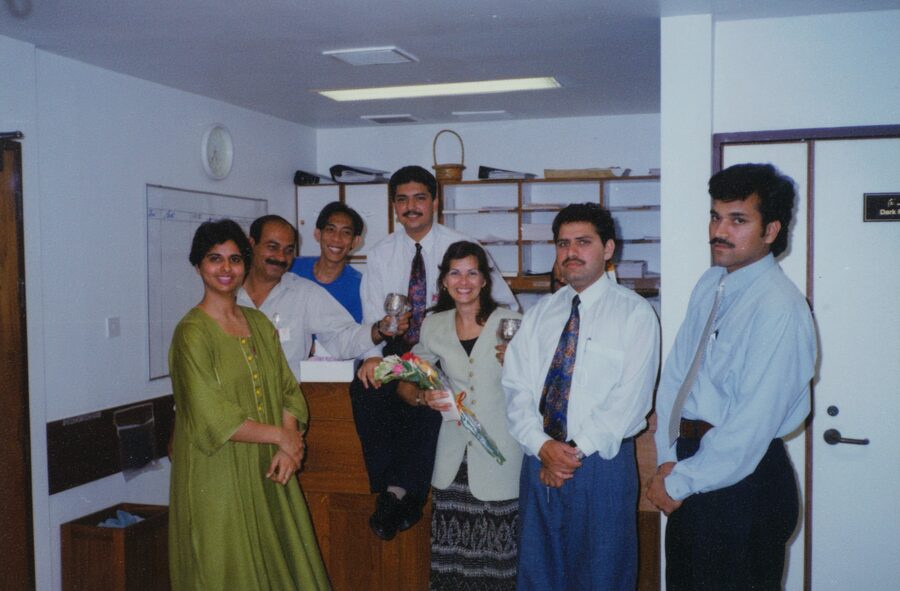
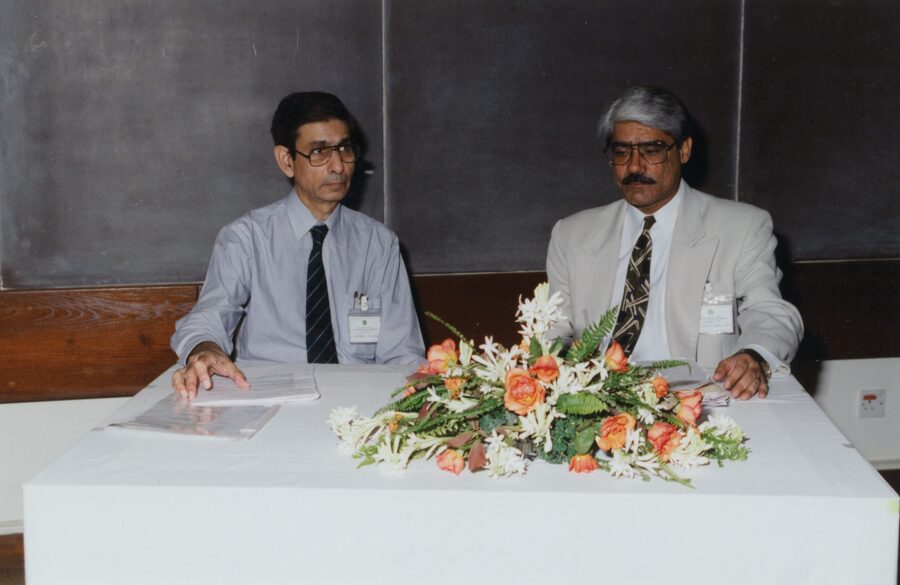
That legacy came full circle in 2014, when Dr. Abdulla — AKU's first Head of Cardiology (1994–98) — met Dr. Zainab Samad, then the current Head of Cardiology at AKU, at an AKU alumni event in Vancouver: a symbol of how the leadership he built has passed forward, from one generation of cardiology leaders to the next. There's a fuller story behind that meeting: Dr. Samad's father, Professor A. Samad, was a cardiologist at Karachi's National Cardiovascular Institute, and was by then its Director when he sat beside Dr. Abdulla at the 1998 INTER-HEART press conference at AKU (see the photograph) — the same institution, under Dr. Azhar Faruqui, that Dr. Abdulla found himself in friendly rivalry with while building the AKU program in the 1990s, a dynamic that helped push AKU's cardiac care to a standard other centres went on to model themselves after. Decades later, the daughter of a cardiologist from that rival institution would go on to lead the very program he built.
A Quarter-Century Timeline
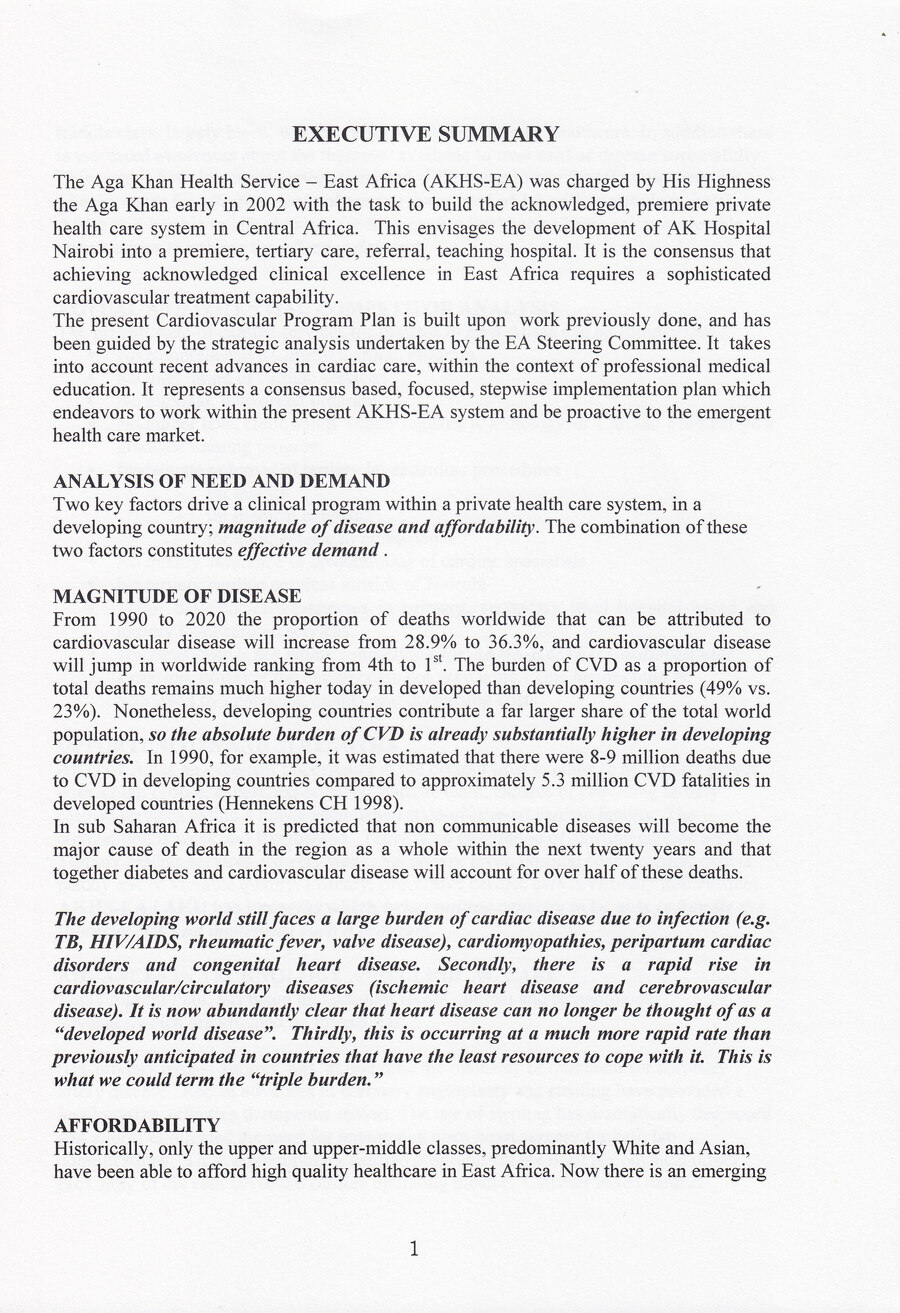
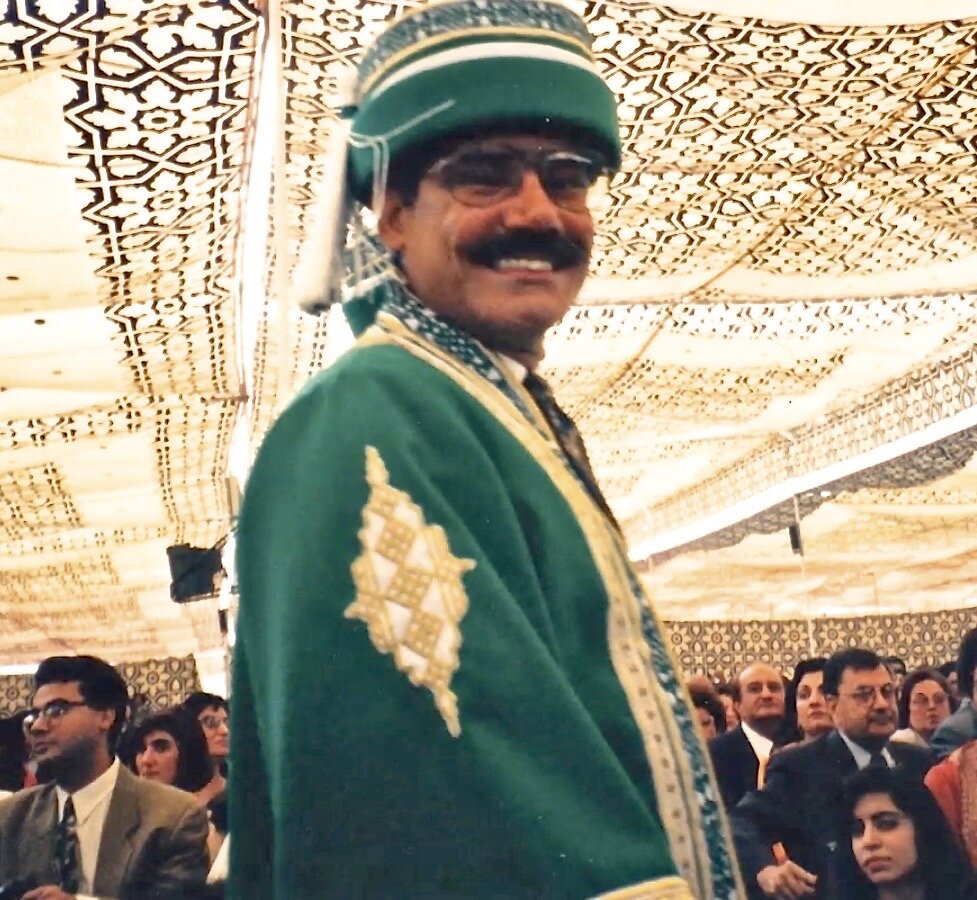
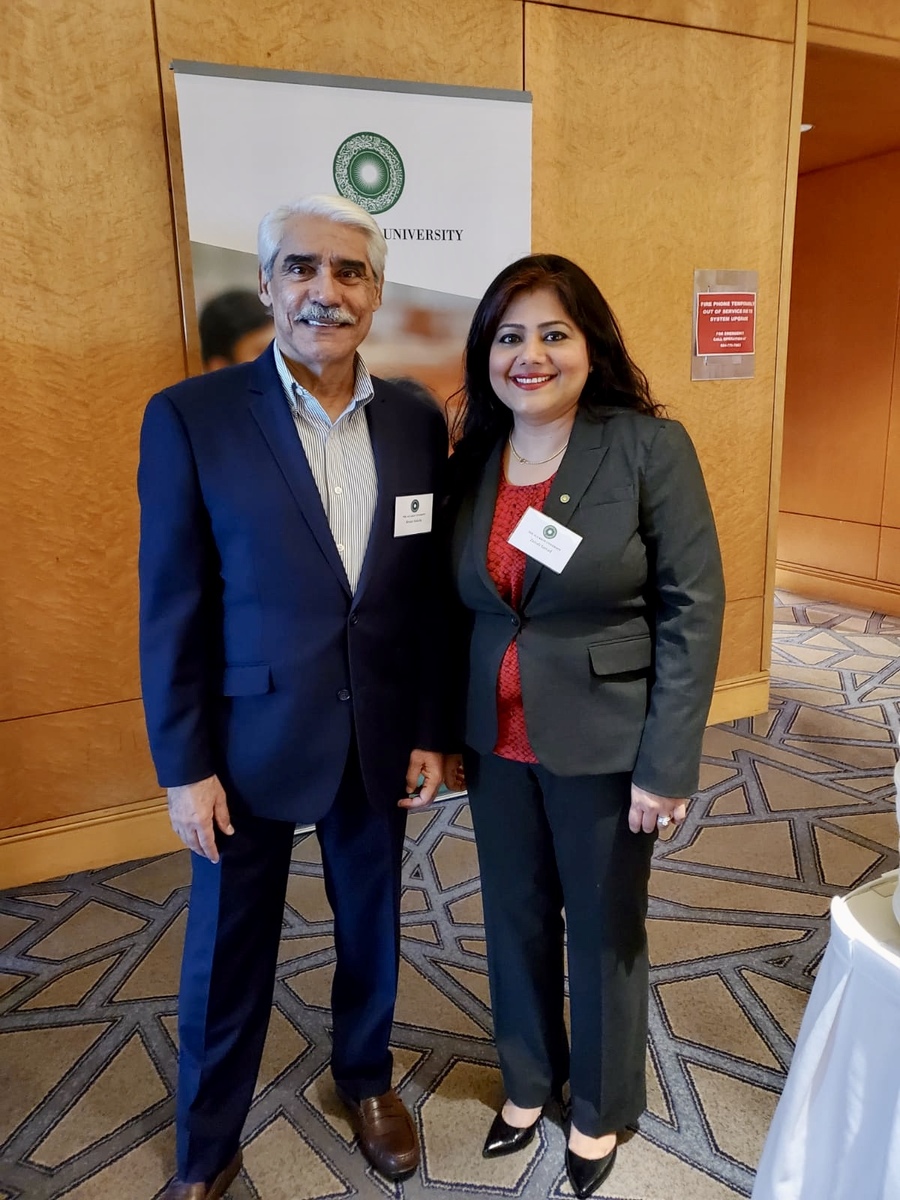
The same reasoning, years later. The case Dr. Abdulla made on opening day in 1994, and again in the Executive Summary above, is that heart disease is no longer a disease of the developed world and has to be met early. It is the case His Highness the Aga Khan put to the Jamat in his Farman of 25 September 2013, speaking of the new, insidious kinds of sickness, heart conditions among them: “The earlier we know that there is a problem, the earlier is the opportunity to correct that problem.”
Three Named Gifts to AKU
Beyond building and leading the Cardiology Program itself, Dr. Abdulla and Almas, then his wife, made three major philanthropic gifts to the Aga Khan University over the years — each now recognized with his name, and in one case his children's names, inscribed on the institution's walls.
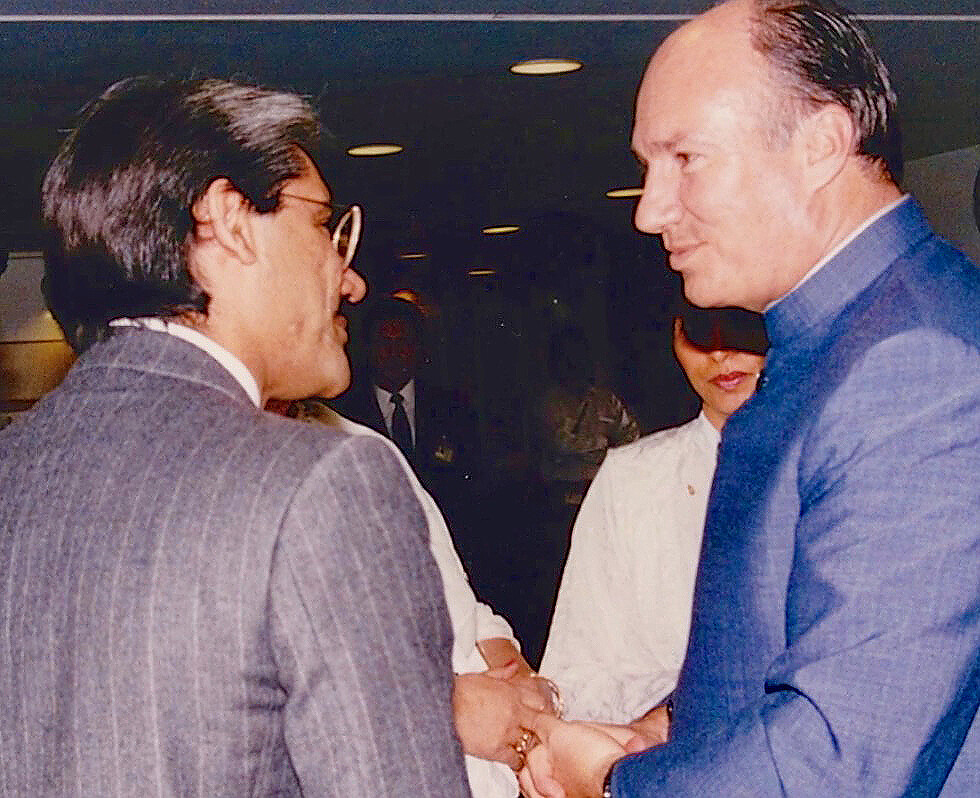
The Endowment Fund (1988). His first major gift to AKU, made years before he would return to the University himself as Head of Cardiology. His Highness the Aga Khan personally met with the Endowment Fund's key donors to thank them individually — the photographs below capture that moment. In his conversation with Dr. Abdulla he spoke about the future directions of AKU and about Dr. Abdulla's own career, with, Dr. Abdulla believes, an unspoken thought that he might one day join the University's faculty. Six years later, at the opening of the Cardiac Program, His Highness told him, “Alnoor, we have been waiting for you for a long time.” The connection had begun with the 1979 scholarship. The gift is recognized with his name inscribed on the front wall of AKU's main administration building.
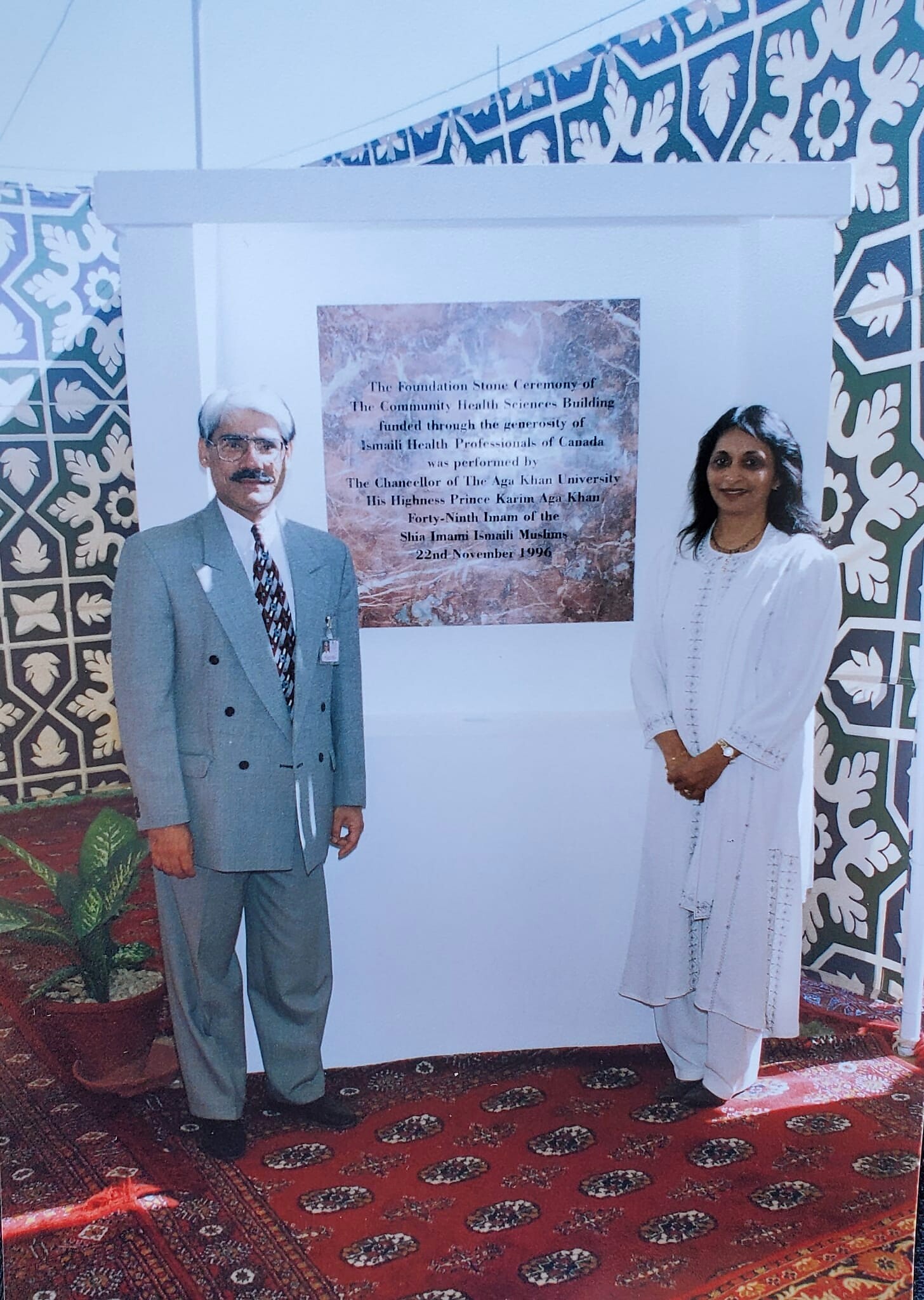
The Community Health Sciences Building (1996). Dr. Abdulla and Almas joined a group of fellow Canadian healthcare professionals — the Ismaili Health Professionals of Canada — in funding the building's construction. His Highness, as Chancellor of the University, performed its Foundation Stone Ceremony on 22 November 1996; Dr. Abdulla and Almas stood for a photograph beside the new foundation stone that day. Their names are inscribed, with their fellow donors', on the building's main wall.
The AKU Sports Complex. His third major gift to AKU was made in the names of his three children — Arifa, Asif, and Alym — and is likewise recognized on the Sports Complex's main wall. (Photographs of the building and its donor wall to follow.)
Three Gifts, Three Decades
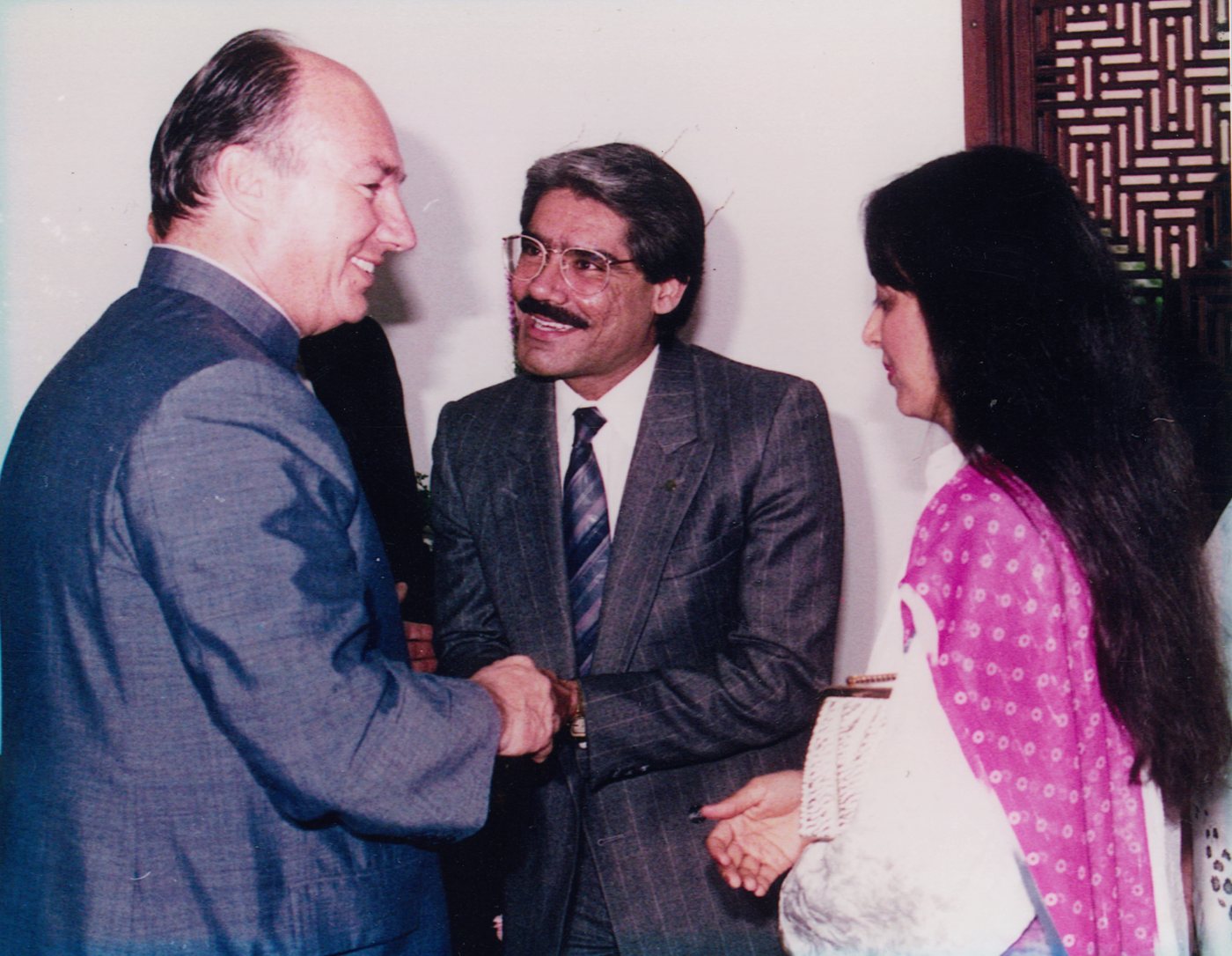
Letters of Blessing from His Highness
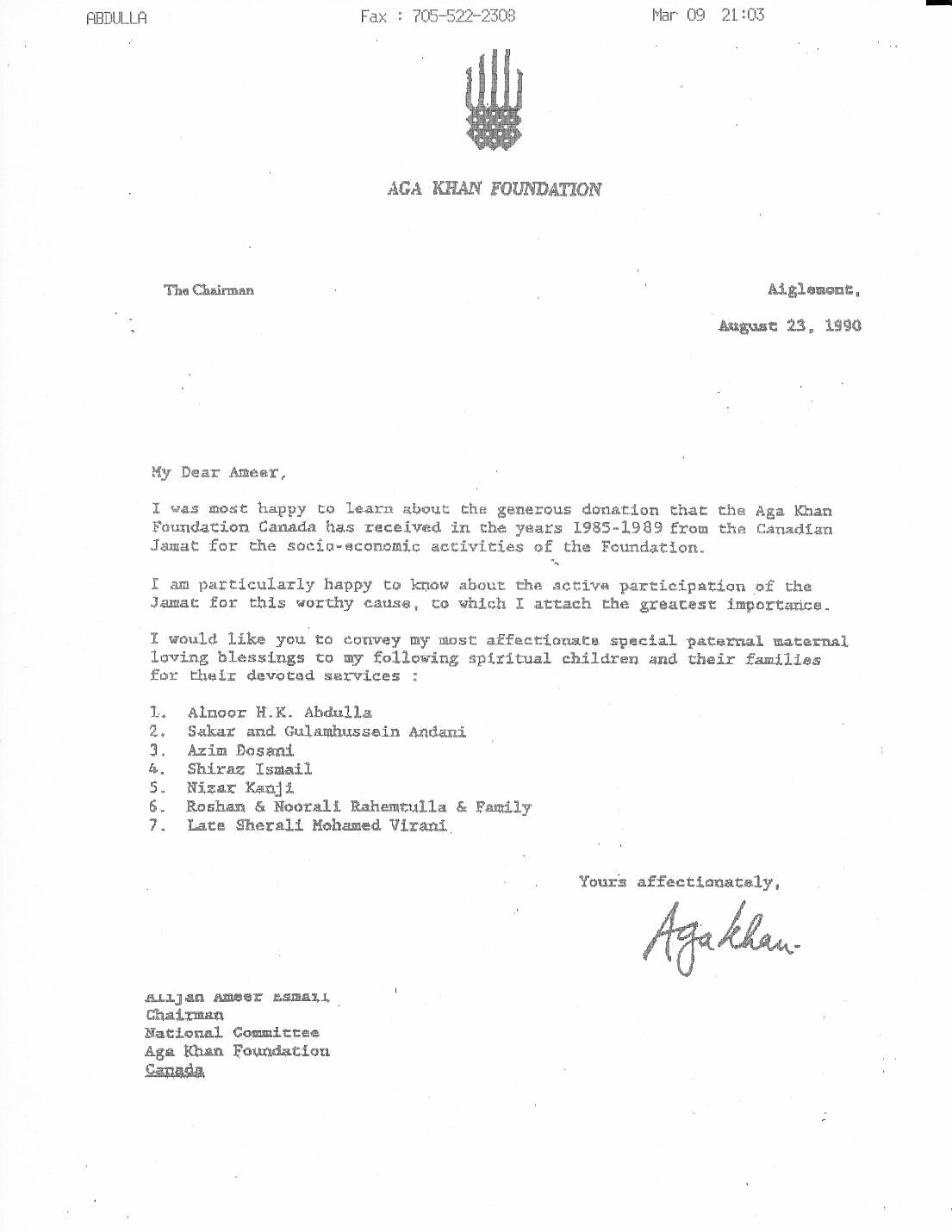
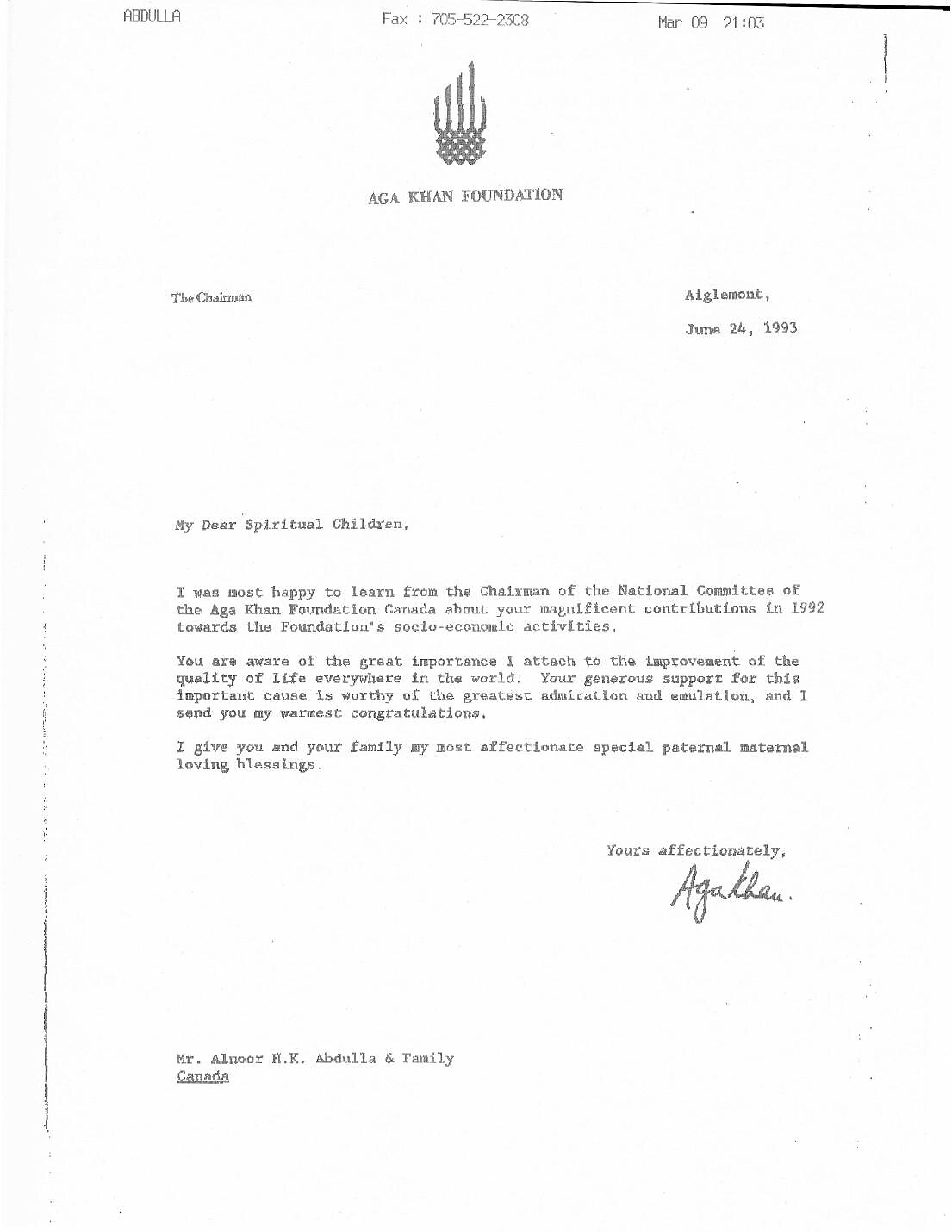
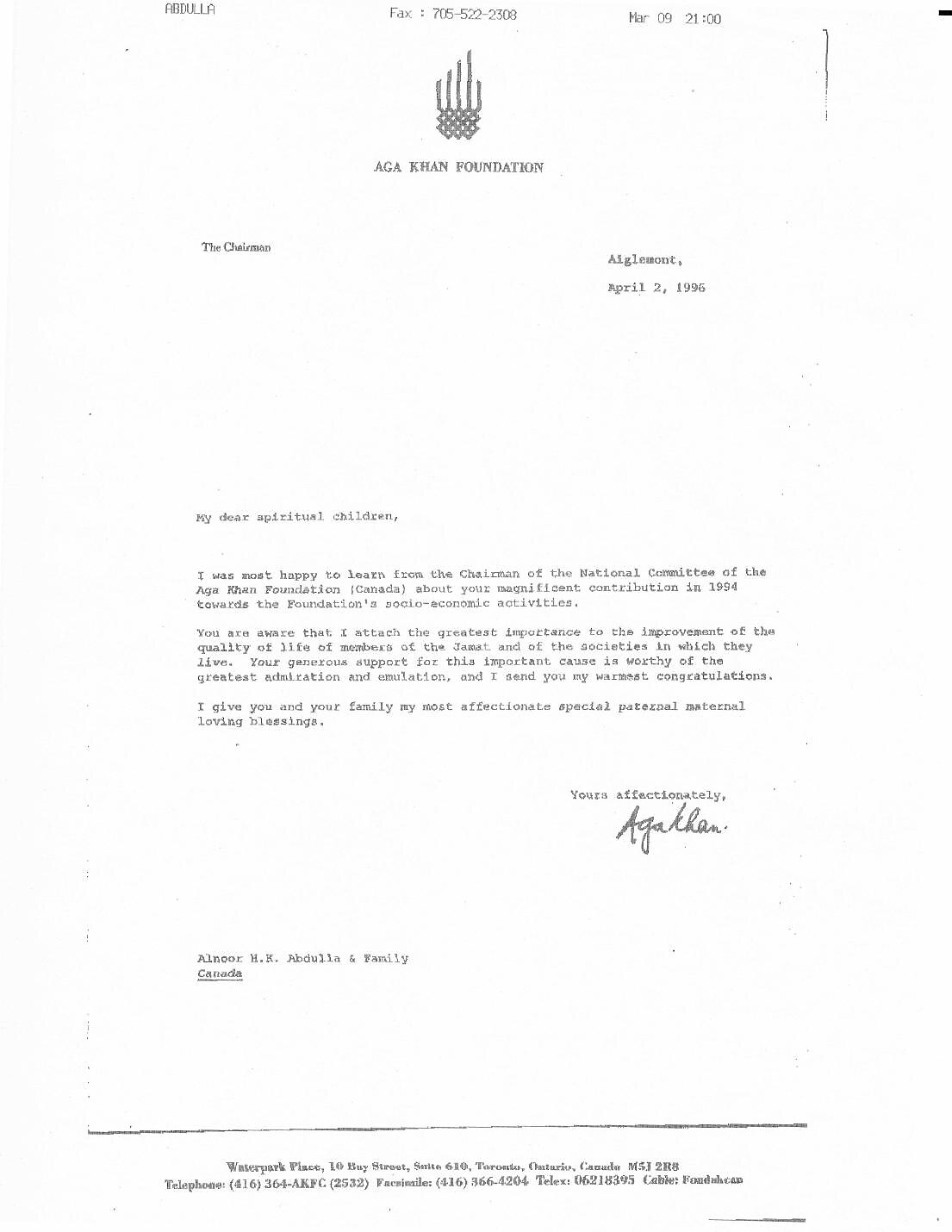
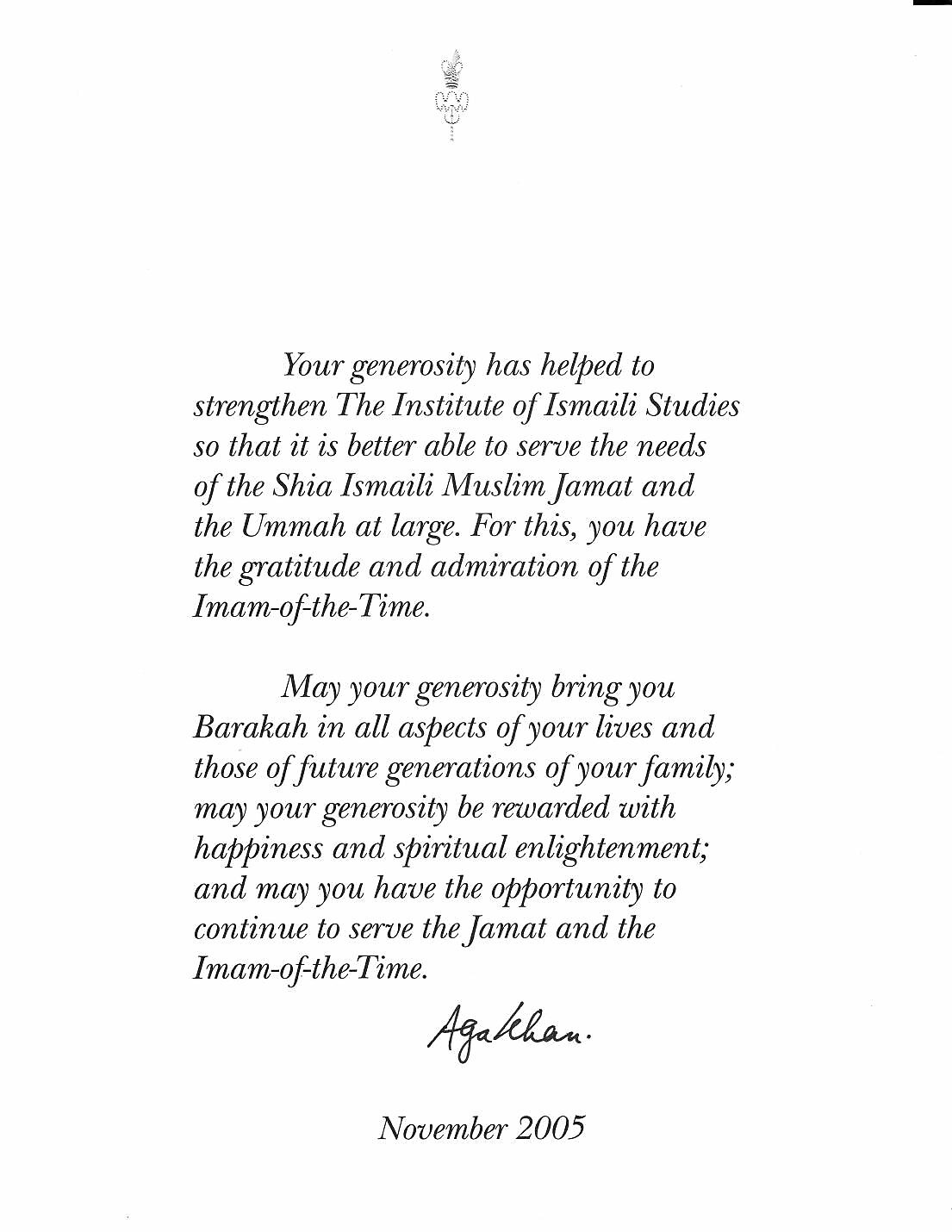
Over the decades, Dr. Abdulla has given generously to the Aga Khan Foundation — including gifts to the Aga Khan University, which from Canada are directed through the Aga Khan Foundation Canada — to many institutions of the Aga Khan Development Network, and to the Institute of Ismaili Studies. His Highness acknowledged that giving in personal letters, and each of the four below answers a different period of it. The letter of August 1990 responds to the Canadian Jamat’s giving to the Aga Khan Foundation Canada in 1985–1989, and conveys his blessings to seven devoted spiritual children, Dr. Abdulla named first. The 1993 and 1996 letters, addressed to Dr. Abdulla and his family, thank them for their “magnificent” contributions in 1992 and in 1994 respectively. The November 2005 letter acknowledges his generosity toward the Institute of Ismaili Studies.
1994 · Opening Day, Aga Khan University Cardiac Program
His Highness had set two conditions for the program years earlier — and would not cut the ribbon until he knew one particular answer. Read the whole AKU Cardiac Program story, 1994–1998.
His Highness the Aga Khan had originally planned to launch AKU's Cardiovascular Program in 1990, but the Gulf War put those plans on hold. When the program was revived in 1993–94, His Highness's two original conditions still stood: the program had to be fully ready and functional in time for the University's Tenth Anniversary Convocation in 1994 — ten years from AKU's founding charter in 1983 — and — unlike the international funding behind so much of AKU's other development — its funding had to come entirely from private donors inside Pakistan, with no foreign money involved.
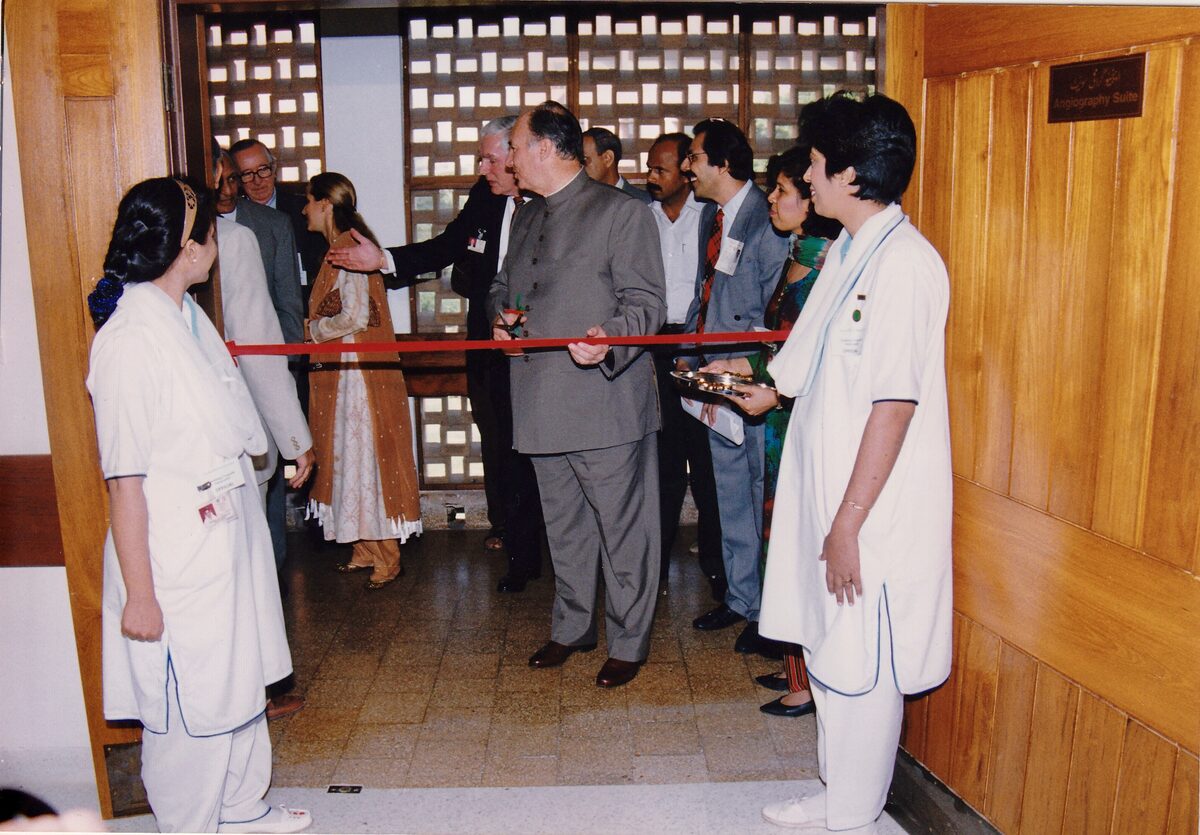
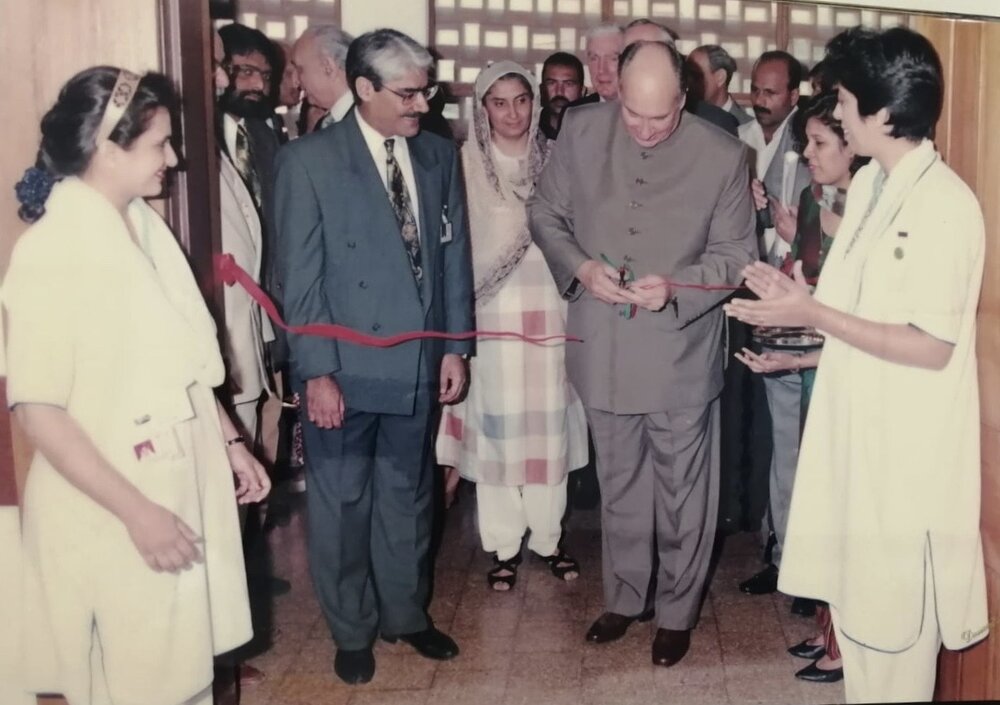
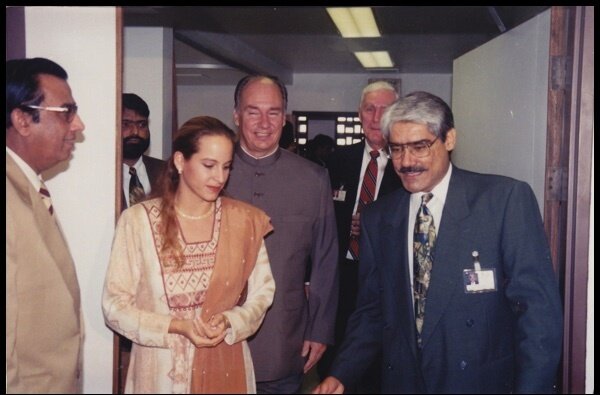
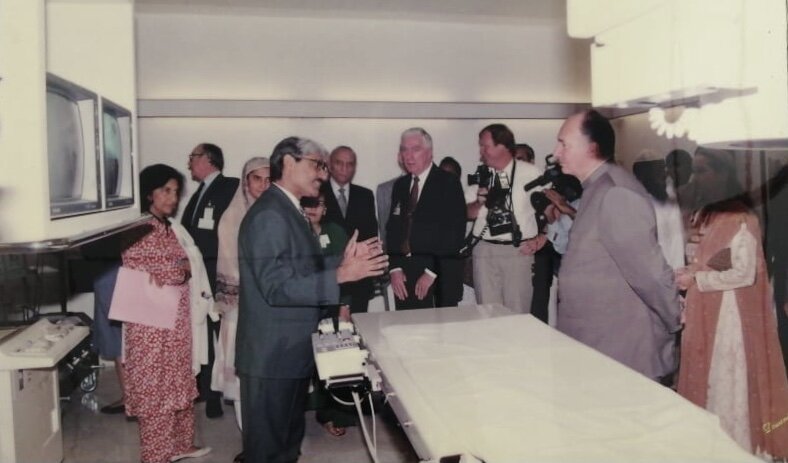
At the Convocation, His Highness came upstairs with his entourage to formally open the new Cardiac Catheterization Laboratory. Dr. Abdulla, who had assembled the program's team from Canada, the University of Maryland, and Pakistan, had been left behind in the narrow corridor as the official party moved forward. His Highness stood ready at the ribbon, scissors already in hand — and did not cut it. He turned and asked, "Where is Dr. Alnoor?" Every head turned, including Princess Zahra's; Dr. Abdulla was brought forward through the crowd. His Highness asked him directly, "Doctor, are we ready?" Dr. Abdulla answered, "Yes, we are ready" — and only then did he cut the ribbon.
As the group moved to enter the new facility, His Highness told Dr. Abdulla to go ahead of him; in keeping with his faith, Dr. Abdulla would not walk in front of the Imam, and the two of them fell into a brief "after you, after you." Princess Zahra broke the impasse by stepping forward herself, and Dr. Abdulla went with her to lead her into the Catheterization Suite, with His Highness — along with Lee Hilling, CEO of AKU Hospital, and Dr. Manji, chairman of the board of health services — following behind. It was a telling moment: here, His Highness was engaging not as Imam but as Chancellor of the University, extending to Dr. Abdulla the professional deference due the head of the Cardiology Program he had built.
Once inside, standing across the catheterization table from Dr. Abdulla with Princess Zahra at his side, and with the Pakistani national press in the room, His Highness questioned him in detail — how the equipment had been procured, how the team had been assembled, how its quality would be held to the same standard as major cardiac centres in North America. The questions were deliberate: he was building a public record, through the press present, for why a Tertiary Cardiovascular Program belonged in a developing country still contending with infectious disease and maternal and infant mortality. Dr. Abdulla's answer — the shifting epidemiology of non-communicable disease across the developing world — was the same reasoning he would later formalize in AKU's East Africa cardiovascular Strategic Plan, and the same reasoning His Highness himself would use years later at that program's own opening.
Choosing that first patient had not been simple. With the opening date set and the community aware of what was coming, Dr. Abdulla came under real pressure — from council leaders and from university leadership alike — to select a particular patient for the honour. He resisted being steered toward any one choice, insisting on deciding for himself.
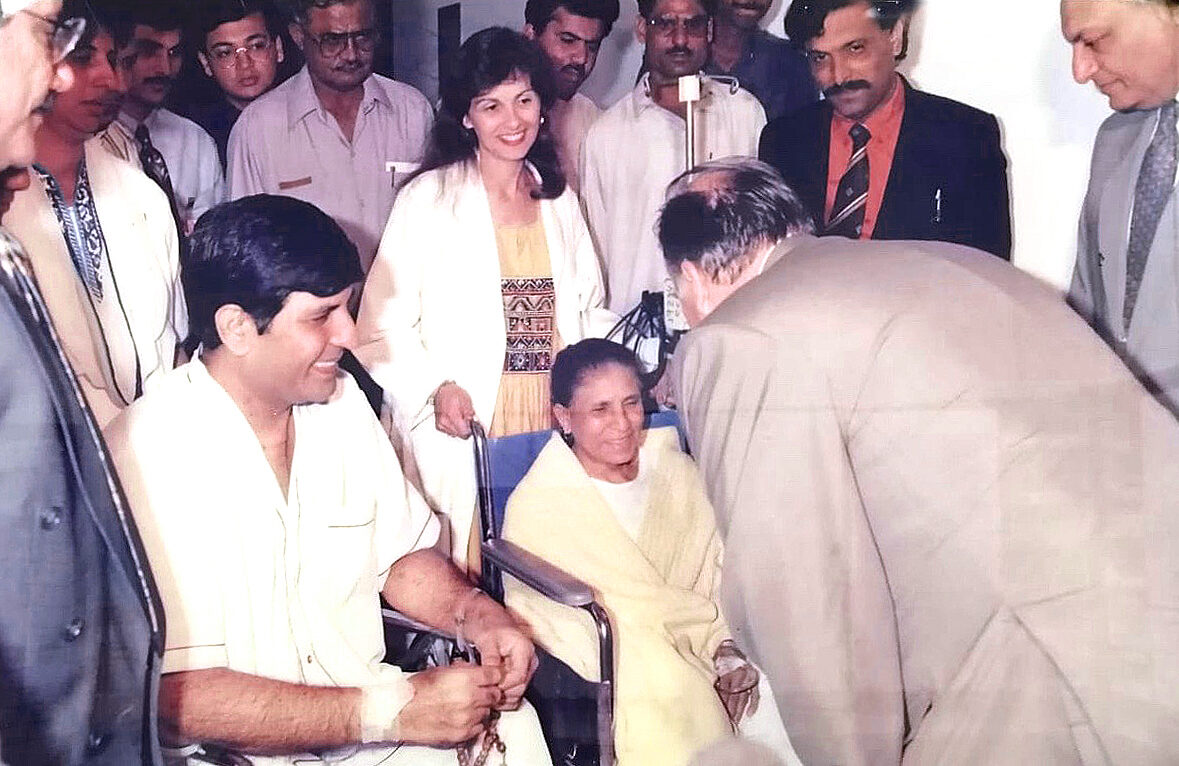
He chose a Hindu woman who had worked in the hospital's housekeeping department for more than eight years, who could not afford cardiac care on her own, and who Dr. Abdulla had recognized in his own clinic as having classic angina — the same warning signs of blocked arteries he has described elsewhere in his career. AKU described itself as a non-denominational institution, serving all faiths and communities equally; Dr. Abdulla decided this first patient should make that claim real, rather than just stated — a deliberate statement that the program existed for the disease and the person in front of him, regardless of religion, gender, influence, or ability to pay.
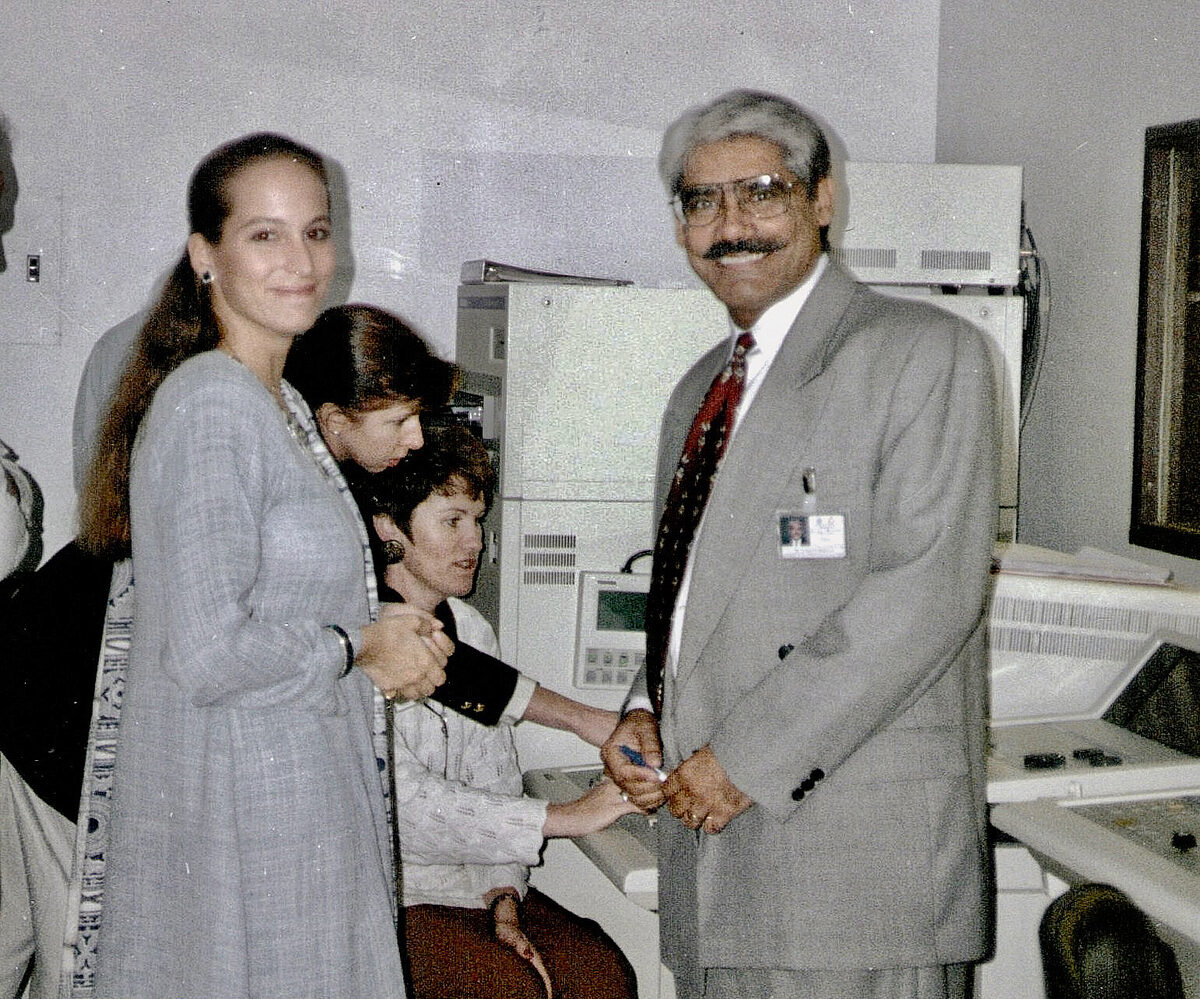
The night before that first case was nearly a disaster. The equipment had been held up at the port in Karachi and arrived late, and the installers were still finishing the day before the procedure. The floors were covered in grease and in dirt from the cine-film developer. Dr. Abdulla and Monique May cleaned the lab themselves until about three in the morning, long after everyone else had gone home. He then performed the first case on a live patient, with no trial run of the equipment and no other cardiologist there to help if something went wrong. Monique assisted him. That night she told him, “Someday we will remember this moment.”
His Highness was visibly moved. As the patient was wheeled out by Monique May — the nurse who built the team in Karachi, who had assisted in the procedure the day before, and who would, years later, become his life partner — he placed his hand on her shoulder and blessed her, then did the same for Monique May.
Standing close to Dr. Abdulla in the corridor, His Highness's tone shifted from the formal register of the tour to something far more personal — the same shift Dr. Abdulla had experienced with him once before, in the Sick Bay in Vancouver in 1978. Dr. Abdulla does not recall all his exact words, but recounts clearly the Aga Khan looking directly into his eyes and saying, "Alnoor, we have been waiting for you for a long time — we have been waiting for a long time," to build this program and to teach the team there how to work together and deliver quality cardiovascular care. Dr. Abdulla has called it the highlight of his career.
Princess Zahra Aga Khan was struck enough by what she had seen that she returned the following day and spent more than two hours with Dr. Abdulla, while his Canadian technicians worked on the equipment nearby — asking in detail how a program like this gets built: the equipment, the training, how the team itself comes together.
Opening Day, By the Numbers

Independent Record: The Aga Khan Health Services Newsletter
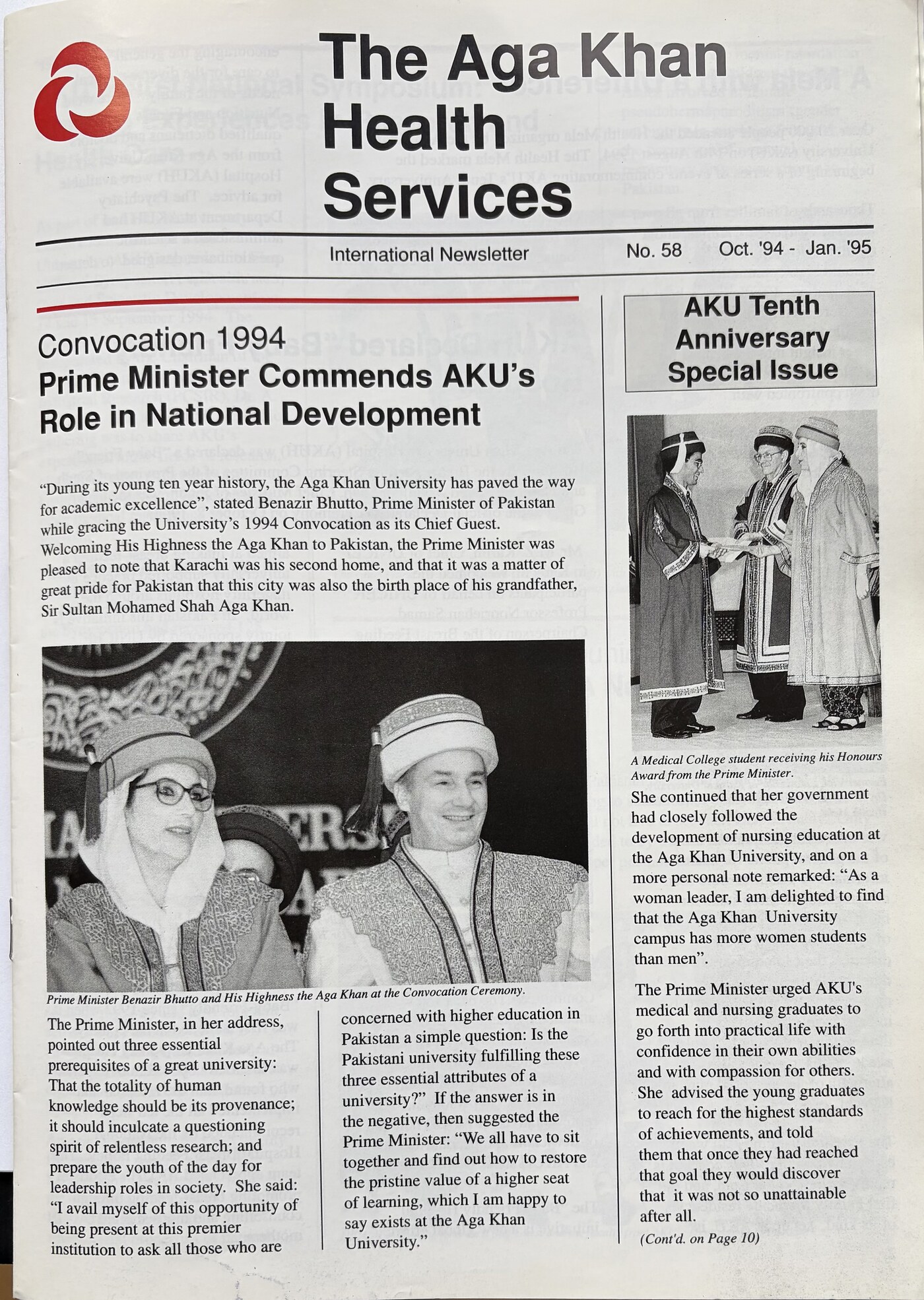
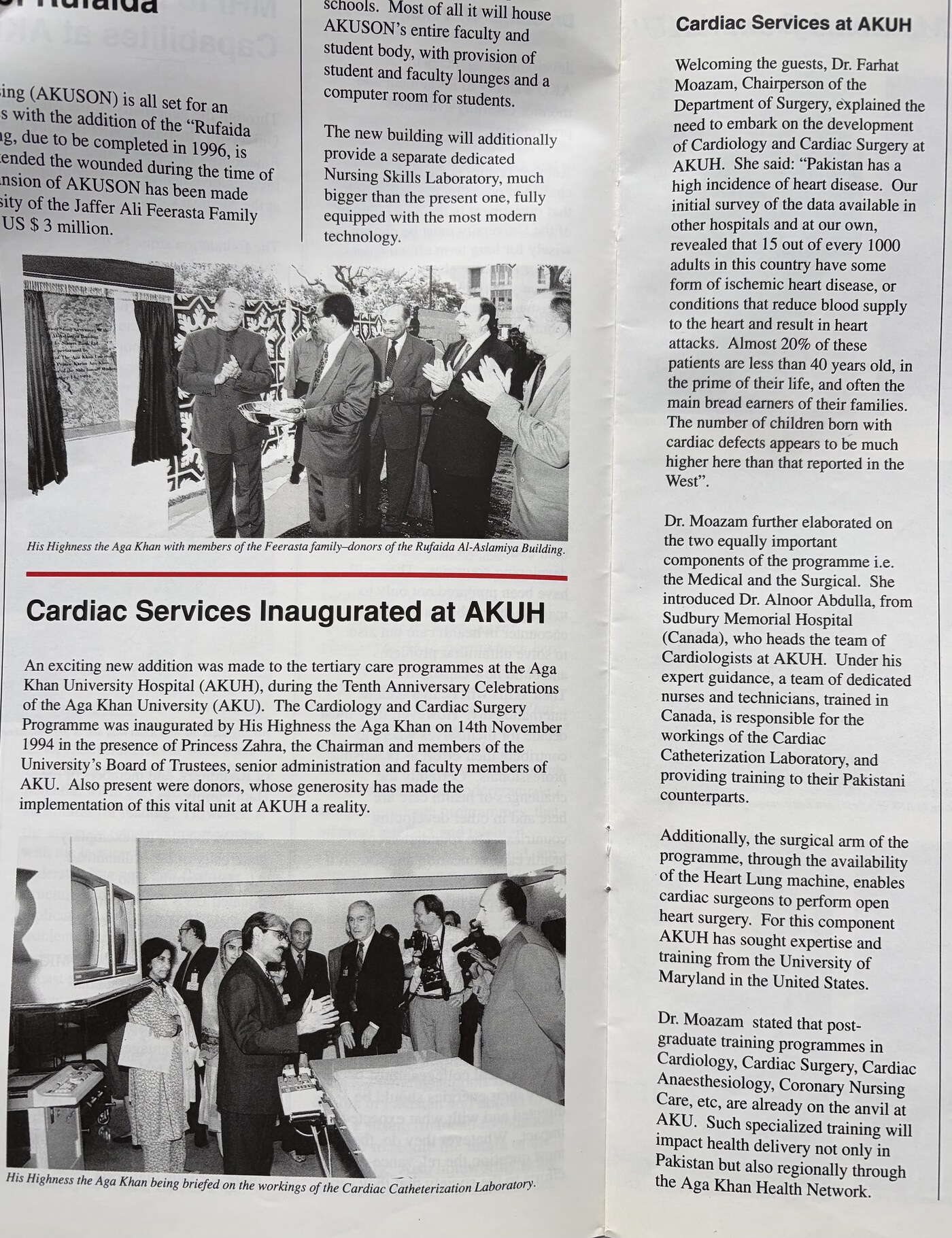
The opening was covered at the time in the Aga Khan Health Services' own international newsletter — issue No. 58 (October 1994–January 1995), its “AKU Tenth Anniversary Special Issue.” Introducing the new programme, Dr. Farhat Moazam, Chairperson of the Department of Surgery at AKU, named Dr. Abdulla directly:
“She introduced Dr. Alnoor Abdulla, from Sudbury Memorial Hospital (Canada), who heads the team of Cardiologists at AKUH. Under his expert guidance, a team of dedicated nurses and technicians, trained in Canada, is responsible for the workings of the Cardiac Catheterization Laboratory, and providing training to their Pakistani counterparts.”
The Fellows He Trained
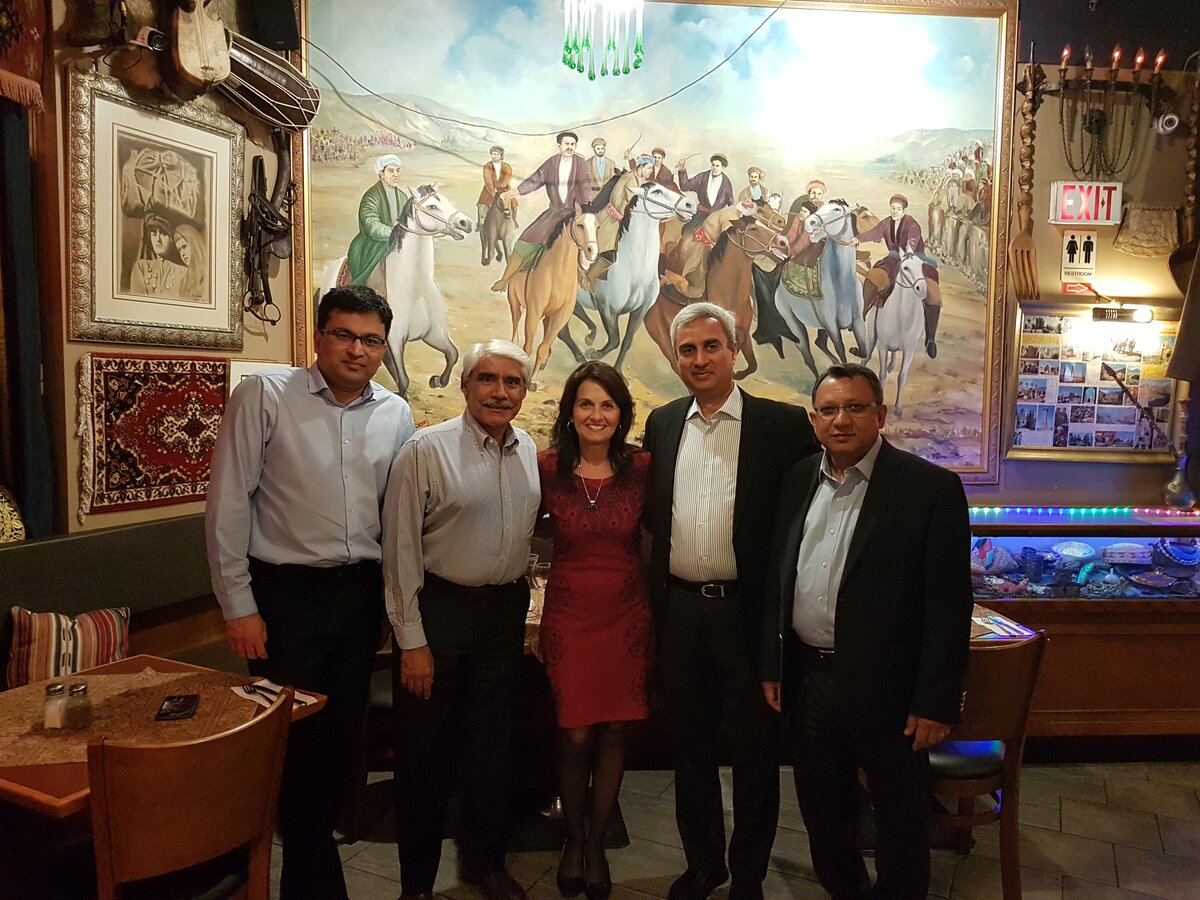
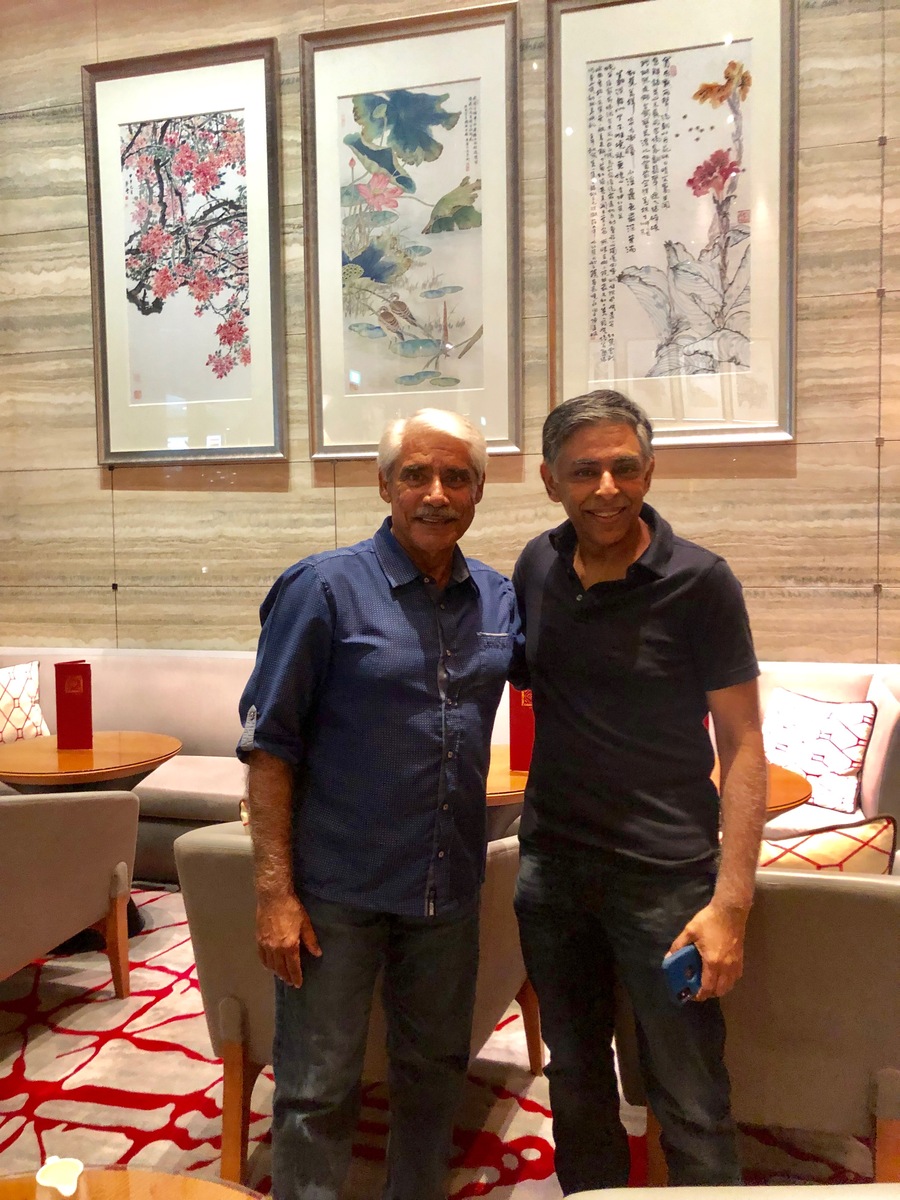
Decades later, three of the cardiology fellows Dr. Abdulla trained at AKU — Dr. Ata ur Rehman Qureshi and Dr. Najaf Nadeem, now Heads of Cardiology in Halifax and Toronto respectively, and Dr. Fahim Haider Jafary, now Senior Consultant Interventional Cardiologist in the Department of Cardiology at Tan Tock Seng Hospital, Singapore — have stayed in touch over the years. Qureshi and Nadeem hosted him for dinner in Vancouver during the Canadian Cardiovascular Congress, and he reconnected with Jafary in Singapore in 2019, on the same trip as his Cardio-Oncology keynote.
A Personal Tribute
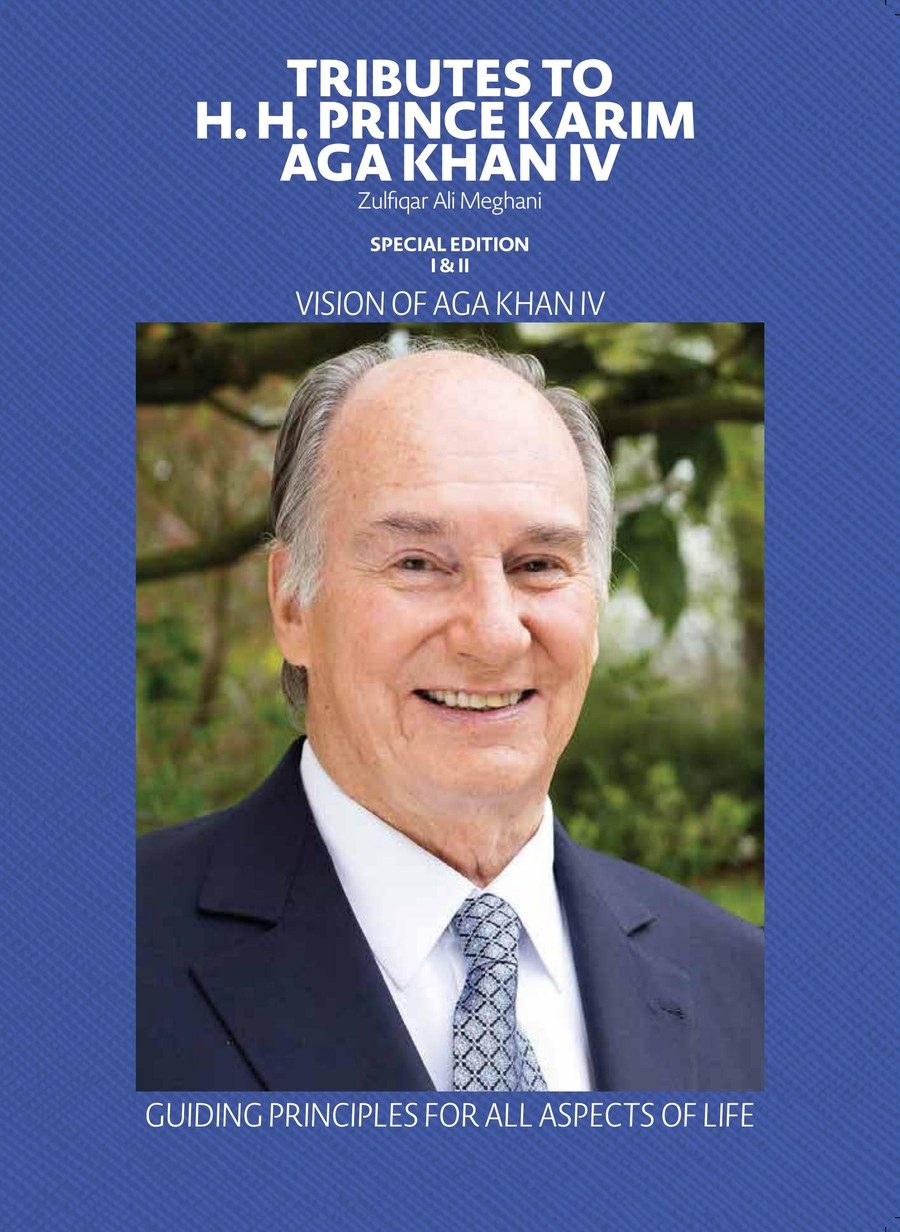
Following the passing of His Highness Prince Karim Aga Khan IV on 4 February 2025, Dr. Abdulla was invited to contribute a personal tribute to Moral Values — Special Edition: A Tribute to Aga Khan IV (1936–2025), a commemorative book compiled by Zulfiqar Meghani. Most contributions came from heads of state, institutions, and the Aga Khan Development Network itself; Dr. Abdulla's was one of only a handful of personal, individually-authored reflections included — a distinction he considers a great honour.
“As an individual member of the Shia Ismaili community, I grew up in a rural town in central Tanzania, where we had rudimentary running water taps, no electricity till I was 8 years old, to now living for 52 years in North America. My biggest satisfaction is not just my career… but that, in any setting whatsoever… I am humbly proud to raise my head and say where I come from and that I belong to the Shia Ismaili Muslim faith, and that the Aga Khan is our Leader.”
His full tribute traces His Highness's 68-year Imamat (1957–2025) — his transformation of a small, developing-world community into one flourishing worldwide in education, health, and civic life; his lifelong work building bridges between Islam and the West; and his succession by his son, Prince Rahim Aga Khan V, as the 50th hereditary Imam.
 Published
Moral Values — Special Edition
“Tribute to Aga Khan IV,” by Dr. Alnoor Abdulla — p. 40, in Moral Values: A Tribute to Shah Karim Al-Hussaini, compiled by Zulfiqar Meghani, 2025.
The complete 166-page commemorative book is on the Resources page.